Tirana Times, February 12 2026 – The rapid deterioration of newly inaugurated roads and tunnels across Albania has exposed far more than technical shortcomings. What authorities have sought to explain as weather-related damage is increasingly understood as a symptom of deeper governance failures rooted in clientelism, weak oversight, and systemic corruption in public infrastructure projects.
At the center of these controversies stands the Deputy Prime Minister and Minister of Energy and Infrastructure, under whose authority Albania’s largest infrastructure projects have been planned, tendered, and implemented. Prosecutors from the Special Anti-Corruption Structure (SPAK) have raised serious allegations involving the artificial inflation of costs, manipulation of procurement procedures, and diversion of public funds in some of the country’s most expensive projects.
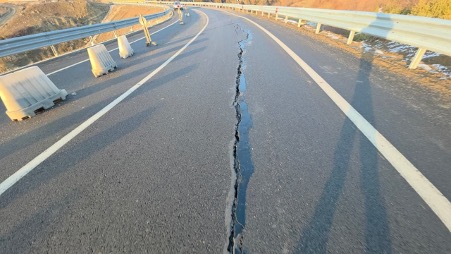
The Qukes–Qafe Plloçe road stands as the clearest and most emblematic example. Inaugurated on September 5 by Prime Minister Edi Rama and the Deputy Prime Minister, the 43-kilometer road was presented as a strategic investment linking Librazhd with Pogradec. Construction began 15 years ago and is estimated to have cost around 260 million dollars. Yet within just two months of inauguration, the road was partially blocked by landslides and soon after suffered structural collapse near the village of Gështenjas. The scale of investment, combined with the speed of deterioration, raised immediate questions about design standards, supervision, and the real allocation of funds.
Similar failures soon emerged elsewhere. The Shengjin–Velipoje road, the southern ring road of Burrel, the Murrizi tunnel on the Arbër Road, and the Llogara tunnel all displayed serious defects during the winter season. Public concern intensified after footage circulated showing water leaking from the ceiling of the newly opened Llogara tunnel, a flagship project in southern Albania. According to investigative findings, the cost of this tunnel alone was allegedly increased by more than 50 million euros through contract modifications and questionable technical justifications.
Beyond individual projects, SPAK is reportedly investigating a broader portfolio of infrastructure investments whose total value exceeds 600 million euros. These investigations focus not only on suspected corruption and abuse of office but also on systematic violations of construction standards and the approval of substandard works. The road segment Qafë Plloçë–Korçë, which cost over 25 million euros, has also been cited by experts for serious quality deficiencies inconsistent with its price tag.
The political dimension of these cases has sharpened following SPAK’s formal request to lift the parliamentary immunity of the Deputy Prime Minister. That request has remained blocked in parliament since mid-December, fueling public skepticism about institutional accountability and reinforcing perceptions of political protection at the highest levels of government.
Experts argue that these incidents are not isolated but reflect a systemic problem affecting the entire chain of public investment. Engineer Xhevahir Ngjeqari points to projects designed without adequate geological and technical studies, rushed through decision-making processes and driven primarily by financial rather than public-interest considerations. Economist Zef Preçi highlights a clientelist model that spans project design, construction, supervision, and final acceptance, creating conflicts of interest and eliminating meaningful control mechanisms.
According to Preçi, a significant portion of infrastructure funding has failed to stimulate the real economy and has instead consolidated the power of government-linked companies while enabling illicit enrichment among politically exposed actors. Some of the most expensive projects, he argues, lack clear economic or social justification and appear to exist primarily to sustain hidden financial networks rather than meet genuine public needs.
Albania’s collapsing roads and leaking tunnels are therefore not merely engineering failures. They are visible manifestations of a governance model in which public resources are systematically diverted, accountability is postponed, and political responsibility is shielded. Until this model is confronted and dismantled, infrastructure will continue to mirror the weaknesses of Albania’s institutions rather than serve the needs and safety of its citizens.