Tirana Times, February 10, 2026 – Thousands of Albanians filled the streets of Tirana on Tuesday evening in a national protest called by the opposition Democratic Party, demanding the resignation of Prime Minister Edi Rama, the dismissal of his government, and the establishment of a technical cabinet to lead the country toward early elections. The protest unfolded amid escalating political tension, as the ruling Socialist majority continues to block the arrest of Deputy Prime Minister Belinda Balluku, who is facing serious criminal accusations brought by the Special Prosecution against Corruption and Organized Crime.
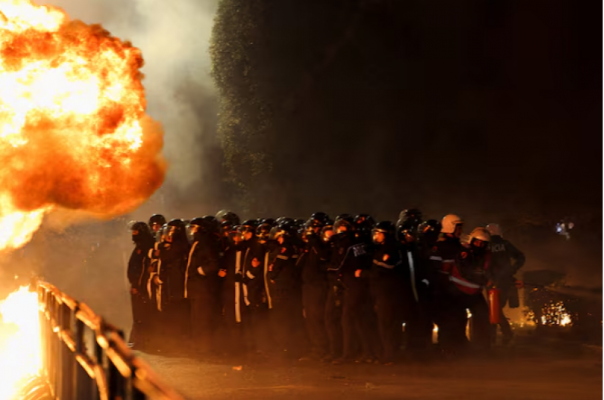
The demonstration quickly turned violent as clashes erupted between protesters and police forces guarding government buildings and the parliament. Demonstrators hurled Molotov cocktails and fireworks, while police responded with water cannons, tear gas, and riot-control units. According to local observers and civil society figures, the police response was widely seen as disproportionate, with footage and on-the-ground reporting showing extensive use of tear gas and force against crowds that included peaceful protesters. Several participants and opposition figures reported injuries, further fueling accusations of excessive policing.
The protests are rooted in a corruption case that has become the most politically sensitive test yet for Albania’s justice reform. Since December, the Special Prosecution has formally accused Balluku of interfering in public tenders linked to major infrastructure projects and of favoring specific companies, allegations she has denied. Prosecutors have asked parliament to lift her immunity in order to proceed with her arrest, but the legislature, dominated by the ruling Socialist Party, has so far refused to take up the request. Prime Minister Rama has publicly signaled that he has no intention of allowing the immunity vote, while his majority has moved to amend provisions of the criminal law in ways the opposition says are designed to shield the deputy prime minister.
This standoff has sharpened the opposition’s narrative that Albania is facing a constitutional and democratic crisis. The Democratic Party argues that the refusal to hand over a senior government figure to prosecutors undermines the rule of law and places political power above judicial accountability. For the first time since the justice reform began, the Special Prosecution has advanced heavy charges that strike directly at the core of executive power, testing whether Albania’s institutions are willing to allow the law to reach the highest levels of government.
Opposition leader Sali Berisha accused the authorities of deploying what he described as “criminal violence in uniform” against citizens, while urging protesters not to interpret their restraint as weakness. Speaking after police dispersed the crowds, Berisha framed the protest as part of a longer confrontation, announcing further demonstrations in the coming days and insisting that sustained civic pressure would ultimately force political change.
The unrest also reflects a broader erosion of public trust following a long series of corruption scandals that have hit Rama’s government. Over the past years, several ministers, senior officials, and mayors affiliated with the ruling Socialist Party of Albania have resigned, been arrested, or placed under investigation for abuse of office, corruption, or links to organized crime. While the prime minister has survived these scandals politically, the Balluku case marks a qualitative shift, bringing prosecutorial scrutiny directly into the innermost circle of his government.
International reporting described the clashes as the most serious challenge in years to Rama’s long hold on power, which began in 2013. As tear gas clouds lingered over central Tirana and protesters chanted calls for the prime minister to step down, the confrontation underscored the growing polarization between a government determined to protect its senior officials and an opposition betting that street pressure, combined with judicial action, can finally break what it describes as a system of entrenched corruption. Whether the protests will translate into political concessions or early elections remains uncertain, but the crisis has clearly entered a phase where Albania’s stability, democratic credibility, and justice reform are being tested simultaneously.