Tirana protest unfolds amid EU concerns over shrinking parliamentary oversight.
TIRANA, May 08, 2026 — Albania’s opposition staged a national protest in Tirana on Friday evening, demanding the resignation of Prime Minister Edi Rama and what it described as his corrupt government, while accusing the ruling majority of abuse of power and the systematic weakening of democratic checks and balances.
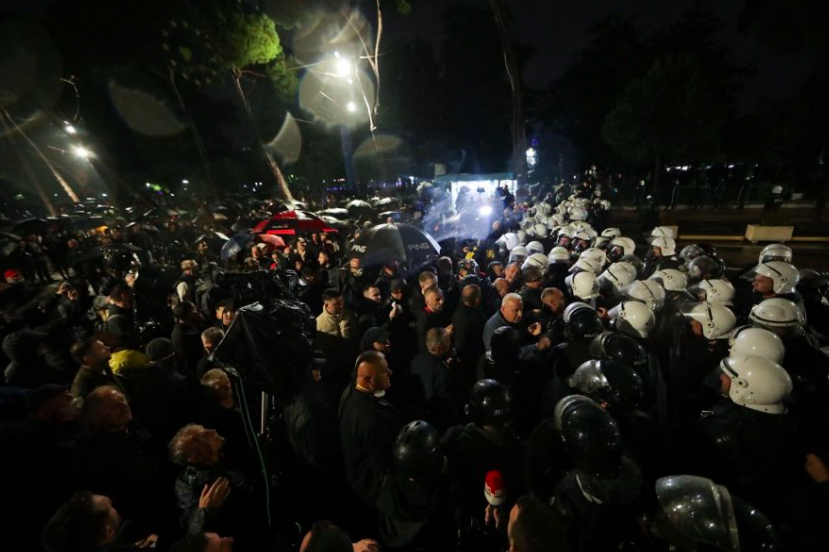
The protest escalated into tensions after police blocked the opposition’s march along the capital’s main boulevard toward the government ministries. Democratic Party leader Sali Berisha denounced the police intervention as a violation of the constitutional right to peaceful assembly and described it as an attempt to prevent citizens from expressing their opposition to the government.
“You saw it yourselves. We were in a peaceful march. Our peaceful march was stopped, the Constitution was trampled on, everything was trampled on, the road was blocked,” Berisha said, calling the police response a “serious crime.”
The opposition leader accused Prime Minister Rama and former Deputy Prime Minister Belinda Balluku of using state structures to protect what he called a corrupt government. At the close of the protest from the Democratic Party headquarters, Berisha thanked citizens who joined the demonstration despite the rain and said the opposition would continue its campaign until Rama and his government leave office.
“There is no police force in the world that can defeat a people in revolt,” Berisha said. “Edi Rama, know this well: you have no future. Your end is inevitable.”
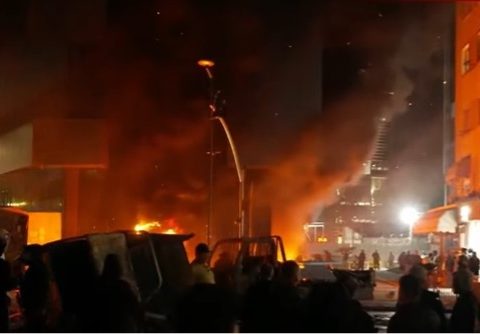
The protest was marked by repeated confrontations after the march was stopped. According to reports from the scene, police used water cannon and tear gas, while some protesters responded by throwing Molotov cocktails, fireworks and hard objects.
Police said three officers from the National Security Force were injured after Molotov cocktails, pyrotechnics and other objects were thrown in their direction. The officers were taken to the Military Hospital and were reported to be out of danger. Three protesters were also reportedly detained and taken to a police station.
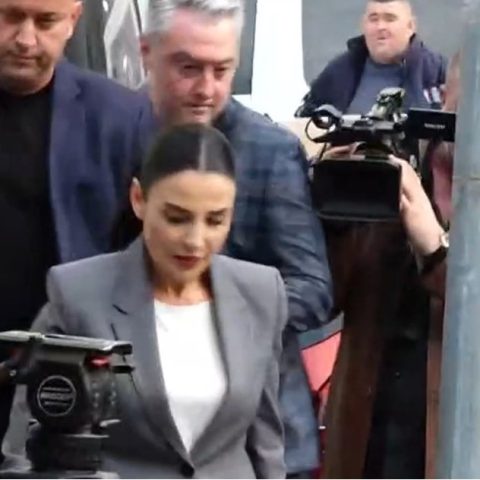
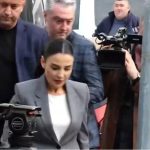
Journalists and camera operators covering the protest were also affected by the police response. One journalist reportedly suffered health problems after exposure to tear gas and water cannon and received medical assistance from an ambulance at the scene, while cameras and media staff were also hit by water cannon during the coverage of the protest.
The opposition’s protest comes against a broader political backdrop in which its space in parliament has been increasingly narrowed, while the government is accused of controlling almost all constitutional institutions and weakening parliament’s oversight role. The opposition has also raised this concern with the European Union, arguing that Albania’s EU integration process is being administered almost entirely by the ruling majority, without proper inclusion of the opposition, civil society or the wider public.
These concerns were recently reflected in a letter by David McAllister, Chair of the European Parliament’s Foreign Affairs Committee, addressed to Enlargement Commissioner Marta Kos. Referring to concerns raised by Democratic Party MP Jorida Tabaku, McAllister asked the European Commission to assess cooperation between the government and the parliamentary opposition in Albania and to explain how the Commission can ensure that the opposition is able to exercise its fundamental rights and fulfill its role as an institution of democratic oversight.
Joeida Tabaku warned that the Council of Ministers does not regularly inform parliament about the progress of accession negotiations, the use of EU funds or reforms linked to integration. She also argued that draft laws and key documents are not shared in a timely, transparent or inclusive manner.
Albania’s EU integration process has also become part of the political dispute. Although the government maintains that there is no blockage and points to last year’s opening of all negotiation clusters, the process appears to have slowed, with member states currently not giving the green light for IBAR. For the opposition, this reinforces the argument that EU accession cannot be treated as an executive driven process, but must remain a national process based on consensus, parliamentary scrutiny and democratic accountability.
The protest ended late Friday evening, with Berisha declaring that the opposition would continue its confrontation with the Rama government and would prepare for further political action.