Strategic ambitions, unresolved disputes, and a relationship caught between political narratives and diplomatic inertia.
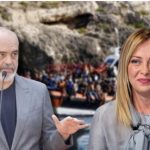
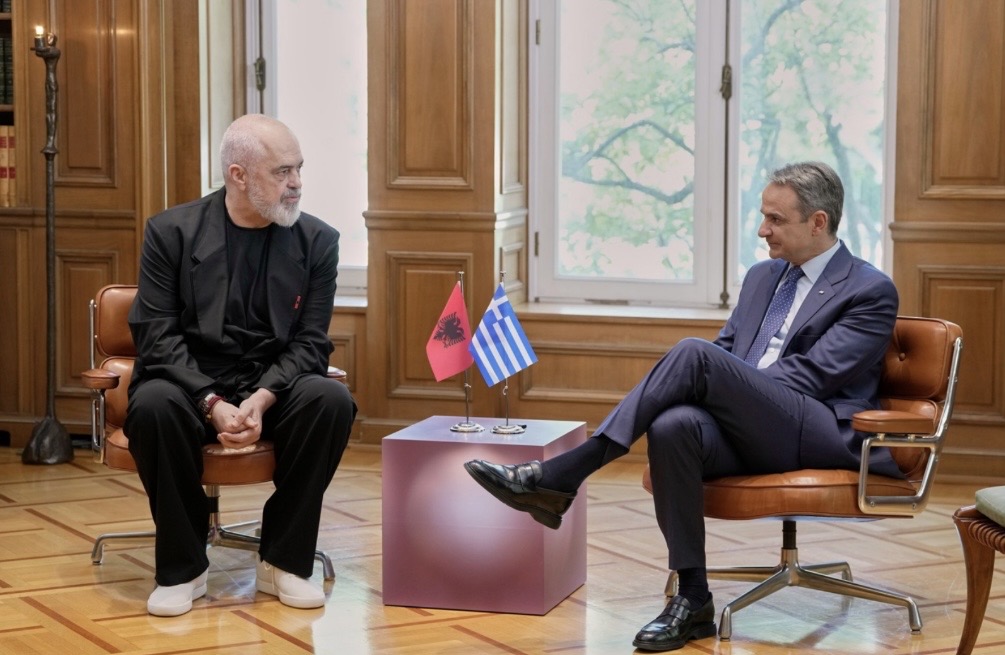
Tirana Times, May 02, 2026 – The latest encounter between Edi Rama and Kyriakos Mitsotakis at the Delphi Economic Forum was meant to signal momentum in a relationship long burdened by history. Instead, it exposed a familiar pattern: ambitious political language unmatched by concrete diplomatic progress.
Speaking after his visit to Greece, Rama struck an optimistic tone. He expressed confidence that Tirana and Athens could “address all outstanding issues” and even move toward signing a new Strategic Partnership document within the year. He praised Mitsotakis as “a valued friend of Albania” and highlighted what he described as a shared willingness to resolve disputes and elevate bilateral ties to a new level.
Yet beyond the language of partnership, the reality of Albania–Greece relations remains far more static.
Despite repeated declarations of readiness, there has been no tangible breakthrough on the core issues that have defined the bilateral agenda for years. Chief among them is the unresolved maritime boundary delimitation in the Ionian Sea, a matter that has oscillated between political commitments and legal uncertainty since the annulment of the 2009 agreement by Albania’s Constitutional Court.
The gap between rhetoric and reality became even clearer in the immediate aftermath of the Delphi Forum. While Rama insisted that there was already an understanding with Athens to refer the maritime dispute to the International Court of Justice and expressed confidence that “our ambition is to complete it within this year,” the reaction from the Greek side was immediate and unequivocal.
As reported in Protothema, citing senior diplomatic sources, Athens moved quickly to distance itself from these claims. The same sources emphasized that, although the issue has long been on the bilateral agenda, the process effectively “froze” when the 2009 agreement was sent to Albania’s Constitutional Court and subsequently annulled. Greek officials further stressed that the discussion on maritime delimitation remains rooted in that legal setback and that it is the Albanian side that must take the necessary procedural steps to revisit the framework.
More significantly, according to the same sources, the delimitation of maritime zones with Albania “is no longer among the immediate priorities of Greek diplomacy,” particularly following agreements with other regional actors such as Italy and Greece’s own expansion of territorial waters in the Ionian Sea. “Greece’s strategy focuses on the overall management of bilateral issues,” the source noted, adding that no one is confirming that the progress reported by the Albanian side will materialize within 2026. Greek officials also underlined that there is currently no agreed text addressing unresolved bilateral issues, contrary to the impression conveyed by Rama in Delphi.
This sharp divergence in narratives underscores a broader problem: a widening gap between political messaging and diplomatic reality.
In practical terms, relations between Albania and Greece are best described as a status quo—if not a quiet freeze. The metaphor drawn from Ismail Kadare’s famous expression, “the wedding guests are frozen,” seems particularly apt. There is no visible movement toward a “wedding” of strategic partnership; rather, both sides appear locked in a cautious, even stagnant coexistence.
Recent developments have only reinforced this inertia. The case of Fredi Beleri, the elected mayor of Himara who was later convicted in a highly controversial judicial process, significantly strained bilateral trust. For Athens, the issue became emblematic of concerns over minority rights and rule of law; for Tirana, it remained a domestic judicial matter. The political fallout effectively disrupted channels of communication and stalled whatever limited progress had been made on broader bilateral issues.
At the same time, rhetorical tensions have not been absent. Mitsotakis himself, in a public interview earlier this year, rebuked remarks made by Rama, describing them as “unnecessary” and reminding that Albania’s path toward the European Union “passes through Greece.” The comment was both a diplomatic signal and a strategic reminder of Athens’ leverage within the EU enlargement process.
Greek media and analysts have been even more direct, often portraying Rama’s approach as overly performative, what one commentator termed a “no problem” narrative that glosses over deep structural disagreements. From this perspective, optimism about imminent agreements appears less like a reflection of diplomatic progress and more like a tool of political communication.
A deeper paradox lies at the very foundation of the relationship. Since 1996, Albania and Greece have had a Treaty of Friendship, Cooperation, Good Neighbourliness and Security, the highest diplomatic instrument signed between the two states and still the most important bilateral agreement between them. Yet, at the same time, Greece’s so-called “law of war” with Albania formally remains in place, a fossil from another historical era that continues to cast a symbolic shadow over the relationship.
As Albert Rakipi, Chairman of the Albanian Institute for International Studies, has argued, post–Cold War Albanian–Greek relations have developed in two parallel spheres: “one is the sphere of peace,” where real relations unfold through economy, trade, investment and dense social and cultural exchanges; while the other is a “sphere of war,” largely virtual, dominated by political discourse, media narratives and contested historical issues .“The first is the real sphere,” Rakipi notes, “the second is fictive.”
Rakipi further stresses the urgency of a strategic reset: “It is high time to develop a new relationship. We have seen that historical issues are often instrumentalized for short-term political purposes linked to power politics, and there is no real will to move forward. We need to build a real and substantial strategic relationship with Greece.”
This contradiction helps explain why relations can be socially and economically dense, yet politically frozen. The two countries have built practical cooperation and human connectivity over three decades, but their official diplomacy remains repeatedly pulled back by unresolved historical and symbolic disputes.
Indeed, while Rama insists that “there are no problems that cannot be solved,” the absence of structured negotiations, agreed frameworks, or even a shared timeline suggests otherwise. Even the idea of a new Strategic Partnership document remains, for now, aspirational rather than operational.
This is not to suggest that the relationship lacks depth. On the contrary, Albania and Greece are deeply interconnected through economic ties, migration and society. The presence of a large Albanian community in Greece and a Greek minority in Albania creates a dense web of human connections that far exceeds the level of formal diplomacy. In theory, this should make a strategic partnership easier to achieve.
But politics continues to lag behind society.
Ultimately, the current phase of Albania–Greece relations reflects a paradox: high-level engagement without substantive progress, friendly rhetoric without policy delivery and strategic ambition without diplomatic traction. The Delphi meeting reaffirmed political will at least in words, but also highlighted how far the two sides remain from translating that will into action.
For now, the “guests” remain frozen. And the long-awaited “wedding” of a true strategic partnership appears no closer than before.