By Auron Tare
These days, in the noisy marketplace of Albanian opinions, a new theme is being articulated: the “love” of certain Albanian public gentlemen for Jewish culture and, beyond it, for Israeli politics. Some say it is pure love; others suspect it is interest; and others see it as a new fashion of the times, a way of aligning oneself with the strongest power of the moment for political interests.
As for me, poor in knowledge of these profound matters, I do not dare to issue judgments. But one thing I think I know well: faith is a matter of the soul. If someone changes religion, grows an Orthodox beard, or places a Jewish head covering on his head, let him do so. It is neither news nor a crime, but a matter between a person and himself.
But true love, the kind that does not shout, the kind that does not appear on political platforms or in hypocritical handshakes, is seen in deeds carried out in silence, in the care shown for the traces of your nation’s past, or even for those cultures you claim to admire.
If the recent love of some of our politicians for Jewish culture were genuine and honest, then it would also be manifested in the way those few symbols and monuments of Jewish culture on the territory of the Republic of Albania are preserved and protected.
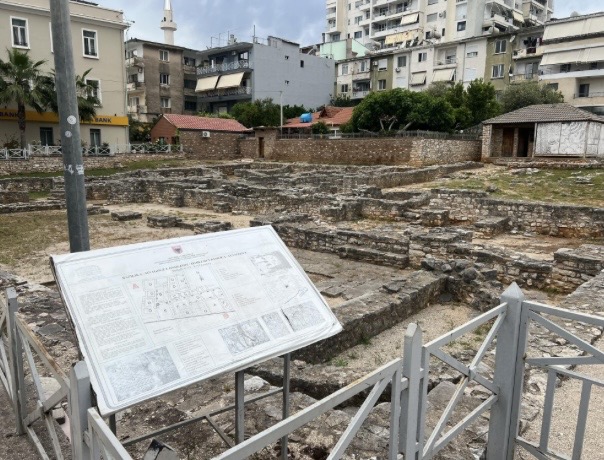
In the middle of the square of the city of Saranda stands one of the most important monuments of ancient Jewish culture, not only in our territory but also in the Balkans. Built sometime in the 5th–6th centuries AD, the Synagogue of Onhezmus is among the oldest in the region, evidence of a Jewish community established in the territories of ancient Epirus.
Raised within the walls of the ancient city of Onhezmus, today’s Saranda, its dimensions testify to an important community in this port.
The Synagogue of Onhezmus, given its importance in our cultural heritage, should have been a place carefully and finely maintained, turned into a visitable space for cultural tourism. Not only as a sign of care for every ancient monument, but also as a sign of the respect we show in particular for cultures that came from across the sea.
In fact, for any visitor curious enough to see it, the Synagogue of Onhezmus is a monument left to oblivion: without restoration, without explanation, and without institutional care. Opposite it stands a bus station, where tourists waiting for public transport do not even glance at that pile of stones with no distinguishing sign, no explanatory panel, and outside the city’s cultural itineraries.
Only a simple sign, faded by time, placed there once when tourism depended on the Ministry of Economy headed by Arben Ahmetaj, is the only indication that the space opposite the bus station is a cultural monument.
Two years ago, workers from the Albanian Development Fund and the Municipality, in order to lay some underground cables, were digging with an excavator very close to the walls of the Synagogue, without anyone stopping them and without any cultural heritage institution showing concern. It was clear that no one knew the history or importance of this monument.
Around 2003–2004, together with architect Artan Shkreli, we spoke with the then prime minister, Fatos Nano, about the extraordinary importance this Synagogue had, not only for the city where he was an MP. At that time, most of the ruins had been occupied by numerous kiosks that had sprung up after 1997, to the point that even archaeologists found it difficult to study it.
The excavations carried out by Albanian archaeologist Etleva Nallbani and two professors from the Hebrew University of Jerusalem confirmed that the ruins once discovered by archaeologist Kosta Lako had not been an early basilica. The mosaic with the Jewish symbol of the Menorah and other symbolic scenes proved that the ruin had begun as a very important Synagogue.
It was Prime Minister Nano who made possible not only the liberation of the Synagogue ruins, but also the removal of the constructions near the surrounding Roman walls. The works, overseen at the time by Artan Shkreli, brought the Synagogue to light in its majestic appearance.
Despite objections and arguments that these demolitions would cost him votes in the next elections, Fatos Nano rendered a great service to Albanian cultural heritage and to Jewish culture in particular.
I remember that, through some private channels, I received a letter of thanks for Prime Minister Nano from an important Jewish organization based in London, which I passed on to him. Certainly, a gesture made with love and respect for culture did not need public advertising, and Nano kept that letter for himself.
From that time until today, the Saranda Synagogue has been left in the dust of oblivion, without any intervention or care from the Ministry of Culture of the Republic of Albania, even though “love” for Israel and Jewish culture seems to be in fashion today.
So much for the current state of the Synagogue, with the hope that perhaps some “lover” of Jewish culture will read these lines and place his hand on his heart in order to do something more for this monument left in oblivion.
The History of the Synagogue of Onhezmus
For all lovers of culture in general, I am adding a few lines on the extremely interesting history not only of the Synagogue of Onhezmus, but also of its importance in Mediterranean culture.
The first excavations in this area were carried out by archaeologist Kosta Lako, a valuable name in Albanian archaeology. After several excavation seasons, he published his conclusions, arguing that the building must have been a large Byzantine basilica, later damaged and most likely burned during one of the barbarian incursions of the Early Middle Ages.
The ruins in the city center received no further study until the period after 1997, when archaeologist Etleva Nallbani, together with two archaeologists from the Hebrew University of Jerusalem, began a new expedition.
Etleva told me that during a presentation in Paris on the archaeology of southern Albania, the presence of several Jewish symbols in the mosaic of the “Great Basilica” had attracted the attention of a Jewish archaeologist. For this reason, the Hebrew University and the Institute of Archaeology in Tirana undertook new excavations, which confirmed that the ruin in the city center was, very likely, a Jewish Synagogue built between the 5th and 6th centuries AD.
This placed it at an extraordinary level of importance, as it was considered the second oldest synagogue discovered in the Balkans.
Meanwhile, some scholars cast doubt on the presence of such an early synagogue on the Epirote shores. But a discovery made decades earlier in southern Italy seems to confirm the presence of a Jewish community in Onhezmus.
In 1853, near Venosa, ancient Venusia, in the region of Basilicata, on a limestone hill known as the Hill of Magdalene, catacombs were discovered with skeletons and wall inscriptions in Latin, ancient Greek, and Hebrew. The scholar Graziadio Isaia Ascoli dated them as early as 1883 to between the 4th and 6th centuries AD and considered them part of a Jewish necropolis.
Later, the scholar Umberto Cassuto created the first catalogue of these inscriptions. One of the transcribed inscriptions, as follows, would be of great importance for confirming the presence of a Jewish community in the small port of Onhezmus:
“HIC requiescet Augusta … Filia Isatis patris de Anciasmon”
“Here rests Augusta, daughter of Isatis/Yishai from Onhezmos.”
Later scholars identified Isatis as a Latinized form of the Hebrew name Yishai and considered him a spiritual leader, perhaps a rabbi, of the Jewish community of Onhezmus.
The funerary inscription, dated around the year 521, is thus directly linked to the existence of a Jewish community in ancient Onhezmus.
This may be precisely the reason why the archaeologists from the University of Jerusalem came to Saranda convinced that they would find traces of this community.
But why would a Jewish community choose to settle in the small port of Onhezmus? To this day, we do not have an exact answer. Trade routes or other unknown reasons may have influenced this presence.
Meanwhile, I happened to hear a very interesting hypothesis after a coincidence in the lecture hall of the Explorers Club in New York. Located in the former residence of the onetime owner of the “Singer” sewing machines in New York, the building is not only an important historical monument, but also the base of a number of 19th-century explorers who, after expeditions into unknown spaces, presented their discoveries there. In fact, even the presentation podium had not changed since the founding of this Club, making the act of climbing onto it a very emotional moment.
My presentation in the packed hall was on underwater research carried out in cooperation with the American expedition of the RPM Nautical Foundation and Texas A&M University, two of the world’s leading institutions in underwater research. Until then, little-known Albania had made modern research possible, placing the team’s discoveries among the ten best expeditions in the world, according to the American magazine Archaeology.
My presentation, based on the discoveries of the team of researchers aboard the research vessel Hercules, also touched on the finding of a shipwreck not far from the ancient port of Onchezmus. The ship, somewhere around 30 meters long, had on board several hundred amphorae, most of them untouched, although trawling appeared to have begun damaging them. From the in-depth study carried out by specialists from the University of Texas, it became possible to understand that the amphorae had been produced in ancient Judea during the 5th century AD, the early Byzantine period. These amphorae are often known as a type used for transporting wine.
After the presentation, a cocktail reception had been organized by the hosts as an opportunity to meet and speak at greater length about ancient and modern Albania. Among others, an elderly lady introduced herself to me and asked whether I would be able to give my presentation at her community club. She told me that many of her friends, men and women of Ioannina origin settled in New York, would be interested in attending. Very curious about the invitation and about this Ioanniot community in the middle of New York, the next day I found myself in the hall of an elegant hotel, in a room filled to capacity. After the presentation, several of those present asked about the ship discovered near the port of Onchezmus, as well as the fact that the amphorae on it had been identified by American specialists as 5th–6th century Byzantine amphorae that had come from ancient Judea.
The lady who had invited me stood up after I had finished and, thanking me on behalf of her community, said:
“I invited you not only because you come from Albania, a country our ancestors knew quite well and where they had many friends, but for something far more important to us. The Jewish community of Ioannina, a community with very strong and deep roots, preserves in its historical memory a story inherited from our ancestors. They left us testimony that our community is a very ancient one and settled in Ioannina after coming from the Epirote shores, where they had settled following a maritime disaster. A large group sailing on a ship from Judea managed to survive the shipwreck and settled in a small port, from where, after a long time, they moved into the interior and settled in Ioannina. Of course, for us this old legend is a story of our origin and we have inherited it generation after generation. But when I saw your presentation at the Explorers Club, where you spoke about the ship discovered with amphorae that came from Judea, as well as the Synagogue of Saranda from more or less the same period, I thought this was more than a coincidence. And, to make the story even more mysterious, here we are, the community that came from Ioannina, believing that our origin comes from a shipwreck.”
Certainly, this remains within the boundaries of legend and collective memory, but the correspondence between the account preserved by the Jewish community of Ioannina, the shipwreck with amphorae from Judea, and the presence of the Synagogue of Onhezmus remains one of those beautiful mysteries that history leaves us from time to time as traces.
And perhaps, precisely for this reason, this monument deserves more than silence, dust, and oblivion.