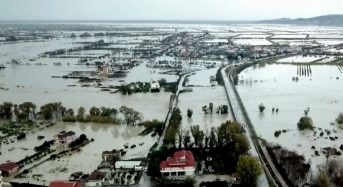
TIRANA TIMES, December 6, 2025 – Albania is once again under water. Torrential rains over the past days have triggered massive flooding across almost the entire country, exposing not only the fragility of urban infrastructure but, more fundamentally, the long-term failure of governance. From the northern plains to the southern coast, the scenes are disturbingly familiar: submerged roads, paralysed cities, evacuated families and public institutions reduced to emergency mode. What should have been an exceptional natural event has once again turned into a systemic crisis that increasingly resembles a return to a Hobbesian state of nature, where the state is absent when citizens need it most.
The coastal city of Durrës has become the most striking symbol of this collapse. Following just twenty four hours of intense rainfall, large parts of the city were submerged, traffic was blocked on more than a dozen roads, schools were closed and residents in several neighbourhoods were effectively cut off. Images circulating on social media showed citizens moving through flooded streets by inflatable boats, prompting bitter comparisons with Venice, though without Venice’s planning, heritage or drainage system. The flooding of the Veliera underpass, a twelve million euro flagship project personally promoted by Prime Minister Edi Rama, became emblematic of a governance model focused on spectacle rather than substance.
Opposition figures and local activists were quick to point out that this was not a natural disaster alone. Durrës floods repeatedly, year after year, because drainage canals are blocked, pumping stations malfunction and urban expansion has proceeded without any serious investment in water management. The city’s experience highlights a broader pattern: expensive iconic projects coexist with neglected basic infrastructure, turning heavy rain into urban paralysis.
The crisis is not limited to Durrës. According to the Institute of Geosciences, intense rainfall and flood risks have affected multiple regions, including Shkodra, Lezha, Kukës, Elbasan, Vlora and Gjirokastër. Controlled water discharges from the Koman and Vau i Dejës hydropower plants have raised concerns of further flooding in the north, underlining the chronic vulnerability of river basin management in Albania.
In Vlora, the country’s largest city in the south and a strategic port, the situation exposed another dimension of institutional failure. The city reportedly remained without running water for five consecutive days. Strikingly, the government, despite being in power since two thousand thirteen, shifted blame to an investment dating back to two thousand five, highlighting a governing reflex that prioritises deflection over accountability. This narrative rings hollow in a country where more than a decade of uninterrupted rule has not translated into resilient public services.
The paradox becomes even more glaring when placed in seasonal context. During the summer, Albania, despite being a water rich country, suffers from chronic water shortages. Even parts of Tirana experience prolonged cuts, including affluent suburban areas where politicians, criminals, wealthy businessmen, media figures and Western diplomats reside side by side. Albania thus oscillates between drought and flood, unable to manage either abundance or scarcity, a clear sign of infrastructural decay and policy failure.
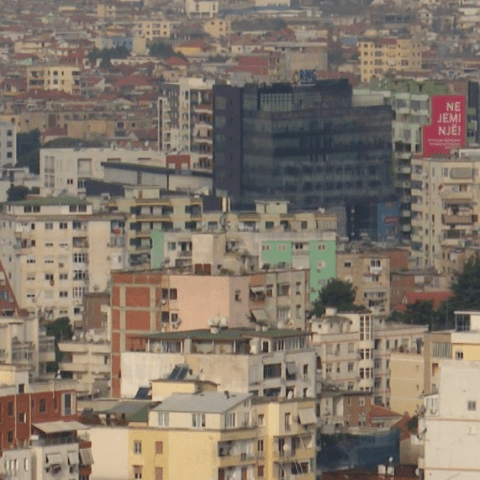
At the heart of the problem lies an outdated system. Much of Albania’s water supply and sewage infrastructure dates back to the communist era, designed for a Tirana of fewer than one hundred and eighty thousand inhabitants. Today, the capital’s population has at least tripled, possibly more, while construction, particularly of high rise towers, has exploded without corresponding investment in underground networks. As one local analyst remarked sarcastically, first the towers exploded, now the sewage will. The comment captures a grim reality: urban development has been decoupled from basic public health and environmental safety.
Northern cities such as Shkodra and Lezha appear increasingly resigned to seasonal flooding, while central Albania faces similar risks. Even the newly built Vlora international airport, yet to be officially inaugurated, has reportedly been affected by flood related problems, raising questions about planning standards and long term viability.
Prime Minister Rama, currently on an official visit to Paris, has communicated via social media that the situation in the north is being monitored and that controlled discharges are under coordination with local authorities. Yet such reassurances do little to address the structural causes of the crisis. Albania’s flooding is not merely the result of climate change or extreme weather. It is the predictable outcome of years of poor urban planning, weak regulation, corruption and the prioritisation of political optics over public resilience.
Ultimately, Albania under water is not just a metaphor but a diagnosis. The floods reveal a state that builds monuments but neglects maintenance, celebrates growth while ignoring sustainability and governs through propaganda rather than preparedness. Until infrastructure, transparency and accountability become central to governance, Albania will continue to drown, not only in rainwater, but in the consequences of its own misrule.