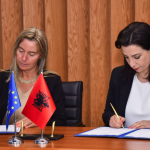
TIRANA, Oct. 17 – Albania’s temporary General Prosecutor Arta Marku opened the call for applications for the High Prosecutorial Council again on Friday, as the first round failed to receive any applications.
The new deadline is 15 days, while the candidates should come from the appeals prosecutions.
The High Prosecutorial Council is made up of 11 members, five of which come from outside the system. The remaining six spots are divided among three prosecutors from first instance prosecution, two prosecutors from appeals prosecution and one from the general prosecution.
While the first instance and general prosecution have more candidates that can answer the call, as a number of prosecutors have passed the vetting process under the judiciary reform, only Arben Dollapaj from the Shkodra Appeals Prosecution can be appointed by the appeals prosecutions.
The country’s ongoing vetting process disqualified the other two candidacies – Besa Nikelhasani by the Shkodra Appeals Prosecution and Luan Kaloci by the Tirana Appeals Prosecution.
Although Albania’s judicial reform – a precondition for the opening of the country’s EU accession negotiations and later EU integration – foresaw exactly this: the cleanup of the current system by corrupt or incapable judges and prosecutors who could not justify their wealth, the big number of lost judges and prosecutors had not fully been predicted by anyone.
In these circumstances, in the best case scenario, the HPC will be established in the end of January, as, according to the law, the process of re-evaluation alone takes minimally three months.
Only after the HPC is established can the preparatory stages for the creation of the National Investigation Bureau and and the Special Structure Against Corruption and Organized Crime (SPAK) begin.
The High Judicial Council was in much of the same situation, as a second call to the appeals courts was necessary to draw two candidacies.
Delays in establishing the HJC further postpones the full seat completion of the High Court, which is currently left with four members who have successfully passed the vetting process, among the 19 the law foresees.
These two are not isolated cases – the Albanian media has been reporting Albania’s collapsing justice system as soon as the vetting process of judges and prosecutors actively began. The most serious problem arising of the ongoing resignations, sackings and investigations has been particularly this – the freezing of certain courts and the lack of existence of other judicial bodies foreseen under the justice reform.
The Constitutional Court, left with only four judges, has been out of order over the last months as six judges are needed to start a meeting and five to take a decision.
The Constitutional Court situation has also inevitably affected Albania’s domestic and foreign political affairs, with the most prominent issue being the governing Socialist government’s aim to negotiate a new maritime border agreement with Greece.
Recently, Prime Minister Edi Rama said that when the ongoing negotiations between the group groups lead to an agreement, it will pass to parliament without waiting for the CC to become functional.
Rama’s comments followed President Ilir Meta’s statement a day earlier, who stressed that such an international agreement in the name of the Republic of Albania should be ratified in parliament only once the country has a functioning Constitutional Court again.
“Otherwise, this would not serve both countries’ best interests,” Meta said, adding he’d made his point clear to Rama as well.
A number of independent experts have voiced the same opinion on the matter.
Meanwhile, opposition members and critics alike have also noted nothing is being done to appoint a General Prosecutor, as Arta Marku was to be temporary and has yet to undergo the judiciary vetting herself.
December will mark one year since Arta Marku was appointed temporarily General Prosecutor by the ruling SP lawmakers amid opposition protests both inside and outside the parliament.
Upon declaring Marku temporary chief prosecutor last december, the parliamentary program was postponed, while the opposition lawmakers released smoke grenades inside the building and protesters clashed with police outside.