By Sidonja Manushi
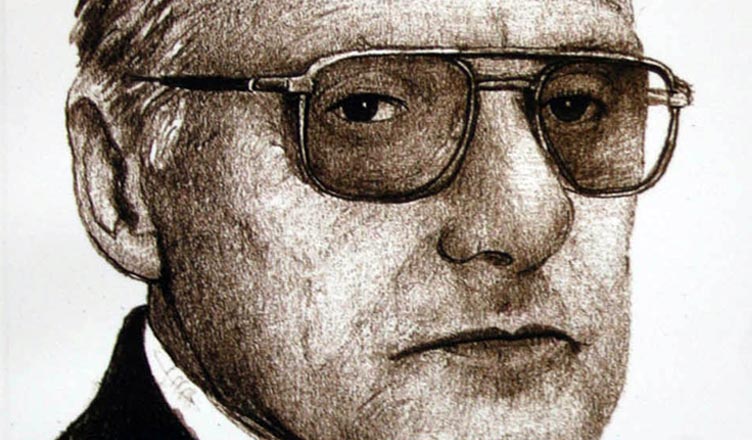
TIRANA, Nov. 6 – One of the most valuable Albanian writers, Kasà«m Trebeshina, passed away on Monday, at the age of 92. The funeral, which was held on Tuesday, officially bid the great author goodbye, marking the loss of a figure worthy not only due to his literary contributions, but also the principles and determination he personified during his difficult life as a writer, prisoner of the communist regime, and Albanian.
Trebeshina’s last days were spent among his books and unpublished works, which count to 11 in total. Unfortunately, unpublished work was nothing new to the author’s life, who was first arrested in 1953, after publishing for the first time his historical drama Kruja e à‡liruar (Liberated Kruja). What followed was years of imprisonment, internment and, worse even, mental disabilities’ treatment.
Thus, more than a writer, Trebeshina was a dissident, a revolutionary, and a person of ideas, ready to protect them in the face of imminent threat towards his well-being, establishing himself as an example to be followed, despite the fact he remained among the little-known figures of the early years of postwar Albanian literature.
Trebeshina was born in Berat and studied at the Shkolla Normale (Normal School) in Elbasan until he joined the communist resistance movement, in 1942. When the war ended, he studied at the Ostrovsky Theatre Institute in Leningrad. A committed communist, but by no means a conformist, Trebeshina left the communist party and later the Writer’s Union in Tirana. Much of his work was written in the late forties and early fifties, but never published.
Trebeshina’s non-conformist, fearless nature appeared early on. The famous Albanian studier, Robert Elsie, has described how Trebeshina, “in an extremely rare act of open dissent in Albanian intellectual life” , sent a ‘pro memoria’ to communist dictator, Enver Hoxha, in 5 October 1953, warning him that the cultural policies he was following would inevitably lead the nation in the road to disaster. Needless to say, Hoxha was not a man who received criticism well. Kasà«m Trebeshina, the unpublished author of eighteen volumes of verse, forty-two plays, twenty-two novels and short stories, disappeared from the literary arena altogether after this altruistic and self-destructive act, leaving almost no trace.
It took seventeen years in prison, and twenty years of both written and spoken silence, for him and a handful of other writers and intellectuals to find their way back to the Albanian society and see, sadly, that his prediction of the communist regime had come true. More than the whim of a moment, Trebeshina’s reaction to a system he initially supported was based on strong ideals, which he was ready to defend regardless of the consequences. Resulting in a life of physical and emotional hardship, internment also served Trebeshina’s literary creation, making him one of the most apt verbal painters of the communist regime, its horrors and suppressions, its darkness and wrath.
Of Trebeshina’s voluminous writing, only one collection of poetry, Artani dhe Min’ja ose hijet e fundit tà« maleve, (Artani and Min’ja or the last mountain shadows), and an anonymous translation García Lorca’s plays were published at the time. Three of his prose pieces were later edited by Ardian Klosi in the volume Stina e stinà«ve (The season of seasons), providing the reader with an initial glimpse into a fantasy world not unlike that of the tales of Mitrush Kuteli, another prominent Albanian writer.
Trebeshina’s work is known for its surrealistic touch, a feature the author himself called ‘poetic realism’, which came as a result of his self-aware revolt against the dominant current of socialist realism.
Since the fall of communism, Trebeshina finally published twelve volumes worth of work, which consisted of short stories and drama. Trebeshina’s creative place in the Albanian literary arena has not been finally defined. ‘The season of seasons’ might be the work best representing the author as a whole, having grabbed the attention of intellectuals and scholars home, and abroad. Three novels are part of this volume: ‘The season of seasons’, ‘Odin Mondvalsen’ and ‘Albanian whim’. Whereas the first and third novels speak of childhood as remembered by the author, breaking the taboos usually identified in this age and moving past them, to the historic-philosophical burden that surpasses childhood, the second novel, ‘Odin Mondvalsen’, is so unique in its story-telling technique that it has become the epitome of Trebeshina’s creativity.
Despite the sadness of his parting and the creative loss an entire nation experiences by it, Kasà«m Trebeshina will now surely be remembered as a founding figure of the culture and literature that followed Albania’s darkest time, aptly becoming both a reminder of what was, and a torch shedding light on what came after it.