The crisis deepens as the government shields Deputy PM Balluku and a criminal network emerges in AKSHI
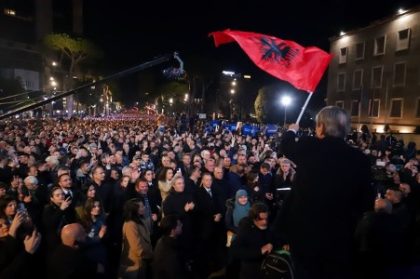
Tirana Times, January 25, 2026 – Albania’s main opposition party returned to the streets on Saturday with a second national protest against Prime Minister Edi Rama, challenging the legitimacy of his fourth term and deepening a political crisis that has increasingly blurred the line between governance, justice and street confrontation.
The rally, organized by the Democratic Party, turned violent as protesters clashed with police outside government buildings in central Tirana. Molotov cocktails and fireworks were thrown toward the prime minister’s office, while police responded with tear gas and water cannons. Authorities said 11 police officers were injured and about 20 protesters were detained.
The protest capped weeks of mounting tension following the disputed 2025 parliamentary elections, which handed Rama and his Socialist Party another landslide victory. The opposition has rejected the results, citing what it describes as systemic manipulation of state resources, pressure on voters and the fusion of public administration with the ruling party’s campaign machinery.
International observers from the OSCE and ODIHR issued sharply critical findings, noting abuse of incumbency, unequal media access and the use of public funds and institutions to benefit the ruling party. Local analysts say the pattern closely mirrors the 2021 elections and represents a regression to the first pluralist practices of the early 1990s, when elections formally involved multiple parties but state power was mobilized against a single political opponent.
For the Democratic Party, the protest was not only about the election result but about what it calls the transformation of Albania into a captured state. Opposition leaders accuse Rama’s government of presiding over a criminalized economy fueled by drug trafficking, money laundering and systemic corruption, allegations the prime minister has repeatedly dismissed as politically motivated.
Several high-profile corruption cases have nonetheless eroded public trust in recent years. A number of former ministers and senior officials have been arrested, convicted or placed under investigation by the Special Anti-Corruption Prosecution, known as SPAK, an institution created as part of Albania’s EU-backed justice reform.
The most destabilizing developments have come in recent months. Prosecutors have filed criminal charges against Deputy Prime Minister and Infrastructure Minister Belinda Balluku, one of Rama’s closest allies and a central figure in large infrastructure and energy projects. The case has triggered an open institutional clash between the government and the judiciary, after Rama challenged a court decision suspending Balluku from office at the Constitutional Court.
At the same time, investigators uncovered a structured criminal group operating inside the National Agency for Information Society, a key institution responsible for state digital systems and national security data. The agency’s director, deputy director and other officials were arrested, along with a civilian coordinator, Ergus Agasi, described by prosecutors as wielding extraordinary influence without holding any formal public office. Investigators allege Agasi ran a parallel criminal structure embedded within the agency.
According to investigators, Agasi operated as a powerful coordinator between state institutions and organized crime, exercising control not only over AKSHI but also exerting influence across other key institutions. Prosecutors allege he ran a parallel criminal structure embedded within the state, a revelation that has further shaken confidence in the government’s ability to safeguard public institutions.
These scandals have significantly weakened the government’s legitimacy in the eyes of the opposition and parts of the public. Protest leaders are now demanding Balluku’s arrest, arguing that parliament, controlled by Rama’s Socialist majority, is shielding her by refusing to lift her immunity despite a request from SPAK.
Speaking to supporters on Tirana’s main boulevard, Democratic Party leader Sali Berisha declared that the opposition was entering what he called a season of resistance and claimed the government had reached its final stage. His speech was followed by renewed clashes with police as protesters moved from the prime minister’s office toward the parliament building.
Government officials rejected the opposition’s narrative. Socialist Party parliamentary leader Taulant Balla dismissed the protest as violent theater orchestrated by Berisha, a polarizing figure who has dominated Albanian politics for three decades. He expressed concern for injured police officers and accused the opposition of attempting to destabilize the country.
Beyond the immediate confrontation, the protests highlight a deeper structural crisis. Albania finds itself caught between formal democratic institutions and a political culture increasingly defined by street pressure, judicial battles and mutual delegitimization. With EU accession negotiations underway but fragile, continued instability risks reinforcing perceptions of democratic backsliding and institutional capture.
For now, neither side appears ready to step back. The opposition has vowed to continue protests, while Rama has shown no sign of conceding ground. As Albania enters another cycle of confrontation, the struggle over elections, justice and state power is once again being fought as much in the streets as in parliament.