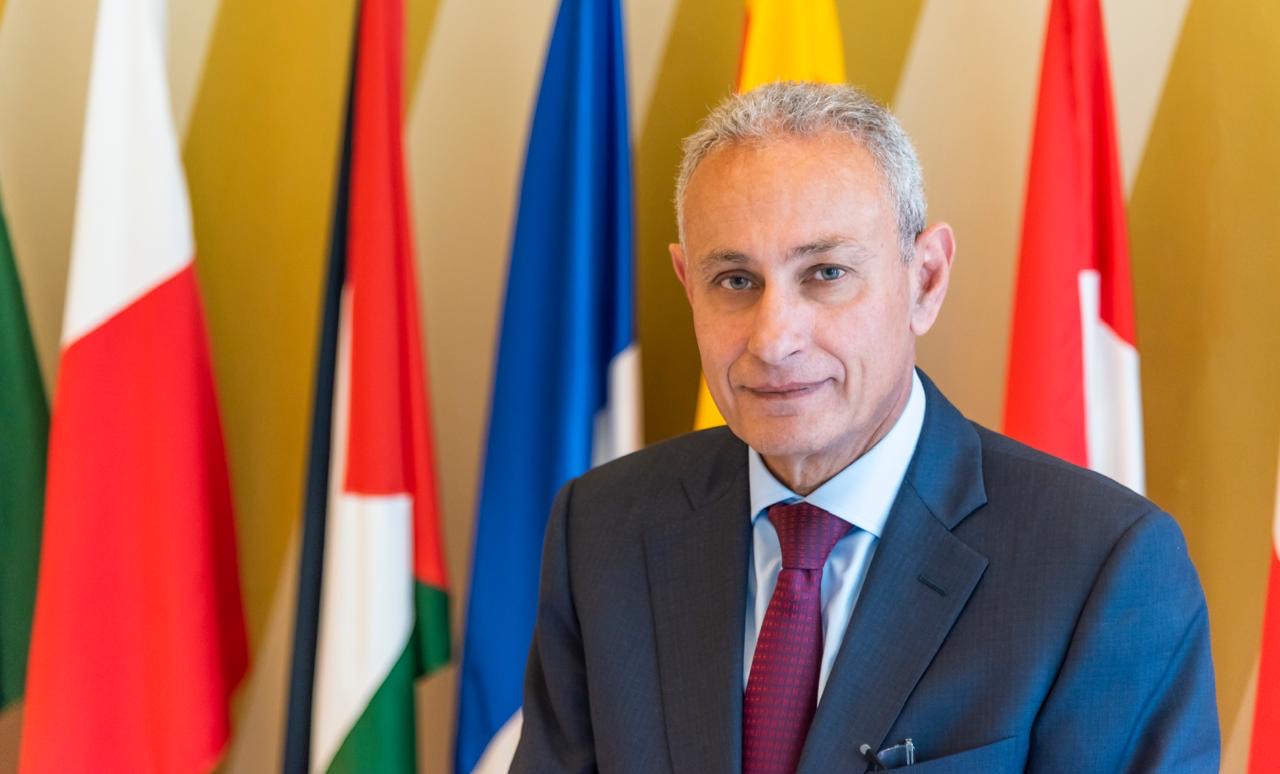
By H.E. Ambassador Nasser Kamel, Secretary General of the Union for the Mediterranean.
Tirana Times, June 25, 2026 – They say no man ever steps in the same river twice. The universe is in a constant state of flux: such is my sentiment as I reflect on my mandate at the Union for the Mediterranean, an organisation I see as being more relevant today than ever. As it stands, it is not even remotely similar to the one I joined as Secretary General eight years ago. The region has changed, the organisation has evolved, and I leave it its most convinced advocate. I like to think of it as an ongoing journey to a destination that is yet to be reached after years of navigating the turbulent waters of conflict, crisis and global disruption.
There is a compelling story to tell about how we have consolidated our capacities and mobilised an ever-expanding ecosystem of partners, donors and stakeholders. We have co-produced landmark reports on topics ranging from climate change to economic integration and delivered value through initiatives such as the UfM Grant Schemes, the Mediterranean Pavilion at COP or the Mediterranean Capitals of Culture and Dialogue. Within the framework of the Blue Mediterranean Partnership, we have helped mobilise over one billion euros in investment for sustainable blue economy projects. And with the first ever Intergovernmental Monitoring Mechanism on Gender, we have created a tool for tracking progress and shaping policy recommendations on equality across the region.
In parallel, we have modernised the UfM Secretariat to make it more agile, more impact-oriented and better equipped to respond to the region’s evolving needs. There is much we can celebrate, thanks in no small part to the dedication of our team that, together with our convening power, remains our greatest asset. Much more, however, should have been achieved. This bittersweet realisation is the product of eight years of hard work and perceptions, prejudices and practices that have impeded our full potential and, by extension, that of the region itself.
Beyond the nature of conflict in our region, which has assumed a new catastrophic dimension with the war on Gaza, other pressures are building.Climate change, widening economic disparities, and persistent inequality that disproportionately impact women, young people and rural communities are all cross-border challenges wemust collectively address. Nearsighted, security-based responses that do not address the root causes of issues will never succeed in the long run. Despite the need for deeper integration as a prerequisite for peace, stability, and prosperity, we face a growing preference for the immediacy of national agendas over the long-term sustainability of regional welfare.
Over the three decades since the launch of theBarcelona Process, development cooperation hasfailed to fully evolve beyond the entrenched habitsof bilateralism that too often cast southern partners as aid recipients rather than co-architects of a shared future. Despite the powerful logic of deeper integration, a strategic myopia continues to govern our choices. It sustains an artificial division between those deemed convenient partners and those consigned to the margins, as though the most elementary fact of geography were somehow negotiable. Neighbours, however, are never a choice. As a new “world chaos” emerges, wecannot afford fragmented measures when a vast population will continue bearing the consequences of our lack of regional preparedness.
We know that our ability to successfully take on future challenges will be greatly conditioned by our readiness to act together at a regional level. And yet, we still see a lack of political engagement among many of our Member States. These countries favour bilateralism over multilateralism for many reasons including the perceived crescendo of European regularisation and over-engineering of development cooperation instruments. At a time when successive ministerial mandates and regional developments call for deeper and broader involvement, the UfM isconstantly held back by the tight resources and budgetary uncertainty that this results in: a quick glance at the organisation’s annual budget reveals a serious imbalance in terms of commitment and support received from Member States.
I leave now with one affirmation and one question that I invite you all to reflect on. The Union for the Mediterranean is the only obvious vehicle for building a region capable of acting as acoherent bloc at a time when irreversible global changes are upon us. Are Member States serious about this vision and willing to invest in it?
Until then, the Union for the Mediterranean will continue to deliver and set the standard of commitment in full knowledge of the growing scale and complexity of crises that no Euro-Mediterranean country can tackle alone.