TIRANA, Aug. 29 – Coach Gianni De Biasi has called up 25 players for the friendly against Morocco, a key test ahead of the first World Cup qualifier against neighboring Macedonia on Sept. 5.
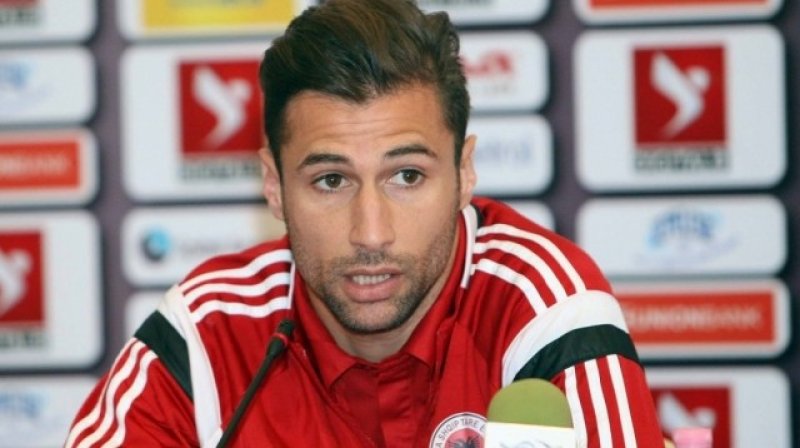
Speaking at a press conference on Monday ahead of the Aug. 31 friendly against Morocco, coach De Biasi announced Lorik Cana had decided to quit the national side after captaining Albania for the past five years. Much-travelled defender Cana, now at 33, has also prematurely quit French club Nantes, and could try a new experience outside Europe before his eventual retirement from professional football.
“He was a great player, captain and man. He enjoys my highest appreciation for his contribution and values,” said De Biasi, who didn’t unveil who the new captain will be.
The 33-year old defender joined France’s Ligue 1 club Nantes from Italy’s Lazio in Sept. 2015 on a two-year deal but did not shine in his France comeback where his career as a professional kicked off.
Born in Kosovo, Cana began his professional career in France with Paris Saint Germain and also played for Marseille, Sunderland and Galatasaray before moving to Italy with Lazio in 2011.
He was a regular starter with the national side and much of the success in the Euro 2016 qualifiers is also dedicated to him.
“Morocco is a very tough team and we have to seriously consider this friendly,” said De Biasi.
The two teams are facing each other for the first time.
One of the toughest African sides, Morocco ranked 54th in the latest FIFA ranking compared to Albania’s 37th, one of their best world historical rankings.
The Morocco fixture is seen as a key test ahead of the first Russia World Cup qualifier with neighboring Macedonia following Albania’s historic debut at a European championship last June.
“We face a tough challenge in our qualifying group stage with Italy, Spain and Israel. We have to do our best against Macedonia because we risk making a bad impression. We must forget what we achieved in the Euros. That should only serve as experience,” said De Biasi.
Coach De Biasi also downplayed voices of an exodus of players of Kosovo origin from the Albanian national side after three players recently left the national side to join Kosovo which will be making its international debut in the World Cup qualifiers following its FIFA and UEFA membership earlier this year.
“There is no exodus from the national side. The players joined Kosovo for more playing opportunities,” he said.
The departure of 20-year-old talent Milot Rashica who plays as an attacking midfielder for Dutch Eredivisie side Vitesse is the biggest loss for the national side as it faces a tough challenge in the upcoming World Cup qualifiers.
Macedonia’s coach Igor Angelovski has called up five Albanian-Macedonians for the first qualifier away to Albania.
“Albania’s participation at the Euros shows a lot about the opponent we face, but we’ll try our best to begin this round of qualifiers with a positive result,” he said.
Naser Aliji, a 22-year Macedonia-born defender to ethnic Albanian parents who joined Albania in 2015, will likely play against his home country.
“It was a special feeling for me when I saw that Albania was drawn against Macedonia. I have my whole family in Macedonia and it will be a special feeling,” Aliji, the first Albanian-Macedonian to play for Albania earlier said.
Ethnic Albanians officially account for around 25 percent of Macedonia’s 2 million population, but the figure is estimated to be higher.
Both matches with Morocco and Macedonia will be played in the newly reconstructed “Loro Borici” stadium in Shkodra, northern Albania.
The national side will travel to Liechtenstein on October 6 before hosting Spain on October 9 in its next two qualifiers.
The Red & Blacks will play at home to Israel on November 12 and travel to Italy on March 14, 2017 in the first round of World Cup qualifiers in Group G.
Differently from the Euro qualifiers where the top two group teams qualified directly and the third-placed teams were given a play-off chance, the road to Russia World Cup for European national sides is much tougher with only the nine group winners directly qualifying and the 8 best group runners-up contesting in a play-off round.