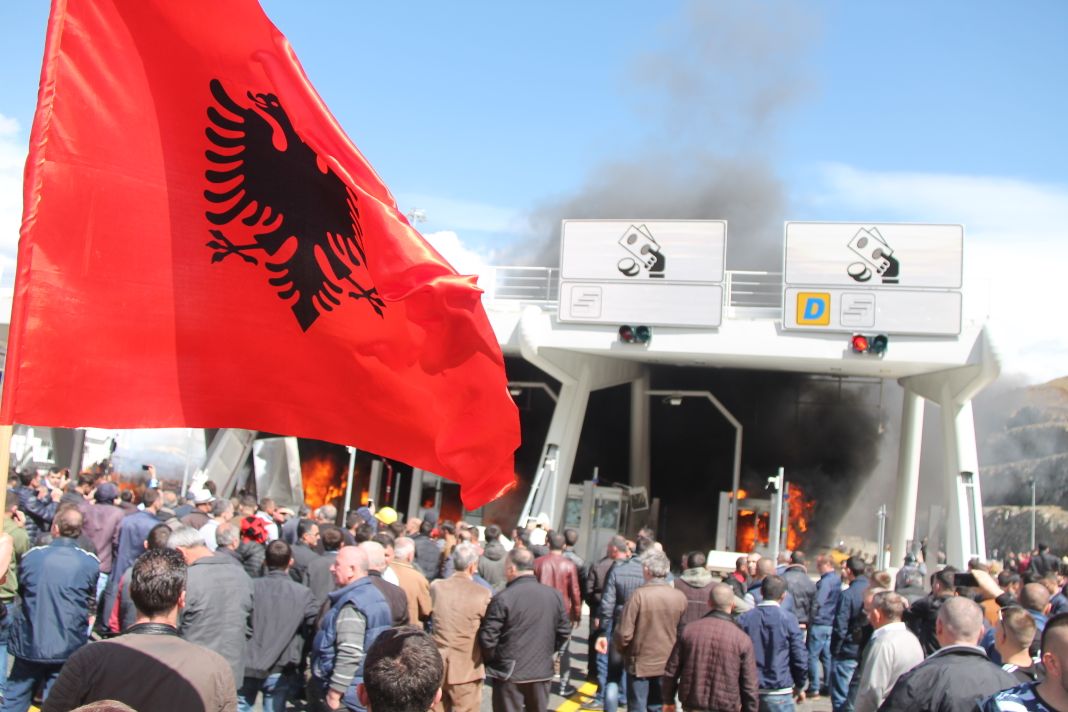
TIRANA, March 31 – The protest against the first toll road in the Nation Highway connecting Albania to Kosovo introduced by Prime Minister Edi Rama last week turned violent Saturday morning, with protesters clashing with police and setting the toll collection boxes on fire.
Protesters told local media it was police that aggravated what started as a peaceful protest.
“We hadn’t planned anything and the protest was peaceful, but the police made the situation tense,” one anonymous protester said.
Hundreds of protesters came from the Kukes area, one of the poorest regions in Albania concerned over this road tax bringing isolation unless tax incentives are provided to them, and were also joined by protesters coming from neighboring Kosovo.
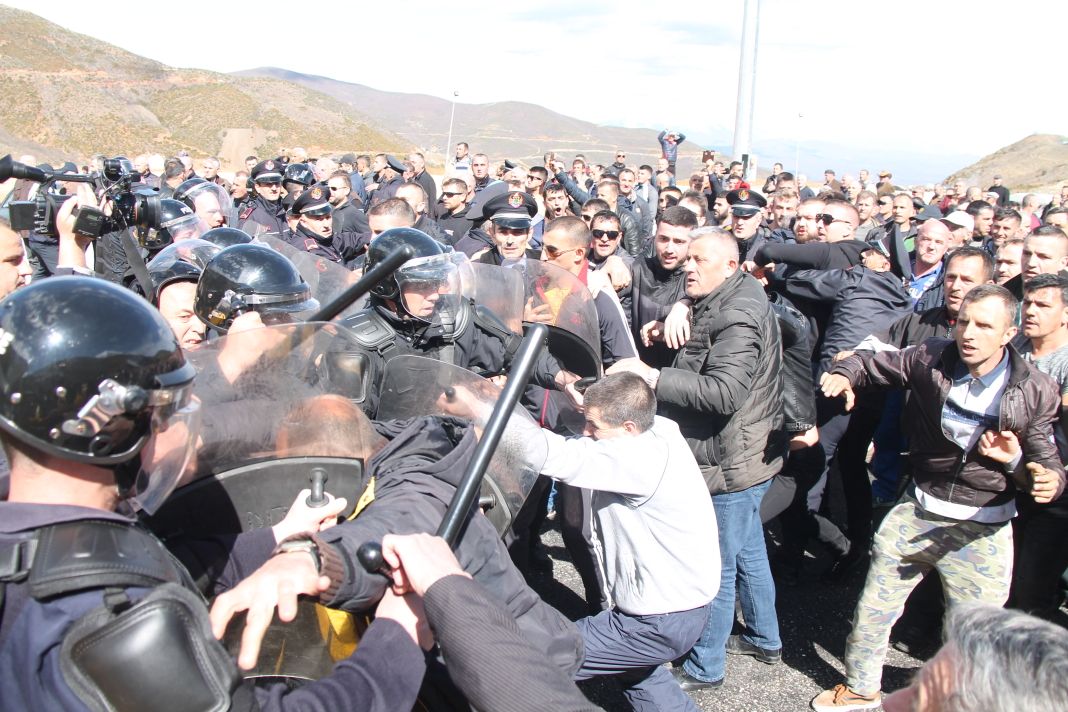
After clashing with police forces, which later withdrew and stayed at a distance, protesters set the boxes on fire and reportedly kept firefighters from putting them off.
Local media also reported the clashes resulted in at least 13 injured police officer and several injured protesters, while the protest blocked traffic in the area for hours, with lines of vehicles extending to ten kilometers from the border crossing to the tolls.
In a Facebook statement, Rama wrote that “the barbarian violence on common property and the violent reaction against police forces in Kukes will receive the appropriate reaction,” and announced a press conference at 7pm on Saturday concerning what he called “a crime towards private property and lawful investment.”
Opposition’s Democratic Party (DP) leader Lulzim Basha, on the other hand, said in a press conference minutes after the protest ended that “this was the revolutionary voice against the nation’s mockery and extortion through taxes for politicians’ benefit.”
Basha called on Rama to remove the toll road tax and tell police forces to “stop violence against protesters.”
The pay toll price – which ranges from €2.5-€22.5 depending on the vehicle – brought concern amid local communities, private businesses and even experts fearing the country’s first road toll will have a negative impact on the poor Northern Albanian households as well as trade and tourism flows between the two ethnic Albanian neighboring countries.
“Economic cooperation between Kosovo and Albania as two countries of a divided people is not at the desired level. There exist different tariff and non-tariff barriers that hold back cooperation progress and that’s why the implementation of the toll will be an extra barrier that will mostly affect Kosovars who visit Albania more each year,” said Safet Gerxhalliu, the head of the Kosovo Chamber of Commerce regarding the toll roads.