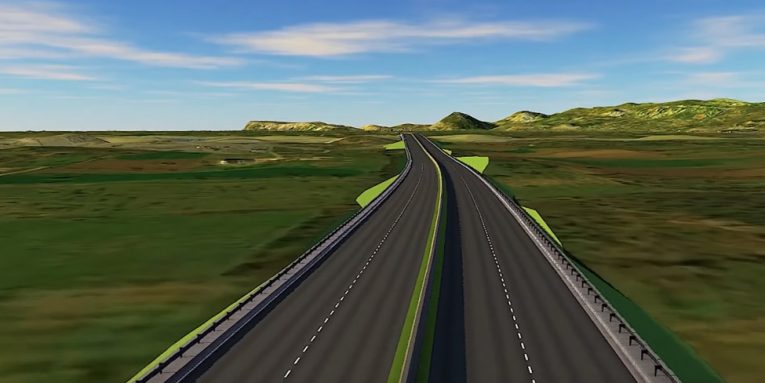
TIRANA, July 19 – The Albanian parliament approved on Thursday evening only with the majority’s votes, during the session’s last seance, two controversial concession contracts under the Public Private Partnership (PPP) formula, for the Milot-Balldren road construction, 17,2 kilometers long for a value of 256 million euros and for the Orikum-Dukat road in the country’s south, 14,7 kilometers long, for a value of over 60 million euros.
Both contracts, but especially the Milot-Balldren road, have raised numerous debates not only for their high cost, but also the lack of transparency regarding the pursued procedures.
The PPP contract formula foresees the winning company doing the construction work, while the government then repays the costs during a 13 year period.
In the case of the Milot-Balldren road, A.K.N. Sh.p.k., which has been awarded its construction, has stated that it will borrow 70 million euros, invest 52 million euros from its capital and take 19,5 million euros by its suppliers.
The company, however, officially appears to have, according to the 2018 balance sheet, a capital of only 3,4 million euros.
The road includes, in addition to the main axis and the construction of secondary roads, two bridges and two tunnels with a length of 850 meters. In its initial offer the company had foreseen the construction of only one tunnel, while in a second phase it took over the construction of the second tunnel without claiming additional value.
More question marks were added to the fact that in the bid made in 2017, the company calculated a construction cost of 63 million euros and a maintenance cost of 3.5 million euros, and a year later, the cost increased by more than double, while the maintenance with more than five times.
The authorities have not provided any public explanation regarding these doubts, which have been raised more than once by the opposition, but have been sufficient to state that the road will be of European standards, that its costs were increased due to the construction of secondary roads and interconnecting segments, from the construction of two bridges and tunnels, and that maintenance costs were also calculated in the final price.
Before the majority in parliament approved the concessions, the opposition’s resigned Democratic Party reiterated its accusations that “with the Milot-Balldren concession, Edi Rama broke every record of corruption and clientelism. Within 1 year, Edi Rama gave his family friend Ndue Kola 526m euros or nearly five percent of National Production through today’s concession and that of the Arber road, which is being built by the same family,” former DP lawmaker Albana Vokshi said, adding the “Milot-Balldren and Orikum-Dukat concession are part of the ‘1 billion euro’ criminal project, which is turning Albania into the paradise of money laundering, the cost of which is paid by Albanian citizens.”
Both concessions are part of the government’s “1 billion Euros” package of PPP contracts. Both of these contracts did not receive any offers, so the winners of the tenders were the companies that made the unsolicited request.
Vokshi also commented on the construction companies who have been awarded the PPPs, accusing Prime Minister Edi Rama of having close ties with the owners.
Due to similar issues in the last year with other costly road segment constructions and, especially, the Great Ring Road segment for which Astir residents are still protesting, local media compared the costs of building a road.
According to Exit.al, for American standards, the construction of a road with a completely new bed and two separated lanes costs in urban areas 3-5 million dollars per mile, or roughly 1,9- 3,1 million dollars per kilometer.
In euros, the standard cost of building new urban roads is 1,8- 2,7 million, figures many times lower than the cost of building the Milot-Balldren and Orikum-Dukat roads.
Experts further pointed out that in the case of the Milot-Balldren road the figure appears even more redundant, considering the road lies on straight ground and will follow the trail of the existing one.
Only ten days ago, the European Commission criticized the government for uncontrolled Public-Private Partnership contracts, which have already reached a historic high for Albania – as much as 31 percent of the country’s GDP.
The EC predicted that only in 2019 the government will sign even more PPP contracts, worth as much as 15 percent of GDP.
“PPPs have reached a value of 31 percent of gross domestic product (GDP) and are expected to increase by 15 percent in 2019,” the CEC report says.
The majority of road construction projects are also PPP contracts, media has reported time and time again, frequently awarded without proper competition and to uncertified professionals.