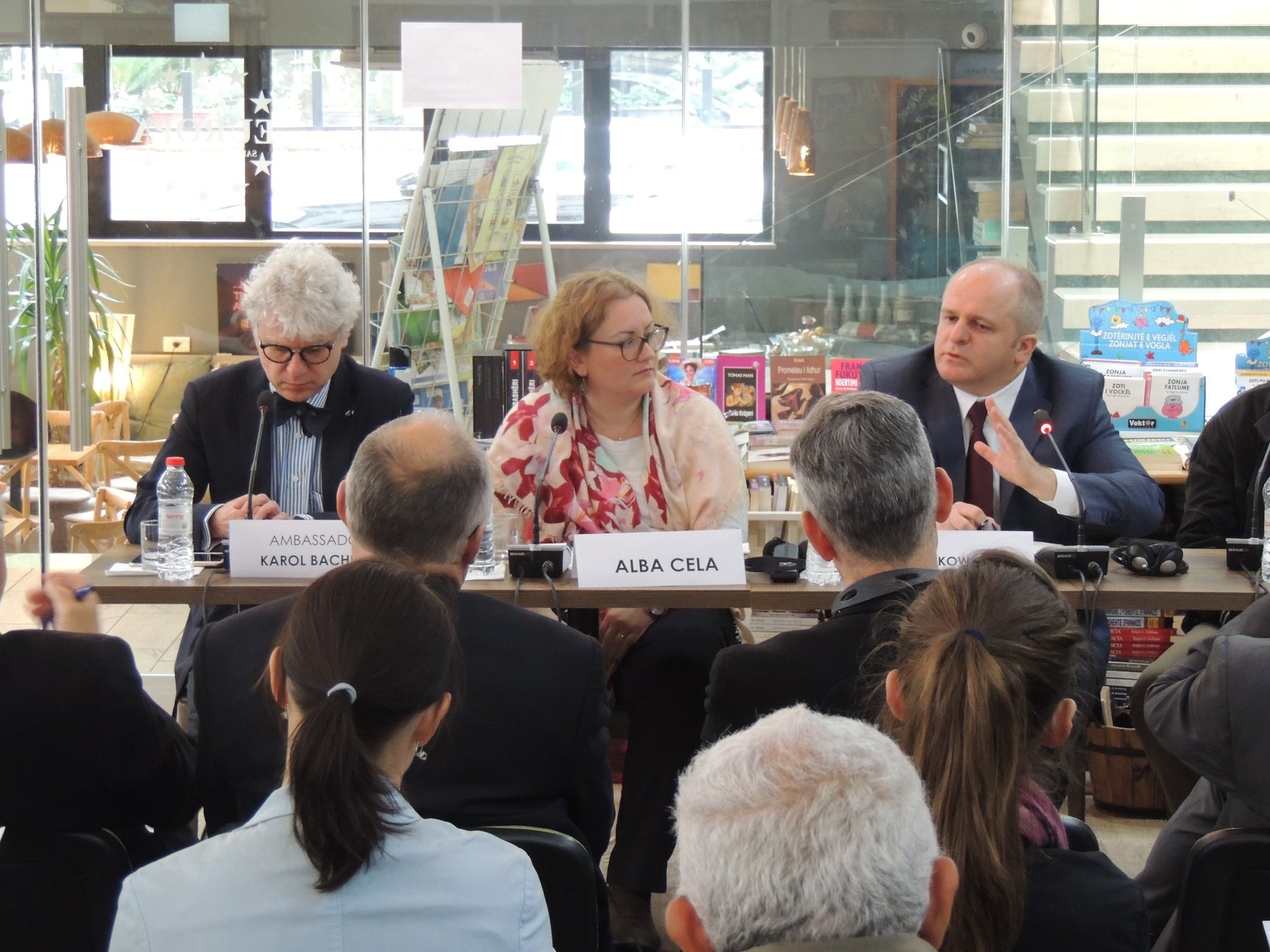
TIRANA, Mar. 28 – On Thursday, the Embassy of the Republic of Poland and the Albanian Institute for International Studies (AIIS) organized the seminar “Poland and Central Europe – 30 years after the Great Transformation.”
Dr. PaweŠ‚ Kowal, former Secretary of State in the Ministry of Foreign Affairs and a member of the Polish Academy of Sciences, was the seminar’s keynote speaker, accompanied by the Polish Ambassador to Tirana Karol Bachura.
In the opening remarks, Bachura said we are celebrating a year of anniversaries – the 20th anniversary of Poland’s NATO membership, 15 years of Poland’s EU membership, 10 years of Albania’s NATO membership, 80 years of Albanian-Polish bilateral relations – and that he hopes this is also the year Albania opens accession negotiations with the EU.
Following, Kowal said that in order to understand the current situation in Europe, it is very important to remember and have a good knowledge of the past, especially what happened in after the First World War.
At that time, the multinational empires like Russia, Austro-Hungary, were replaced by several small national states. The key to the matter now is how to ensure the collaboration between these small countries and for these countries a balanced dynamic.
Another element in understanding the current situation according to Kowal is understanding what happened in 1989-1991 in a very large territory from the eastern Europe to Mongolia. It was a very abrupt and extraordinary transformation in a very short time. From the Soviet Union and Yugoslavia almost 30 new states were created from Eastern Europe to Mongolia.
“This part of Eurasia is very important for the developments in the world,” said Kowal, adding the key to this transformation is what can be called the pax americana.
Kowal described this pax Americana as a soft hegemony based on the concept of ‘soft power’ by the American professor Joseph Nye. The bases of this system are the division of powers, the liberal government and help from the West.
The main question, according to Kowal, is if the pax Americana has succeeded or not. He said that the two organization that have had the biggest impact and success have been NATO and the European Union. In the beginning two aspects were important: first, the Americans would participate in the build up of the European Union; and secondly, the historical memory. The generation of the American leadership at the time, especially George Bush, were participators in the Second World War. The creation and the expansion of the EU has gone hand in hand with the expansion of NATO. Until the end of communism, NATO was a military organization, but after the end of communism it also became a political organization that could influence the political developments in the member countries.
Despite the still considerable power of NATO and the EU, Kowal said that soft power has weakened, opening space for other actors such as Russia, Turkey and Iran to exploit the situation and dream of past glories.
In this context, the conference concluded, it is fair to remember that soft power cannot solve everything and that, without the existence of NATO, neither Albanian, nor Polish citizens, would be so calm.