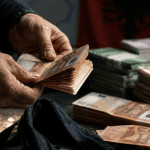
The latest central bank report reveals that the rate of card transactions as cash withdrawals rose to 96 percent at the end of June 2011 up from 95 percent at the end of 2010
TIRANA, Dec. 5 – Despite the number of credit and debit cards in circulation increasing, the Albanian economy has become even more overwhelmingly cash based during this year, not to mention the informal sector which is estimated at more than 30 percent. The latest central bank report on the country’s financial stability for the first half of 2011 reveals that the rate of card transactions as cash withdrawals rose to 96 percent up from 95 percent at the end of 2010.
This means that only 4 percent of people possessing debit and credit cards use them for purchases in authorized Points of Sale (POS), making the Albanian economy, probably the most-cash based even in the region.
Bank of Albania data show the number of credit and debit cards in circulation continued to increase, reaching 712,575 cards in the first half of 2011, up from 694,848 at the end of 2010. The majority of them, some 95 percent, are debit cards– with the number of credit cards at only a mere 28,635.
Almost all commercial banks operating in Albania, 14 out of 16, offer cash withdrawal services from ATMs, but only eight of them offer POS services. The number of ATMs at the end of 2011 rose by 2.9 percent to 783 while the POS equipment placed in shops, restaurants, hotels and trade centers rose by 1.1 percent to 4,729.
Home banking is also expanding. Some 86,000 home banking transactions worth, 46 billion lek were carried out during the first half of this year under this service, launched in 2005.
In its latest progress report on Albania, the European Commission notes limited progress as regards payment systems despite the approval of regulations on the functioning of the Albanian Interbank Payment System (AIPS) and the Albanian Electronic Clearing House (AECH) aimed at promoting the use of non-cash payments by also defining the bank’s commissions and increasing clearing sessions for payments.
As regards electronic payments, the volume of payments that were settled through AIPS increased compared to 2010, although the value of transactions decreased slightly. There was an increase in both the volume of payments and the value of transactions cleared through the AECH. “There is no complaint system in place for the settlement of disputes between the customers and the payment service providers, although there are some mechanisms for out of court arbitration. There was no progress as regards the establishment of a Banks Ombudsman as recommended by the Competition Authority,” adds the EC report.
Earlier this year, the government called on commercial banks operating in Albania to offer internet and mobile banking services at minimum or zero tariffs.
A recent study published by the Competition Authority showed commercial banks operating in Albania are not transparent with their customers and charge higher fees even compared to regional branches in the Balkans, creating barriers in the use of banking services in Albania. The study covering the end of 2009 and 2010 showed banks often charge fees in euro and not in the national currency, lek, for some services such as current accounts putting consumers at risk of facing negative currency exchange rate effects. The monitoring also revealed second-tier banks in Albania, which are overwhelmingly foreign-owned, apply different fees for the same services and do not notify their customers when commissions increase, violating the regulation on the transparency of banking products and services.