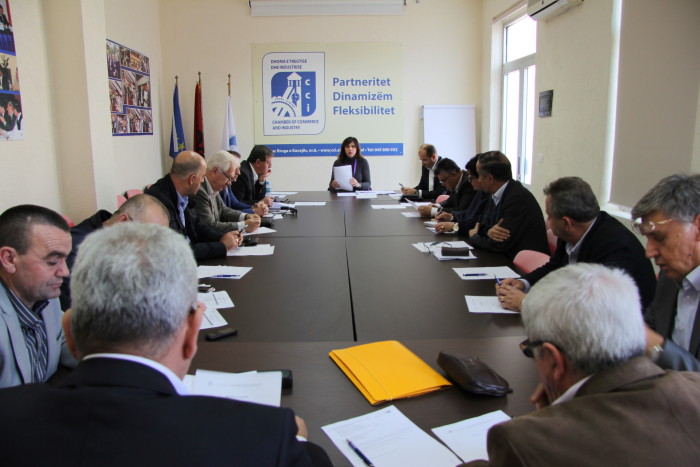
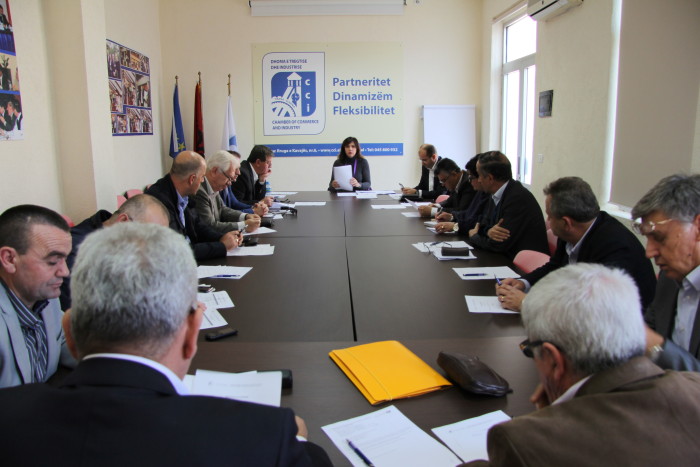
 TIRANA, Oct. 3 – Foreign and Albanian business associations have strongly opposed some newly approved legal changes that make the registration of businesses with the country’s public chambers of commerce compulsory by paying an annual membership fee as a new threat to the business environment where the high level of taxes is already the top concern.
The reaction comes after the ruling Socialist Party-led majority approved last week some controversial changes to the law on “chambers of commerce and industry” making it compulsory for all businesses to pay annual membership fees ranging from 100 lek (€0.71) to 100,000 lek (€715) based on their size starting next January. The draft law, which had been submitted to Parliament since December 2015, but whose approval in Parliament had been delayed because of strong opposition by the foreign business community, was okayed last week by 69 votes in the 140-seat Parliament.
“None of the suggestions and remarks by the business community was taken into consideration in the approved law. All businesses nationwide will face a new obligation while it is not clear yet what the benefits of the compulsory membership in regional public run chambers of commerce and industry will be,” says a joint statement by the American Chamber of Commerce, the Foreign Investors Association and the National Chamber of Garment and Footwear Producers.
“The strengthening of voluntary based organizations is an important indicator of the business development and the society’s democratization in general. And this is how regional chambers of commerce should also operate. Every favor to these chambers, without offering any special services to businesses, is an extra cost for doing business in the country and discriminates against other organizations representing this community,” they add.
The majority has ruled small businesses will pay between 100 lek (€0.71) to 100,000 lek (€715) to the public run regional chambers of commerce and industry. The membership fee for mid-sized and big businesses will be between 3,000 lek (€21.5) to 100,000 lek (€715).
Earlier this year, the American Chambers of Commerce representing some of the country’s biggest foreign investors described the legal changes as a hidden tax imposed on businesses.
“The American Chamber estimates that this obligation will increase business costs and prevent the opening of new businesses. The initiative to strengthen public chambers is being undertaken by imposing a hidden tax on businesses,” Lorenc Gjoni, the AmCham executive director said.
However, majority MPs says the law is a necessity for a real and decent representation of the country’s enterprises.
“This consolidates representation in a structure that will have its branches all over Albania and will provide an opportunity to all businesses to have a voice with no discrimination and prejudice,” Eduard Shalsi, the head of the parliamentary trade committee has said.
The draft law came after the compulsory membership of businesses in chambers of commerce was lifted in 2007 and after public chambers of commerce and the Union of Chambers of Commerce and Industry of Albania have been facing financial trouble due to low membership, risking their membership in international and regional chambers.
“The increase in income will enable the chambers and of the Union of Chambers not only to fulfill their obligations stemming from international agreements with associations such as EuroChambers and the Association of Balkan Chambers, but also conduct normal activity in offering services to meet their legal obligations toward their members,” says the bill.
Mark Crawford, the AmCham president, had described the compulsory membership in a public chamber through an annual fee as a hidden tax which increases business costs and also puts into doubt their independence.
“If a chamber depends on the state budget or a government decision to attract members this means they are not independent but rely on government decisions. How relevant is their criticism in this case?” Crawford doubted.
High taxes were the top concern for the business community in the latest AmCham Business Index which hit a four-year low in 2016.
Taxes were the second most problematic factor for doing business for 21.3 percent of respondents in Albania after corruption, according to the latest Global Competitiveness report published by the World Economic Forum, a Switzerland-based think tank.
Business associations have continuously appealed for a review downward of taxes on profit, dividend and personal income and a return to a flat tax regime of 10 percent as an incentive giving the business community more room to develop and increase registration numbers.
Since 2014, the corporate income tax and the withholding tax on dividends, rents and capital gains have increased by 5 percent to 15 percent, making the tax burden in Albania one of the region’s highest.
With less than one year to go before the next mid-2017 general elections, the Socialist Party-led Albanian government has announced a new fiscal package that significantly reduces penalties on businesses but keeps unchanged the current high tax burden, one of the major concerns for the business community, following tax hikes in the previous three years.
The Albanian economy has grown between 1 to 3 percent since 2009 compared to a pre-crisis decade of 6 percent.