TIRANA, Jan. 31 – Facing a slowdown in revenue, mainly due to Europe’s single currency trading at a 10-year low against the Albanian lek, the government has been forced to revise down its 2018 budget for a second time in six months.
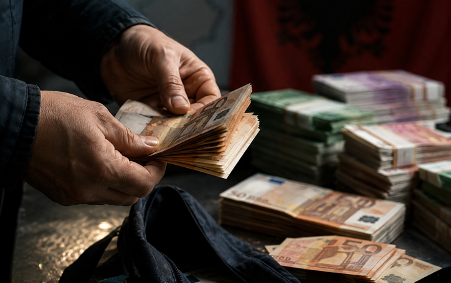
Europe’s single currency lost around 7 percent against the Albanian lek last year and currently trades at a 10-year low of 124.6 lek in a situation that has also hit government revenue through lower taxes collected from cheaper Eurozone imports among a series of negative effects on the Albanian economy, primarily on exporters, but also savers and remittance recipients in euro.
Using a fast-track procedure known as the ‘normative act’ intervention for the second time after a similar review in mid-2018, the ruling Socialists have proposed to cut both initial spending and revenue targets on the 2018 budget by 2.8 billion (€22.6 mln).
Approving the legal changes this week at the parliamentary economy committee, new Finance Minister Anila Denaj said the budget review was also intended to reallocate funds on priority public investment and serve to pay off part of the accumulated unpaid bills which a recent report by the International Monetary Fund said had increased to around €200 million by Sept. 2018, representing about 1.5 percent of the country’s GDP.
Latest finance ministry data shows budget revenue rose by an annual 4.3 percent in the first eleven months of 2018, but failed to meet targets by a considerable 2.8 percent equal to 11.4 billion lek (around €91 mln).
In its 2019 budget, the government cited the euro’s free fall effect hitting customs revenue as the main reason behind the revenue underperformance.
The finance ministry says the depreciation of both the euro and the US dollar has negatively affected customs income for all categories of imported goods, hitting revenue by 6 billion lek (€47.8 mln) for the first eight months of 2018 and expected the blow to extend to 9 billion lek (€71.7 mln) for the whole year.
On the positive side, the euro’s free fall has reduced interest rates on sizable Euro-denominated loans for both the Albanian government and businesses and households.
A hike in business closures and sluggish domestic consumption as also identified by tax administration data and poor credit growth also hit government revenue last year.
The tax administration says more than 15,000 small and medium-sized enterprises in 2018, two-thirds more compared to 2017, temporarily suspended their activity in 2018, in a sharp hike apparently fuelled by poor purchasing power and rising competition by shopping centers and supermarket chains that are gaining constant market share over traditional small businesses.
Meanwhile, credit struggled with growth rates of around 4 percent when adjusted for the euro’s free fall effect and the write-off of bad debt has spent three years in the ‘loss’ category of banks’ balance sheets.
A key barrier to credit growth and easier lending standards, non-performing loans in Albania’s banking system stood almost unchanged at around 13 percent in 2018, following sharp declines in previous years after hitting a record 25 percent in mid-2014.
The new budget review kept unchanged the initial budget deficit at 32.3 billion lek (€258 mln), equal to 1.6 percent of the country’s GDP in a bid to continue the debt reduction agenda with a target of bringing it down to a more affordable 60 percent of the GDP by 2021.
The finance ministry says public debt dropped to 67.2 percent of the GDP in 2018, down 3 percentage points compared to 2017, in an estimate that does not include government arrears of 1.5 percent of the GDP and potential liabilities resulting from the rising use of controversial public private partnership to carry out public investment in the road, health, education and waste management sectors.
Back in mid-2018, the ruling Socialists also revised the budget through a fast track ‘normative act’ intervention.
The normative act, which has the force of law for temporary measures and must be approved by Parliament within 45 days to turn into law, has been commonly used by incumbent Albanian governments to speed up procedures for emergency interventions to the state budget, especially mid-year and year-end cuts due to revenue underperformance.
The ruling Socialists expect the country’s economy to recover to 4.3 percent and public debt to drop to 65.5 percent of the GDP for 2019 in more optimistic forecasts compared to key international financial institutions such as the and the World Bank and the IMF, which expect growth to slow down on lower foreign investment following the completion of TAP and the Devoll Hydropower projects that led FDI growth for the past four years.
Albania will be holding local elections on June 30 in a pre-electoral period that traditionally produces political tension, negatively affects government revenue because of soaring spending ahead of the elections and potentially has a negative effect on the peak tourism season unless everything goes smooth.
Albania also expects a long-awaited okay to the launch of its EU accession talks which experts say could have a positive impact on the Albanian economy, boosting investor confidence and helping the country continue rule of law and economy reforms.