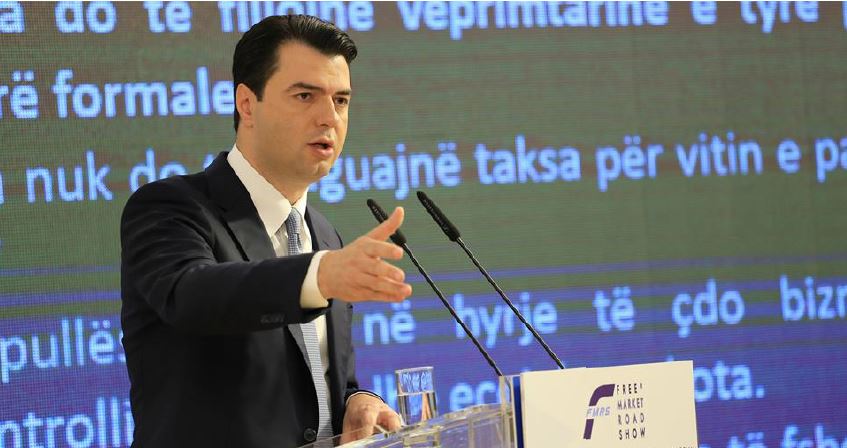
 TIRANA, April 7 – Opposition leader Lulzim Basha has unveiled the Democratic Party’s economic platform which he says will help create jobs and boost the country’s ailing economy.
The opposition leader introduced what he called four pillars related to well-governance and rule of law, public investments, human capital and the improvement of the business climate.
“In order for the economy to grow, first of all well-governance and rule of law is needed. The second pillar is related to public investments which have become an exotic phenomenon in Albania and the third pillar is the strengthening of human capital by creating more jobs,” said Basha at a forum organized by the Tirana-based Foundation for Economic Freedom.
“The fourth pillar is related to the business climate and the increase of competitiveness through a taxation system which promotes but does not punish businesses,” added Basha, promising a one-year tax-free period for newly created businesses.
The Democratic Party leader also expressed concern over massive Albanian asylum-seekers.
“It is a fact that Albanians are today much poorer and that hundreds of thousands of Albanians are leaving the country for Europe and undertaking steps to go to the United States,” added Basha.
The main opposition party’s economic platform comes more than one year ahead of the next June 2017 general elections.
The opposition Democrats who take to the next June 2017 general elections after two consecutive heavy defeats in the 2013 general elections and 2015 locals have proposed a shift back to the flat tax regime this time at 9 percent, lower than the 10 percent rate applied when it was in power until 2013.
The tax cuts will improve the business climate and fight corruption and informality in the tax and customs administrations, say the Democratic Party.
The key changes include the introduction of a 9 percent flat tax on personal income and corporate income taxes, compared to current progressive taxation, and the reduction of the key value added to 15 percent, down from 20 percent currently.
The Democrats’ fiscal platform also includes the lift of what they call several hidden taxes on fuel and environment and the easier procedures.
Arber Kadia, the head of the Foundation for Economic Freedom and a political coordinator for the opposition Democrats, says the increase in taxes and increased statism have also affected the country’s present economic situation.
“Albania lost places in economic freedom rankings measured by the Heritage Foundation in the past few years, it also lost 35 places in doing business. These indicators are undoubtedly concerning and are a result of an increase in taxes and the strong etatist spirit by this government,” Kadia has said.
Back in the 2013 general elections, the then-opposition Socialists also focused their electoral campaign on promises of lower taxes and fighting corruption. However, almost three years on, they have failed to deliver on several key promises and some of the key taxes such as the corporate income and the withholding tax on dividends rents and capital gains have increased by 5 percent to 15 percent.