TIRANA, March 29 – Medium-sized and big businesses operating in Tirana have complained they are being charged a new local tax on education infrastructure for each of their units which is significantly increasing their operational costs.
Starting this year, the Municipality of Tirana has introduced a new tax on education infrastructure in a bid to reconstruct existing pre-school and school facilities and build new ones. The ‘temporary’ tax which will be in force for seven years ranges from an annual 1,800 lek (€12.7) for Tirana households to 4,000 lek (€28.4) and 37,000 lek (€263) for businesses depending on their size.
Local media have unveiled bills of businesses being charged for all their Tirana units operating under the so-called secondary tax identification numbers as subsidiaries of the parent companies.
In one case, a business was charged an annual 81,000 lek (€575) for its three units at 27,000 lek (€192) each.
Nikollaq Neranxi, the head of Association for the Protection of Traders and the Market describes the new tax as absurd and unconstitutional.
“The education tax is an unconstitutional tax because under the constitution public education is offered free of charge. Now it has to be paid several times by every shop run by a business which has several secondary tax ID numbers but operates as a single company,” says Neranxi, a businessman and former MP.
The Association is challenging a series of decisions taken by the Tirana municipal council in late December which increased local taxes and tariffs by several times.
The Tirana Municipality plans to collect about 650 million lek (€4.6 million) from the education infrastructure tax this year. The tax ranges from 4,000 to 9,000 lek (€28 to €64) a year for small businesses to 11,000 to 27,000 lek (€78 to €192) for big businesses and 18,000 to 37,000 (€128 to €263) for VIP businesses.
The new bigger Tirana municipality following the 2015 administrative reform has some 750,000 residents and some 40,000 businesses.
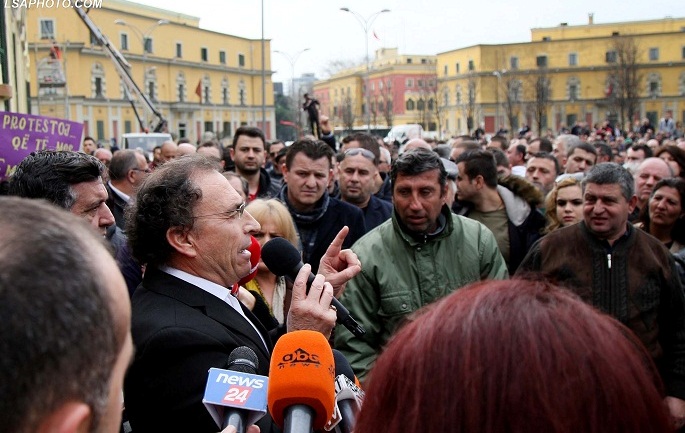
Small business owners staged protests last February demanding a review of the taxes on occupation of public space, buildings, advertising, education infrastructure and cleaning which have increased by 2 to 10-fold starting this year. The Tirana Municipality reacted by revising only the tax on occupation of public space and lifting, but leaving in force all other taxes which the association has appealed with the Tirana Administrative Court.
In early March 2016, Albania’s Constitutional Court turned down a heavy fines law increasing fines on tax evasion by up to 50-fold as running counter to constitutional principles. The new legal changes envisaged fines of 500,000 lek (€3,529) to 10 million lek (€71,000) on informality in apparent “disproportionate” penalties to income and offences committed.
The Traders Association has also challenged as unconstitutional some legal changes replacing fines with prison time over tax evasion which is being examined by the Constitutional Court.