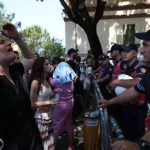
TIRANA, Dec. 7 – Public university students have resumed protesting to have their economic and academic demands met, thus marking a full-month’s boycott of university halls.
Although their numbers have significantly dropped in comparison to December, when thousands were railing in front of the education ministry, a number of protests still gathered in front of the Prime Minister’s Office on Tuesday, despite the freezing cold that has enveloped the capital.
Ever since the beginning of December, university students have been seeking lowered university fees, an increase in the education budget and higher student participation in universities’ decision-making process, all part of an extended list of eight demands.
During its last Socialist Party assembly, Prime Minister Edi Rama, claiming to respond directly to student requests, announced a series of decisions and law amendments supposed to meet their demands during its last meeting, but students claim none of the changes fulfill what they seek.
In this context, the governing SP shared publicly the 11 decisions taken, mainly focused on rewarding high-performance students and those facing economic difficulties, who will benefit from free education and monthly scholarships. Master program students with high performance will receive tariffs decreased by 50 percent.
Other students will receive state funding of fifty percent of the registration fee, provided that during the studies they maintain an average grade of over 6.
Master’s fees will be additionally paid 50 percent by the government for high-grade students, and those from families in economic aid, the blind, paraplegic and tetraplegic students, orphans, and children of killed policemen.
Other decisions provide for different benefits in student and university life, as well as budget transparency and academic transparency with regard to professors.
Rama said in December, when the university students’ protests just broke out, that taxpayers’ money should not be covering “failing students university fees,” while an official public university payment statement that recently resurfaced online showed students are still being charged full fees, despite Rama’s claims that the amendments come into power immediately.
However, students resumed the protests, because, as they say, their demands are nothing but universal human rights for education and not a system of rewards for the best, as the government is making it be. University students seek for tariffs to be lowered equally for all.
In this context, the students that are no longer supporting the protest on the streets have been reported to not be attending the classes since they resumed after the holidays while students from district universities, who were also supporting capital students in December, have mostly returned to auditoriums.