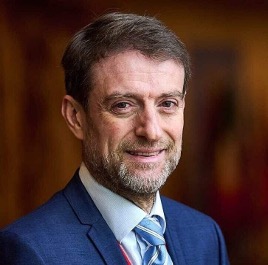
By: James Pettifer
When I started writing my ‘Blue Guide to Albania twenty years ago, communism was disintegrating, and there were many real problems. Many people did not have enough to eat, the shops were more or less empty and there was little or no transport on the roads. People wandered into Greece with little more than the clothes they wore. My book which quickly became the authoritative guide for foreigners to Albania was in the first edition a book about a country with a very rich past but a poor present.
But the landscapes and buildings were wonderful and there was nowhere better than Butrint and the surrounding region. I tried to celebrate them as well as I could in those early days. The beautiful unspoilt seascape looking across to Corfu from Saranda was famous. Saranda itself was a pleasant quiet little town with very helpful shopkeepers and other local people. Even though most people were very poor they were very proud of being Albanian and had a good working knowledge of the history as the communist teachers understood it.
Although resources were very limited, some archaeology was underway and to visit Butrint was always a wonderful experience, a true ‘classical landscape with ruins’ as I wrote in my first edition. There was a pristine purity in the landscape with little or no litter, either inside or outside the archaeological site and no piles of rubbish by roadsides in blue plastic bags. There was even a steady flow of tourists, perhaps 30,000 in the last year of communism and most of them made a visit to Butrint or Apollonia.
Up the road, Ksamili once was a small and tidy little village with a few cafes by the sea and rows of tidy houses stretching down towards the main Saranda-Butrint main road, and the sea was clear and clean and blue. Now it is all very different. It is hell of new but unfinished roads, chaotic building, pools of filthy smelly water left from building works that are a health hazard and no plan for the town ( as it now is) at all. While the basic site of Butrint is very well developed, almost everywhere else is under some kind of threat from illegal and arbitrary development; a lack of basic respect for the natural environment is everywhere. Trees seem to be the enemy of the people of Ksamil.
Ksamili has become a vast and ugly building site and almost everywhere there is dumped rubbish, many rats and environmental destruction. There is a wide road being driven down from Saranda to Butrint that is quite unnecessary – a minor enlargement would be quite sufficient for the usual volume of traffic- and vehicles. When I was in Saranda with my fellow author and Albanologist Miranda Vickers we asked local people what they thought about it all. Most people were quietly angry and dismissive about the environmental crisis but seemed to see it as somehow inevitable, as part of tourism
It is not. Tourism needs planning and regulation, just as all markets do in a modern economy. It is not as though nothing is known on the subject. Several years ago we met American Peace Corps experts who had produced an excellent long-term plan for the town, with a big tree planting programme and all kinds of good ideas. A small group of people have seized control of Saranda and regional development and many of them are not even Albanian. They are interested in quick profits only, but not in the Albanian national cultural heritage. There have been some terrible losses in the recent period. The quarry that mined the stone for ancient Butrint has been destroyed in this process, for instance
Countless trees have been cut down, including productive olive trees, and it is hard to see a single tree or shrub planted in their place. Clouds of dust fill the air in the summer and inches of mud in the winter. Foreign tourism of a modern kind based on environmental sustainability will never flourish in this kind of environment. The bosses of Saranda and the Butrint area are making the same mistakes as were made in southern Spain in the 1960’s and 1970’s. As A Dutch couple from Rotterdam told us who had planned to come to Albania for a week but were returning after only three days, ‘We did not come all this way to have our holiday on an out of control building site’.
Almost everywhere in the world tourism has been understood to be capable of destroying a local economy but this realisation does not seem to have reached southern Albania yet. The proverb of killing the goose that lays the golden eggs comes to mind. If you have a major world class archaeological site like Butrint it needs a top class regional plan to protect it. The declaration of the National Park area ten years ago was a good start but now even the National Park land is threatened by illegal development.
Saranda itself is another major cause for concern. Illegal and semi-legal development is spreading up the hillsides behind the town. Many buildings are not built of a standard to survive earthquakes or natural disasters.There is no proper water supply in many places. If you drive north from Saranda towards Nivica on the road tourists must use if they are going to Himara or Vlora there is hundreds and hundreds of meters deep rubbish and building rubble dumped material, as if there had been a war and a community was rebuilding in haste. A huge concrete structure has destroyed the old bus station, and the buses have to operate in chaos, blocking the roads.
In the background on some issues is the sinister hand of the Vorio Epirus lobby in Greece. Greek money is a cancerous tumor in Saranda. The vast and wholly pointless new road running up the St Paul river valley towards Saranda has no conceivable normal economic purpose, like the semi-motorway running north from Konispol. They are roads built by Greek contractors, for Greek interests, no doubt with the deal over the sea bed in mind that thankfully has been defeated in the Albanian courts. It is useful to have some new roads of course but these are not normal highways. They have Greek nationalist ambitions written all over them, and it is no coincidence they are being built on a massive scale, to take Greek army heavy armored vehicles in the event of an emergency in the future in that area. There is no sign at all of what is actually needed, small scale new roads to help people live better in the villages and keep society functioning there but of course the Greek hand in the EU prevents money being released for that.
But if things are bad on the land, what about the sea? Here the problems are if anything worse. Communism did not pollute the sea much as say Ksamili because only a few people visited there and even fewer lived there all the year round. Now only a small part of the beach is fairly clean (although it is difficult to be sure of that) because of dirty water coming from illegal new housing developments. Elsewhere you only have to walk near, say, large parts of Saranda harbour and you smell untreated sewage which is a major health risk, particularly for children. Why on earth is this allowed by the municipality? This is not just a local matter- without infrastructure, nobody will come if they think they may be ill as a result of swimming in the sea and the whole economy will suffer
It does not have to be like this. Ten or fifteen years ago the beach at Shengjin – then a very poor place – was dirty and unusable. Now it is quite reasonable and improving gradually. Some parts of Durres beach are better than they used to be although there is a long way to go to meet EU standards.
What can we do? I have stopped work on the new edition of my book as I do not believe it is responsible to encourage foreigners to visit against this background. My ‘Blue Guide’ has brought many visitors and much interest in Albanian tourism but those days are over. And perhaps we need a national competition? For the first government minister to have a swim in Saranda harbour?