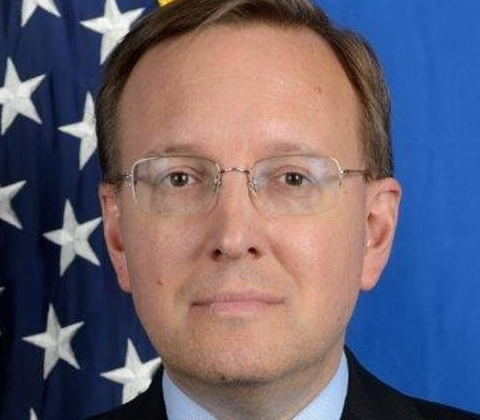
Ellen Goldstein, the World Bank country director for Southeast Europe, says Albania’s challenges to guarantee long-term growth include restoring macroeconomic and fiscal stability, creating an attractive investment environment and improving the quality of public services
TIRANA, April 20 – With the Albanian economy struggling at growth rates of 1 to 2 percent in the past three years, the World Bank says improving the investment climate and reforms in the energy and property rights areas are key to the country’s new growth agenda and its transition from a consumption and remittances-based model to a model oriented toward investments and exports.
Speaking in an interview with VoA in the local Albanian service, Ellen Goldstein, the World Bank country director for Southeast Europe, says Albania’s challenges to guarantee long-term growth include restoring macroeconomic and fiscal stability, creating an attractive investment environment and improving the quality of public services.
“In order to shift from an economic model based on consumption and remittances to a growth agenda oriented more toward investments and exports, Albania needs to carry out reforms in the investment climate, in sectors such as energy, land and property rights as well as bureaucracy in the business development environment and improve the qualification of the labor force including youth and women,” said Goldstein.
The senior World Bank official says she is optimistic about Albania’s economic growth prospects considering the country’s huge natural and human resources despite obstacles such as public debt at 70 percent of the GDP and non-performing loans at around a quarter.
“In the long run, I am very optimistic about Albania as it has many natural and human resources and neighbors the EU, the world’s most powerful economic group.”
“Albania has a potential to develop tourism, it has hydroelectricity resources which it can export to neighboring countries and of course human capital is Albania’s greatest resources as has been proven by successful migration,” she said.
In its latest South East Europe Regular Economic Report issued in early 2015, the World Bank expects the Albanian economy to accelerate from 2.1 percent in 2014 to 3 percent in 2015 and 4 percent in 2016.
In its 2013-2017 program, the Socialist Party-led government recognizes the limitations of the development model based on a remittances-fuelled construction boom and raw material exports, and aims to shift the focus to new sources of growth by identifying manufacturing, energy, tourism and agribusiness as priority areas.
Remittances are estimated to have declined to 6 percent of the GDP at the end of 2014 compared to around 12 percent of the GDP just before the onset of the global financial crisis in 2008. Meanwhile, the long-ailing construction sector, once a key driver of the economy, has seen its GDP share drop from 18 percent in 2008 to 12 percent in 2014.
With the attraction of foreign direct investment high on government’s agenda, Albania has recently launched an Investment Council serving as a linking bridge between the business community and the government and a catalyst helping to create the right business environment for investments. The launch of the Investment Council comes at a time when government has undertaken legal action, offering simplified procedures for investments in strategic sectors.
Foreign investors will be offered simplified and accelerated procedures in the next three years for strategic investments in energy, mining, transport, telecommunication, infrastructure, urban waste, tourism, agriculture and fishing and special economic zones, according to a draft law government has submitted to Parliament.
Strategic investors in Albania’s tourism sector will also be offered state-owned property for a symbolic 1 Euro under 99-year concession contracts to develop tourist resorts.