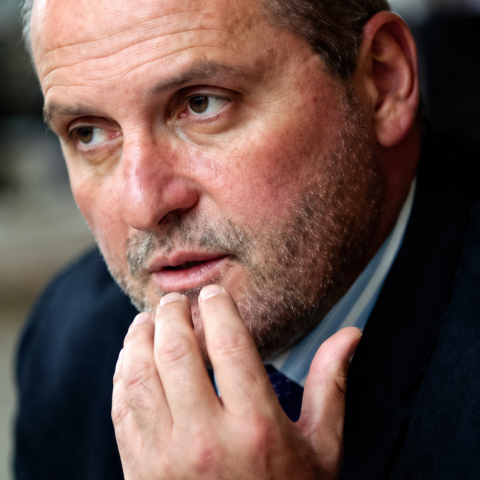
Last week, the efforts of the OSCE Presence in Albania to mediate between the government and the opposition for electoral reform ran into strong opposition by some of the main players of the opposition camp. While the majority supported the efforts of the OSCE, some opposition leaders questioned even the need for the Presence in Tirana. To talk about these issues and the role of the OSCE in the future, Tirana Times talked to Ambassador Pavel Vacek.
TT: Mr. Vacek, the OSCE Presence in Albania has been a constant actor in the Albanian public scene for years. Could you give us a resume of the main concerns of the Presence throughout the years and if they have evolved in any way?
The situation in Albania has evolved over the years and so have the mandate and work of the Presence. Thanks to the overall progress made since 1998, security in the country is much less of an issue for us. Under the reduced mandate of 2003, we have focused more on good governance and capacity-building of institutions in the niches where we are able to contribute. We have also tried to channel more financial and material resources through our projects. On this, we have gone from tens of thousands Euro in early 2000s to the order of millions per year now thanks to the support from willing donors. Of course, we keep pursuing the principal elements of the mandate: human rights, rule of law, legislative and other sectoral reforms, border police support and the list goes on. However, in my two years here, I have looked for the Presence to take a lesser role in political mediation, especially in the area of electoral reform. However, the need does not seem to recede, contrary to what I would hope.
TT: The Presence started working at a time when the levels of confidence between different political groups in Albania were very low. In the meantime, it has tried hard to reestablish trust and communication between the different political parties. Do you think that it has been successful in this regard? More generally, are Albanian politicians more capable of consensus on questions of basic national interest than they were ten or fifteen years ago?
I cannot make such direct comparison first-hand Šand it would not be appropriate. The difficulty remains how to translate the consensus on a few key, strategic issues, which Albania seems to have, into a more constructive relationship between the Majority and the Opposition in dealing with operational issues of governance. How to overcome the tendency to turn every other legislative or governance issue into a casus belli, and a cause for obstruction, boycott or even street protests. This, of course, requires that rational arguments of the Opposition are listened to and reflected – and not ignored by the Majority. When such process is exhausted, the difference of political programmes usually lead up to a vote and then decisions taken by the majority have to be respected by the minority. It is not the end of the world but it’s the end of the particular debate on a particular decision. Simply because the voters so decided in the last elections and that should hold until the next elections. This may all sound like a lot of ‘textbook wisdom’ from me, but to achieve such state of mind and affairs is perhaps the most strategic issue Albania faces.
TT: There seem to be different expectations on the role OSCE should play in Albanian politics. Some see it as an arbitrator, others simply as a discreet backdoor facilitator, while others still want a more active role for the OSCE to put forward concrete proposals for breaking logjams. Could you please clarify the mandate of the OSCE during the various ‘political crises’ that revisit the Albanian political scene?
We are mandated to assist with several key reforms and this has historically involved facilitation of political processes. I have looked to reduce the Presence’s involvement in such facilitation and sincerely hoped that the agreements on the electoral reform and the zones of 2004/early 2005 would be the last. Therefore, the need for the agreement of 30 August itself was a failure of the political class. However, I hope there is still a chance to remedy the failure to deliver on that Agreement.
TT: Lately, there have been loud criticisms mainly by opposition politicians of the OSCE for its position on electoral reform. What was OSCE’s position and what is your answer to such criticism?
We do not take public positions in the domestic political debate over electoral reform Ưr on any other issue for that matter. We simply follow the set of general recommendations made by international observation missions and sometimes offer more specific legislative and technical advice. That advice is very often based not only on the proverbial standards, on practices and yes even common sense. This is a sovereign country and so our Albanian partners are of course free not to accept our advice. I can always live with that. Let us just hope that on such occasions the politicians’ decisions are informed and considered in political and technical terms, with the full knowledge of consequences, both domestically and internationally.
What I have a difficulty with is when slogans replace facts, pretexts replace issues and where the messengers are attacked while the message is ignored. The question is what have all the political class concretely achieved for the reform to take place? Issues also change in time. For example, if you had had a thorough and lengthy debate over the number of election commission members one year ahead of the actual elections then of course you could have looked to go from 35.000 to 50 or 60,000 in election administration – that would be the effect of going for 11-member commissions. Whether this is actually achievable with just two months before the legal date for local elections is another question – especially when we know that the CEC was already concerned about such added load last spring. When we raise such issues we mean to provide input into a rational debate that should take place between domestic political actors and less so with the international community. And the insults …? They are not worth responding to.
TT: In your opinion, is Albania on track for the upcoming local elections in terms of electoral code reform and election infrastructure?
Albania is definitely not on the right track for better municipal elections. The reform, at least the reform relevant for the municipal elections which should have taken place, has not been agreed and the technical preparations are delayed due to political and legislative manoeuvring. And, of course, the weather which you usually have within the legal window for the municipal elections will not make it any easier to conduct smoothly all election routines, at least in some parts of the country. However, this last problem has been well known to all. Was it not already well known during the last reform? Hasn’t there been enough time for debating and agreeing on all key issues since September 2005?
TT: What is your vision for the OSCE Presence in Albania after the elections?
I can hope the elections will be considerably better than those in the past but the chances of that happening are reduced with each and every day which passes without the reform debate concluded and technical preparations done. Otherwise, we have our standard plans prepared for the 2007, including the budget, consulted with the government being discussed in Vienna and we will follow those. There is always life after electionsō
TT: Anything else?
So how about this one: “You dont need a weatherman to know which way the wind blows… “(Bob Dylan said that… I guess in the first song on his first “electric” album of 1965,…)
_________________________________________________
Curriculum Vitae – Ambassador Pavel Vacek
Born in August 1962 in the Czech Republic, Ambassador Vacek was appointed Head of the OSCE Presence in Albania as of 6 October 2004. During his career, he has served in a variety of international positions related to security and co-operation in the OSCE region.
At the Prague School of Economics, Mr. Vacek studied foreign trade and joined the Czechoslovak Foreign Service upon graduation. From 1989 to 1990, he was a member of the Czechoslovak delegation to the confidence- and security-building measures (CSBMs) and the Conventional Armed Forces in Europe (CFE) talks in Vienna. Subsequently, he served as Assistant to the Deputy Minister of Foreign Affairs.
In 1993, he became Director of the Security Policy Department of the Czech Ministry of Foreign Affairs and then Head of the Czech Delegation to the CSCE Committee of Senior Officials. He also represented the Czech Republic in the talks on the EU/OSCE Pact on stability.
Ambassador Vacek moved to Brussels in 1995, where he became Deputy Head of the Czech Embassy. In 1997, he was appointed Head of the Mission of the Czech Republic to NATO and to the Western European Union. He returned to Prague as Director General for Integration and then Director General for Multilateral Affairs at the Czech Ministry of Foreign Affairs.
In 1999, he was appointed Head of the Permanent Mission of the Czech Republic to the UN, the OSCE and other international organizations in Vienna. He has chaired several groups, including the OSCE Forum for Security Co-operation and the UN Commissions on Crime Prevention and Criminal Justice, and on Narcotic Drugs.
Ambassador Vacek is fluent in English, French and Russian.