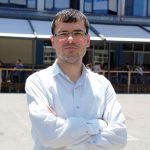
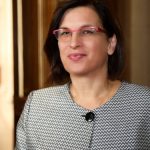
As I seek the hall of the hotel where the meeting for the interview is arranged, a young man smiles to me and starts to greet me in perfectly smooth Albanian. Many foreigners stay in Albania for more than two years yet so few of them succeed with the language. In this respect Mieczyslaw Boduszynski should really feel proud of himself. After giving him the proms for the excellent soft accent, I went on to ask him about his experience in making Tirana a friendly hub for himself. Following are some highlights:
First impressions
Asked whether Albania fits any of the theoretical models that he reviewed while writing his Ph.D. dissertation on democratic transition in the Balkans, he is reluctant to draw a conclusion but notes that his time as a diplomat has taught him that personalities, or what political scientists call “agency,” matter as much as historical and structural factors in shaping post-communist transitions.
When he first learned he was to be posted to Tirana, Mr. Boduszynski was happy because Albania was then the only country in the Balkans he had never been to. He did not know what to expect. “In the US there is lack of information about Albania. If the country has an image problem in Western Europe, in America it does not have an image,” he notes. But that too is changing rapidly. In the past two years he has seen Americans coming in and out more frequently and contact between the two countries growing steadily. His job, as well as the aim of many activities coordinated by the Public Affairs Section, where he worked during his tour in Tirana, has been in part to facilitate such contacts.
Friends
Mietek’s (as Mr. Boduszynski is called by friends and colleagues) goodbye bash at one of the city’s trendiest clubs was important in many ways. But the most significant fact was that he could finally gather all the people he had the chance to work with, all the ones who became some of his closest friends in these two years. Many of these people come from academia, civil society, media and cultural fields. “I am proud of the many contacts I made in these fields,” he comments on the relationships he built here. As the Assistant Public Affairs Officer (and most recently as Acting Public Affairs Officer) he had the unique opportunity to meet the people who are shaping the Albanian transition.
Work and accomplishments
Indeed, the work record of Mr. Boduszynski has a very special item: his work with the Student Governments at the University of Tirana and other universities. Now, the student governments are part of the legal framework regulating higher education in Albania and aim at revitalizing the system and making it more responsive to the articulation of the student needs. To support the development of student governments in Albania, the Public Affairs Office brought an American trainer to Albania and helped support the student government telections. Mietek explains that student organizations are an important part of civil society, which, recalling Tocqueville, is an impressive mass of all sorts of independent associations, not just NGOs.
Mietek’s tour also included three months spent in Kosovo, during the charged time surrounding the presentation of the Ahtisaari plan. His Albanian and Serbian language skills were highly needed in that context. “Kosovo has its own identity, as it has been through different experiences from Albania,” he observes.
Albania-fresh perspectives
“I have discovered Albania through the eyes of my guests, from their enthusiasm, from their reactions. They bring a new appreciation of the beauty of the country, of the people’s kindness,” Mietek says. Apparently he had many guests while living here and one of the most recent was his mother. “We went to Dhermi and Berat and saw some wonderful things.”
Asked about the visit of an illustrious guest, President Bush, Mieczyslaw calls it “the most incredible logistical operation” he has ever witnessed. His duty that day was to assist the journalists based at the airport. He recalls being touched by the images from Fushe-kruja. “America continues to have a powerful symbolism for Albania, and there is no need to be cynical about that,” he concludes.
Lost in translation or NOT?
Next destination: the largest city in the world, Tokyo, the economic and consular sections at the American embassy, a new experience. Nevertheless, Japan is not so foreign to him. Ten years ago he was an English teacher on an exchange program there and was amazed by the education system. “Japanese society is very different, hence very challenging,” he says while explaining how much more emphasis is placed on teamwork in Japan while in the West individualism is still the keyword.
What will you miss from Albania?
The question is far from easy. “It will be easier to be anonymous in Tokyo!” he laughs. Indeed Tirana may be the largest Albanian city but it is still comfortably small enough to find friends in bars.
The list then grows: “long conversations over macchiato during warm evenings, the beach in Dhermi, the mountains, the warmth of the people.”
The first things he observed here were the people. Their enthusiasm, their entrepreneurship, their optimism despite what they had been through. This image will fly safely with him, now to Tokyo and later on to wherever the Foreign Service takes him.