By Jose Ignacio Torreblanca
I have just come back from Albania where I found the people wonderful, but also rather unfortunate. If you ever want to check this for yourself, all you have to do is stand in the centre of Tirana. Looking to one side, the massive North Korean styled congress centre dominated by an enormous mural depicting the people in arms looms into view; looking to the other, typical Italian fascist neo-classical design meets the eye, legacy of the occupation by Mussolini’s troops. Turning round, you can see a small mosque, one of the few which survived the crazed regime of Enver Hoxha, who declared atheism the State religion, imposed a reign of terror on the country and destroyed a large part of its cultural heritage. This all makes for interesting pastiche, certainly, but it is problematic too from a historical perspective.
Despite five centuries of occupation, the Ottoman Empire failed to leave so much as a single University behind, and Hoxha’s dictatorship bequeathed the people half a million bunkers and a shattered civil society. The country’s international image is still weighed down by the film “Lamerica”, which portrayed the devastation brought about by the collapse of the banking system in 1997. At the time, people thought a Ponzi scheme of such proportions could only take place in a closed and backward society, but thanks to Bernard Madoff, the Albanians can rest easy, and even allow themselves a smile.
And one thing Albanians certainly do is smile. Mediterranean as they are, Albanians look back on the past with a sense of humour; the bunkers have given rise to a buoyant souvenir industry with a popular line in ashtrays, and in the pyramid shaped mausoleum which Hoxha built, a restaurant called “The Mummy” has been opened. The Mayor of Tirana, weary of the dilapidated state of the city’s buildings, encouraged people to paint their homes in eye catching colours, something which has become a tradition. Tirana has spruced itself up, and it is now a big, bustling city set against the backdrop of stunning, snow capped mountains.
During my trip I had the chance to talk to members of the government and opposition, exchange impressions with leading staff from research centres, and chat with journalists from the local media. All of them impressed me with their intelligence and the clarity of their vision of the future, especially Rexhep Meidani, President of the country from 1997 to 2002. The message I received from the people I spoke to was unanimous; it’s time to leave the past behind, to break with the image of the Balkans as a place of hatred, war, destruction, crime and corruption, and to turns our minds to the Balkans of the future.
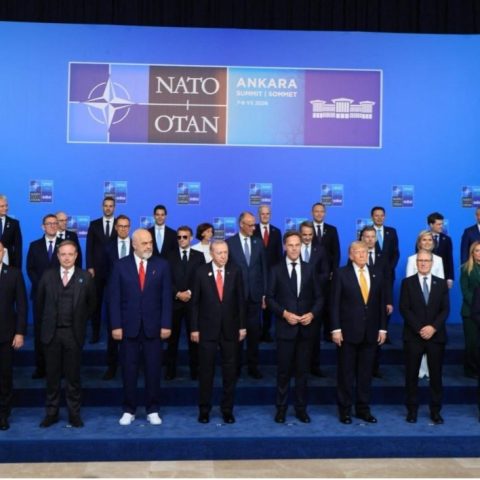
And there precisely lies the key – in a European future. Albania will become a full member of NATO this April and the Stabilisation and Association agreement which governs relations with the EU is about to come into force, which will immediately allow the government to request official recognition as an accession candidate. Albania is afraid it might be left straggling by the pack in the race to join the EU; Macedonia already has official candidate status and it appears that Montenegro and Serbia will present their candidacies as well before too long (possibly during the Spanish presidency). There is a lot still to be done before accession is secured, but Albania is on the right road. The forthcoming parliamentary elections to be held in May will be a test of its maturity, though work is still to be done on some things as obvious as the electoral roll, and the political class remains too caught up in the fight for power, diverting energy from some highly important reforms which are still outstanding.
Naturally, Spain’s success arouses a good deal of admiration in Albania. Our country has an especially strong presence in Albanian cultural and political life thanks to a very active Embassy and a technical cooperation office with numerous projects underway, including the training of Albanian civil servants and the modernization of the civil service. This makes up for some of the misgivings felt in Tirana by the Spanish government’s decision to align itself with Serbia, something Albania has never quite managed to comprehend; at the end of the day, they argue, Albania has contributed a great deal more to regional stability. The tragedy of Kosovo, when Milosevic’s regime drove more than seven hundred thousand Kosovars to the Albanian border after years of torture and killings, is still very much fresh in the memory. At the time, it became fashionable to accuse Tirana of promoting a “Greater Albania” – to include the Albanians of Macedonia and Kosovo – but the allegation has proved to be a complete myth.
Back home, a strange feeling overcomes me that there are two kinds of European in the continent today; those who have Europe (and don’t want it), and those who want it (and don’t have it).
jitorreblanca@ecfr.eu
Jos顉gnacio Torreblanca joined the European Council on Foreign Relations as a Senior Research Fellow and Head of the Madrid Office in September 2007. Previously he spent three years at the Madrid’s based Elcano Royal Institute for International Affairs as Senior Analyst for EU affairs. He has a doctorate in Political Science and Sociology from the Universidad Complutense de Madrid and teaches political science and EU affairs at the distance learning University in Madrid (UNED). He is also Fellow at the Juan March Institute of Studies in Madrid. He has been Fulbright scholar in the European Union-US Program, Lecturer at the George Washington University in Washington DC and a researcher at the European University Institute in Florence. He is also a member of the editorial board of the journal Foreign Policy en espa