By Eduard Zaloshnja
Like every opposition party in parliamentary democracies, opposition parties in Albania are more than interested in early elections, while the majority parties are not. Given the acute political crisis where the opposition’s hunger strike has plunged Albania since April 30, early elections seem to be the only way out of it. But the opposition parties may end up being not very happy with the early elections and the majority parties not very unhappy. Here is why.
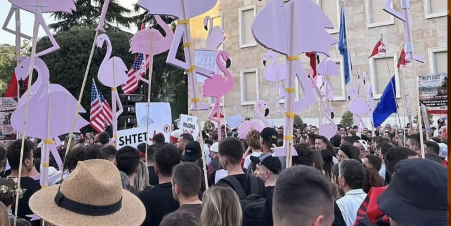
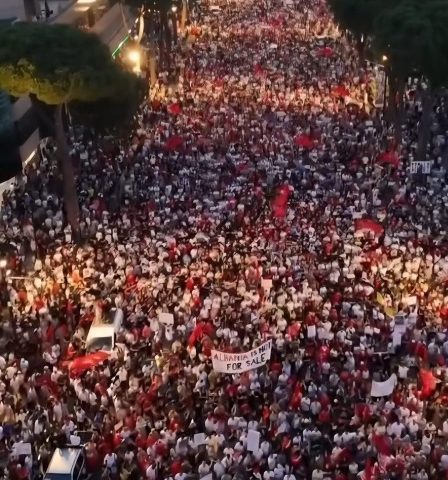
From the day the official results of the June 28, 2009 elections were announced, Edi Rama, the leader of the opposition, has vehemently requested a partial recount of ballot boxes. According to him, the recount and a thorough inspection of the documents in the boxes would bring to light a gigantic manipulation of election results. Mr. Rama demands the recount in the name of the foundations of democracy – free and fair elections. On the other side, Sali Berisha, the Prime Minister, has insistently opposed the recount, arguing that the courts have already spoken on the matter and their decisions should be respected.
Trying not to be cynic, let’s suppose that both leaders are sincere in their defense of the above arguments. Thus, let’s suppose that Mr. Rama is worried only about the fate of democracy in Albania and not about the legitimacy of his own political post, while Mr. Berisha is worried only about the judiciary independence and not about the legitimacy of his government. However, no matter how non-political the motives of these leaders might have been at the beginning of the fight, now it has clearly become a political fight.
If one of the two leaders capitulates, his political capital would certainly deteriorate. A full withdrawal from a position insistently defended for a long time would be interpreted as weakness by the electorate – especially in a country with a macho mentality like Albania . For this reason, it’s highly improbable to see a full retreat of one the roosters in this fight.
However, the health of the hunger strikers will significantly deteriorate one day or, God forbid, a violent incident could happen. At that moment, the pressure to find a solution would become unbearable – especially the pressure of Albania ‘s international partners. The first signal of the pressure to come was given at the Joint Albanian-European Parliamentary Commission meeting on Tuesday.
It is hard to think that a country which is a NATO member and an applicant for EU accession would be allowed by these two powerful organizations to have the parliamentarians of the biggest political party dying in front of the Prime Minister’s Office because of unfulfilled requests that have to do with the transparency of elections.
Eventually, the full political weight of NATO and EU will be raining down on the Albanian leaders and, as a result, a solution to the current crisis will be found despite the expected resistance from the locals. Given the way the solution would be reached, it’s a sure bet to predict that it would be a middle-of-the-road solution.
In an ideal world for Mr. Rama, a solution fully satisfactory to him would be the creation of a caretaker government that would oversee the transparency of the previous elections and the preparation of early parliamentary elections to be held at the same time with the scheduled local elections. On the other side, Mr Berisha would like to have only local elections and a limited transparency of previous elections (i.e., excluding the opening of ballot boxes). These desires, unfortunately, are almost mutually exclusive.
One middle point where the two sides can meet each other is a call for early parliamentary election to be held the same day with local elections, but without opening the ballot boxes from previous elections. Meanwhile, the opposition parties would have the majority in the parliamentary commission that would put in place automatic legal mechanisms that would guaranty the transparency of future elections.
But would this solution be politically favorable to one or the other side? The answer to this question depends very much on the timing of EU visa liberalization for Albania and the economic developments in the country and around it.
Let’s start the analysis with the economy of Albania ‘s neighbors. The Greek economy is on the brink of the abyss because of a precipitous decrease in public and private investments. Even after the massive help from IMF and EU to the Greek government, it is clear that it will take a long time for the Greek economy to regain the status of 2008 – a full 7 years, according to IMF. And these grave difficulties for the Greek economy would mean tough times for the Albanian emigrants in Greece and much less demand for the labor of aspiring emigrants from Albania .
Italy is not yet at the abysmal level of Greek economy, but it’s slowly going there. Similarly with the Greek central government, Italian local governments have used financial instruments suggested by J.P.Morgan Chase in order to hide the huge debt accumulated in decades. Given that the central government is over burdened with its own debt, local governments have no other choice but to curtail their expenditures. And this will deepen the current Italian economic crises. And as in the case of Greece , the crisis would mean tough times for the Albanian emigrants in Italy and much less demand for the labor of aspiring emigrants from Albania .
Meanwhile, the Albanian government has adjusted down its budget several times. And after each adjustment, public investments have been reduced. Meanwhile, according to the Bank of Albania, private businesses are taking loans only for covering their liquidity needs, not to finance investment projects. The reduction of both public and private investment would unavoidably decrease employment.
In a few words, one can say that economic winds, both domestic and foreign, would be against Mr. Berisha, if he accepts to hold early parliamentary elections next spring. But by that time, the much anticipated visa liberalization with the EU may become a reality. And the magnitude of its effect on the Albanian electorate could be the decisive political factor at that time – the joy from freedom of movement among ordinary Albanians may overcome the pain from tough economic times…
Eduard Zaloshnja, PhD