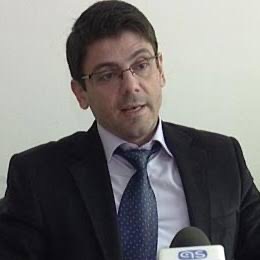
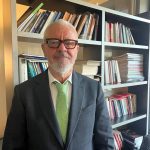
Dr. Michael Schmidt-Neke, born in 1956, is a historian, specialized in Albanian and Balkan affairs. He has published monographs and essays on Albania’s history and current developments. He is deputy chairman of the German-Albanian Friendship Association and co-editor of their quarterly, “Albanische Hefte”. He is currently working with the parliament of Germany’s northernmost federal country, Schleswig-Holstein.
By Edlira Majko
The Albanian Institute for International Studies and its partners organized in the end of October the international conference “Twenty Years After: Rethinking Democracy and State in Albania” where you were one of the keynote speakers. What is your opinion of the topics covered in the conference?
This conference has been a very meritorious initiative of the Albanian, German and Austrian organizations, which have opened a forum for an open exchange of views between Albanian, Western European and US researchers and observers. The 20th anniversary of the beginning of pluralism was a well-chosen occasion to strike the balance what has happened in Albania during the last two decades. Especially the Friedrich Ebert Foundation has the merit to be not only a keen observer, but also one of the foremost foreign institutions propagating democratic principles and disseminating the know how of democracy. This applies worldwide, but for Albania in an outstanding way.
During the conference, we heard also fascinating reminiscences of this crucial time in Albania’s history, which was important, as some foreign participants had no experience with Albania’s reality before 1990. If you need a shortcoming of the agenda, perhaps it was almost exclusively focussing on politics and economics, whereas cultural and educational matters were not discussed. I think that this is highly relevant if you keep in mind the decay of Albania’s education system as proven in the enlarged PISA assessment test a couple of years ago.
How would you assess these two decades of Albania’s transformation? How has Albania changed in these 20 years? Can you draw a balance sheet of Albania’s main achievements and failures in these past 20 years?
There is much light and much shadow. As it was said during the conference, in Albania an extreme form of communism was substituted by an extreme form of capitalism. So, it would be short-sighted to blame communism for everything which does not run well in this country. Communism failed to lead Albania out of her backwardness, but it has been backward before and after communism.
All formerly communist ruled countries have undergone fundamental changes with regard to everyday life of their inhabitants and with regard to their international standing. The relation between state and citizens has changed, but still very many citizens do not accept their state as the organization of society, thus as a common project, a common obligation.
One of the basic sins of communist rule in Albania was that they kept to familiarist structures, dividing society in “good”, i.e. pro-communist and loyal, families and “bad”, i.e. non-communist and potentially disloyal, families. Thus, the extended family network remained what it was before and after communism: the most important structure within the Albanian society, even substituting the failing state. Today there is a blatant contradiction between the well-cared private space and the neglected public space, with dire consequences for the environment.
So, on the plus side, in 1990-1992 we saw a rather smooth transition form communist rule to a multi-party system, avoiding a Romanian-style civil war. But this civil war came a few years later in 1997 as a result of capitalism running wild, of a failing state and of unrealistic expectations.
The full measure of violations of basic human rights in communist Albania became visible – at least for us foreign observers – only after the demise of this regime. Today no one is arbitrarily deported into internment camps without even a court verdict. But that does not mean that human rights in Albania are safe. No one knows how many girls and young women have been abducted by criminals and deported into Europe’s brothels, how many children are deprived of proper care and of education, how many poor, handicapped and sick people are reduced to a living as beggars.
Albania has today a well-established system of political parties, which parallels the mainstream European party systems (I spoke on that topic on the conference). There is still no readiness to cooperate, but only a concept of fundamental opposition.
As a Mediterranean country, Albania has vast chances for tourism, but does not use them, in spite of unrealistic statistics, which count Albanian emigrants on a visit in their mother country as tourists. Environment pollution, ill-planned industrial plants and lacking infrastructure are still blocking its development.
There is a culture of irresponsibility, delegating responsibility to others, often by way of bribery and corruption. The tragedy of G쳤ec is the worst symbol for that. I cannot imagine that in Germany a minister in charge of defence who bears at least the political responsibility (if not more) for such a disaster is forced to resign, only to return into another government portfolio after hardly more than one year.
Can we say for sure that the Albanian transition, meaning the replacement of the totalitarian state regime with a democratic state and the transformation of a centralized economy with a market economy, has already ended?
Tht depends from your definition of transition. If you define transition only as a replacement of one structure by another, it has obviously happened. But if you understand transition as a process which leads to well-established and working system which is generally accepted by the overwhelming majority of the people, it is still a long way to go. During the conference, Professor Nicholas Pano quoted a poll according to which about half of the Albanians are satisfied, the other half-dissatisfied with their country’s achievements during the last two decades.
How would you assess Albania’s foreign policy and international relations?
20 years ago, Albania came out of her shell. From today’s point of view, we condemn the politics of isolationism as ruinous for the national economy, but we should not forget that Albania had won the acclaim and respect of the West for severing ties with the Soviet bloc, especially for denouncing the Warsaw Treaty after the invasion of Czechoslovakia in 1968. Enver Hoxha warranted that Albania would not slip back to offering the Soviet bloc access to the Mediterranean coast, and there was much relief that this policy was continued by Ramiz Alia after Hoxha’s death.
As a German, I have been very happy when both our countries in 1987 finally agreed to restore diplomatic relations which had been blocked by the unsettled problems from the time of German occupation.
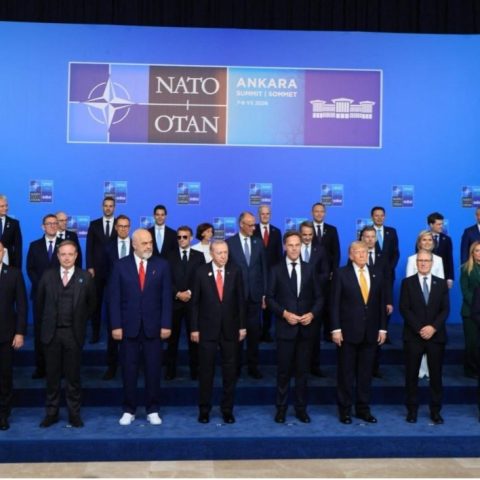
In the situation which the governments in power after 1990 had to handle they looked for support wherever it could be found; so aside the priority of joining the Western structures like NATO and EU there were some odd decisions like joining the Organization of the Islamic Conference.
But the main dilemma of Albania’s present foreign policy – which is shared by right-wing as well as by left-wing governments and which is deeply rooted in the sentiments of the Albanian public – is her ambivalence between Europe and the USA. With the fall of the Soviet Union, the times are gone when the strategic interests of both sides were more or less the same. But nowadays you start doubting whether Albania’s ambition is to be a full-fledged member of the European Union or to become the 51st star in the US flag. There is an exaggerated subservience to the USA, e.g. in taking part in the Iraq invasion, in signing an agreement of non-extradition of US citizens and in naming a road in Tirana after president G.W. Bush.
I do hope that the Albanian politicians refrain from populist manouevres with regard to changing the frontiers within the Balkans. The Ahtisaari project is the foundation of Kosovar statehood. Growing parts of the Albanian public (including Kosovo, Western Macedonia and the diaspora) are somewhat intoxicated by the historical achievements of Kosovo’s liberation and independence, seeing it appropriate to call for further steps towards all-Albanian unification. Such politics would not lead to an Albanian ethnic national state, but to a new isolation of the Albanians in total.
Albania failed to obtain the EU candidate status on November 9, whereas the Commission’s opinion on Montenegro’s application for membership was positive. What is your comment on this?
No one could really have expected another result. The European Commission has appreciated some progress in approaching European standards in the Albanian legislation. But everyone knows all too well Albania’s many drawbacks: the unsettled political crisis, an electoral system, which has been changed before every single election, but never in a satisfying way, the many faults in the administration, in the health system, in the education system, violations of human rights by the police authorities, an unsatisfying policy towards ethnic minorities, especially the Roma and Egyptians. It is hardly enough that the government proclaims on a daily basis that its fight against corruption is highly successful, when everybody knows that corruption is still prevailing in every part of Albanian society.
But there is another side of the medal. Even if Montenegro got a more positive evaluation than Albania, that country will not be a EU member within the next years. The decision makers in the EU, in the first place the French President, the British Prime Minister and the German Chancellor, clearly have no wish to enlarge the EU with Balkan countries. The German Christian Democrats (the party of Chancellor Merkel) campaigned for the 2009 European elections with a promise not to agree to the admission of new East European countries, except, maybe, Croatia.
And let’s face it: all chances for a medium-term admission of Western Balkan countries into the EU have been burnt last year in Greece. During the last weeks, the former “Celtic Tiger” Ireland had to ask for emergency help, and there are other candidates like Latvia, Portugal and Spain. So, it is highly unrealistic that the EU would invite in other economically weak countries which might have to ask for another “financial umbrella” very soon afterwards.
Therefore, the Albanians should be very patient. The EU is not the NATO, and Albania needed 17 years to join the NATO. I am very sorry, but I do not see Albania as a EU member during the next decade.