TIRANA, Dec. 27 – The landslide election win that led to an uncontested rotation of power, growing concerns over the state of the economy and dashed hopes to get EU candidate status dominated Albania’s news in 2013
With decisive and uncontested election results in June – which removed from power Sali Berisha of the Democratic Party and brought Edi Rama of the Socialist Party to the prime minister’s seat, as well as Lulzim Basha as new head of the opposition נthe political fights, the deadlock and the boycotts of past years gave way to clear mandate for the Socialist-led coalition government.
But concerns over the economy and business climate grew throughout the year as Albanians faced the worst effects of the European economic crisis.
Shaped by both political and economic factors, 2013 was a clear year of change in Albania. As the country prepares to celebrate the New Year, Tirana Times looks back at the major stories that shapes 2013.
JANUARY
Cultural heritage at risk
The medieval frescoes of St. Premte Chapel in central Albania survived the Ottoman Empire, various uprisings, two world wars and the world’s only officially atheist regime נbut they could not survive one or more amateurish thieves who tried to chisel them out of the wall in the evenings of Dec. 30 and Jan. 4. Gifted with a great wealth of cultural damage, post-communist Albania has seen a trend of destruction and theft at its cultural monuments in the past 20 years. Experts say investment, better infrastructure, tougher punishments and more education are needed to to protect the country’s historical, cultural and art heritage.
FEBRUARY
Jobs, the economy, health care and education lead early campaign
Albania’s political parties have already started their electoral campaign, and in the early rounds it appears it will largely be fought on everyday issues affecting the lives of Albanians נeconomy, jobs and social services such as health care. In early gatherings taking place across Albania with supporters, political leaders are proposing an array of programs for the next four years as part of their platforms for the June 23 elections. While the government is detailing why it has been successful so far and what it will do in the next mandate, if it is re-elected, the opposition Socialist Party says the economy is ruins and social services such as healthcare in need for a major overhaul.
Analysts note that this focus on these particular topics נunemployment, the economy and health care system נis unprecedented in Albanian campaigns. But there is a typical element of Albanian politics even in this campaign.
CEZ leaves Albania
After Albanian authorities remove its license, the departure of CEZ highlights tough realities of doing business in Albania. The Czech state-owned CEZ Group faced many problems in the last few months as it tried desperately to save its business in Albania, CEZ Shperndarje, which managed Albania’s power distribution system. CEZ went as far as switching off power to public companies like water supply systems נwhich had not paid their bills נan action that landed some of the company’s employees in police custody and forced the Albanian government to resort to a court order to force the company to back off. Albanian authorities נangry the Czech company had failed to fulfill its contractual investments and increase payment levels wanted CEZ out. The Energy Regulatory Entity, ERE, took away CEZ Sherndarje’s license and placed a state administrator at the helm of the company.
Albpetrol privatization fails
What would have been Albania’s biggest ever strategic privatization and a boost to the country’s ailing economy in these times of crisis has turned out to be only a beautiful dream. The Albanian government says it has invalidated a record staggering bid worth Euro 850 million on the privatization of Albpetrol oil firm after the winning bidder, Albanian-led Vetro Energy consortium, failed to pay the financial guarantee leading to the finalization of the contract.
MARCH
Vying for security
The murder of the third high-ranking police officer in just a few weeks, a perceived rise in violent crime and concerns over contaminated food have left Albanians feeling uneasy in what they see as growing insecurity in the country. As Albania approaches the next parliamentary elections, the theme of security has become a major campaign component, with the opposition arguing that the government has overseen a worsening of security indicators, while the government points out to data that Albania is still very safe by European standards, and vowing to crack down on perpetrators of recent acts as well make sure the regulations on the books are enforced.
Albanian diplomacy in crisis
A leaked angry letter over lack of funds at the Albanian embassy in Washington has sparked debate over the state of the country’s diplomatic service and its ability to its job.
APRIL
CEC crisis places elections in question
Election preparations in Albania have come to a halt after a controversial decision by parliament to replace a member of the independent body in charge or running elections. The move has led to deep concern by the international community, sparked protests from the political opposition and led to the resignation of two members of the Central Elections Commission, and boycott from a third, effectively freezing the work of the body in charge of administering the elections. The ruling Democratic Party said replacing the CEC member aimed to restore balance to CEC, which is nominally independent, but which in practice is political with the ruling and opposition parties proposing and controlling members based on a formula designed to give governing parties a majority. However, the Socialist Movement for Integration, which had been part of the governing coalition, switched sides and joined the Socialist Party-led opposition, and its member in the CEC was the one fired and replaced with someone proposed by the Republican Party, a minor party allied with the government.
In SP-SMI pact, the left takes
on new gamble
In a surprising move with major implications for the next parliamentary elections, the main opposition Socialist Party has joined forces in a coalition with the Socialist Movement for Integration, which has left the government, ending its four-year cooperation with the ruling Democratic Party.
Economy tops lists of concerns
Worry about the economy and employment, growing anxiety about rule of law and democratic standards as well as eroding trust in many institutions, particularly the judiciary, lead Albanians’ concerns ahead of the June 23 general elections, according to an AIIS study.
MAY
Integration laws approved, election concerns remain
In a special session of Albania’s parliament, the main opposition and governing parties have agreed to pass three laws that were part of the requirements to move Albania’s EU bid forward. The laws had been blocked for years due to lack of consensus between the opposition and the government. The three laws נon the judiciary, the public administration and a regulation on parliamentary procedures – have been part of Albania’s political discourse for years as they were part of the process of acquiring EU candidate status. The Socialists refused to previously vote on the laws in protest of the government’s unwillingness to work with the opposition to implement other laws. The government, in turn, accused the opposition of holding the country’s EU bid hostage. International representatives congratulated the parties on reaching consensus.
Campaign shifts from promises to accusations
Less than two months before the June 23 general elections, the ruling Democratic Party-led coalition has initiated a parliamentary probe against opposition Socialist Party leader Edi Rama, following an alleged physical assault incident with an Albanian diplomat in Vienna, which the government says ruined the country’s image. The opposition denies a physical altercation took place and says the probe is politically motivated ahead of the elections. The conflict is part of a larger trend in which the government, opposition shift between promises and explaining programs to personal accusations and claims of stealing ideas.
Parties submit lists of candidates
Political parties have submitted lists of candidates for members of parliament, causing surprise, rift on the left. Democrats open seats for allies, Socialist defectors. In force since 2009, Albania’s electoral code, a regional proportional system, leaves it entirely in the hands of party leaders to select candidates for members of parliament, creating a system that critics say lacks democratic foundations and gives voters little choice but to vote for or against the will of the party leaders, who are more likely to appoint obedient rubber-stamp MPs than mavericks.
JUNE
Albanians mark start of new era in landslide election
Albanian voters have handed a landslide victory to the Socialist-led coalition, guaranteeing a rotation of power that is proving to be the smoothest one since the fall of communism more than two decades ago, and one that Albanians hope will act as a springboard for the country’s future membership in the European Union. Edi Rama, the Socialists’ nominee for prime minister, held a conciliatory victory speech Tuesday night, promising quick implementation of his coalition’s program to fight crime and corruption, increase employment and improve services such as healthcare and education. Rama’s speech was followed the next evening by a concession speech by incumbent Prime Minister Sali Berisha who congratulated the winners, took responsibility for the loss and resigned from all party functions after 22 years at the helm, marking an end of an era in Albanian politics, which Berisha had dominated since the fall of communism in the early 1990s. Socialist supporters on foot and in cars braved a heat wave to celebrate in the city center, waving purple party flags as data by the country’s election commission showed the Socialist-led coalition in a hefty lead over its rival. The new 140-member parliament will have 84 members from the Socialist-led coalition and 56 from the Democratic-led group. No independent parties were able to make the threshold. The Socialist-led coalition owes much of its gains from the last election to junior coalition partner Socialist Movement for Integration, led by Ilir Meta, which received 16 seats in parliament in the election.
JULY
EU integration, reforms lead Socialists’ post-election strategy
After claiming a landslide victory in the June 23 general election, the Socialist Party-led coalition is preparing to form the next government and implement its program, driven largely by a European integration agenda and reforms aimed to improving rule of law, growing the economy and improving public services like healthcare and education.
AUGUST
New government pins hopes on new faces
Albania’s next government will be younger, more female and filled with fresh faces, the country’s newly-elected prime minister, Edi Rama, has announced, as he presented the names of those who will serve in his cabinet. The government, which is expected to be sworn in early next month, has the highest number of female ministers in Albania’s history, six, and features several ministers in their early and mid 30s. The majority of the cabinet ministers are newcomers to the cabinet seats and several are of technocratic rather than political backgrounds.
Albania completes electoral process
Six weeks after voting took place in Albania’s June 23 general parliamentary elections, the electoral process has officially ended with the issuing of final results by the Central Elections Commission and distribution of mandates by the Electoral College. Despite the fact that the composition of the new parliament – 83 MPs for the winning leftist coalition and 57 for its center-right rival – was known within a few days after the election was held, appeals and requests for recounts – some of which were approved – led to a delays in the process.
SEPTEMBER
New PM vows to fight ‘poverty of aspirations’
Albania’s new prime minister, Edi Rama, held his first speech in parliament, presenting the program of his new government for the next four years, and calling on Albanians to fight a “poverty of aspirations” that has kept the country from fulfilling its potential. In his hour-long speech, Rama said the next government would be different from what Albania has seen in the past two decades. The people’s voice would be seriously heard, he said, and reforms would be undertaken which could be painful but necessary to promote growth.
Basha becomes new DP leader
The leader of the new opposition is Lulzim Basha, the 39-year-old mayor of Tirana, who was elected leader of the Democratic Party shortly after the party suffered a major defeat in the June general elections, leading to the resignation of its leader for two decades, former Prime Minister Sali Berisha. Basha’s election as head of the Democratic Party is a turning point for the future of the opposition in Albania, and he faces many challenges. How he handles these challenges will not only determine his own political future but also that of his party.
OCTOBER
Albania moves closer to EU candidate status
The European Union’s executive branch has recommended Albania granted official candidate status for membership in the bloc, marking a long-awaited endorsement for the country’s EU integration process. In its annual progress report, the European Commission said that it is proposing Albania should be granted the status based on the advancement made so far without setting specific conditions as it had done in the past.
With EU candidate status in sight, Albania draws renewed attention
“You can do it,” was the simple but encouraging message Italian Foreign Minister Emma Bonino had for the new Albanian government and its hopes to gain EU candidate status this year and open negotiations as soon as possible. Bonino’s visit, in fact, was part of a trend of top EU diplomats visiting Albania after the new government took office. Earlier this week, the Lithuanian and Romanian foreign ministers, whose countries have or will soon have the EU presidency, visited Albania with similar messages.
Albania’s EU bid faces skeptical Europeans
Faced with a European public that is increasingly hostile to EU enlargement to countries like Albania – which are seen as poor, corrupt and crime-prone – authorities in Tirana worry that they have an uphill battle to win the backing of all EU members states to move Tirana’s EU membership bid forward. They will need to convince countries like the Netherlands – one of the most skeptical EU members when it comes to enlargement. Dutch Foreign Minister Frans Timmermans, who held a one-day visit to Albania.
NOVEMBER
Public backlash derails weapons disposal proposal
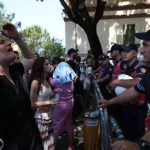
An international proposal to use Albania as a base where Syria’s chemical weapons can be safely destroyed has sparked an unprecedented public backlash with protests across the country urging Albania’s government to withdraw from negotiations. Protesters, coming from all strata of Albanian society, were galvanized by the vague language of top officials and suspicions that a decision had already been made behind closed doors. The protests also marked rare public pressure on the government in this staunchly pro-American country to place limits in what requests it will accept from the international community in general and the United States in particular, after the government confirmed that Washington and other allies had requested Tirana’s assistance with the program. Albanian and American officials say the strong ties between the two countries have not been damaged following Prime Minister Edi Rama’s speech in which he said the country could not participate in a program to destroy Syria’s chemical weapons stockpiles on Albanian soil, despite a U.S. plea to do so.
Despite crisis, delays, Albanian support for EU remains undeterred
Despite economic difficulties within the European Union and delays in Albania’s EU integration process, Albanians continue their overwhelming support for EU integration. Eighty five percent would vote to join the EU should a hypothetical vote take place this year, according to the latest annual survey conducted by the Albanian Institute for International Studies.
Papoulias visit vies to warm up cool relations
Greece and Albania try to address new and old problems, as Greek president makes first high-level official visit in years. The visit follows a long period of stagnation in relations between the two neighboring countries, conditioned by recent disagreements over the shared maritime border and older issues relating to the border region, some dating back to the end of WWII.
DECEMBER
EU members delay Albania’s status bid
Despite full support by EU’s executive and legislative branches, Albania has failed to become an official EU candidate for membership, after five of the bloc’s richest and most powerful countries say they need more time to make up their mind, blocking Albania’s EU progress for at least six months. The European Union’s foreign ministers decided Albania will have to wait until June next year to learn whether it will be granted official candidate status for membership, marking the first time the country is denied progress in its EU bid directly by the bloc’s wealthy northwestern states rather than EU authorities. Both the EU Commission and the EU Parliament had recommended Albania be granted official candidate status as the country had done what was needed to move forward with its stalled EU bid. Granting candidate status is largely a symbolic political decision and actual membership could take a decade to be achieved, integration experts say.
The return of progressive taxation
After years of applying a 10 percent flat tax, touted as a success in attracting foreign investors by the previous government, the new Socialist government has confirmed it will deliver on its campaign promise to return the country to progressive taxation, relying more heavily on high-income earners and large businesses and lowering taxes on the rest. Business community says increase of tax on corporate earnings by 50 percent will backfire and increase informality.