TIRANA, Oct. 18 – Only a couple of months before the June 2013 general elections, farmers in a village of Lushnje area, some 90 km south of Tirana, decided to boycott the elections in protest against the government’s failure to reconstruct their local road which was keeping their agricultural products destined for export trapped because of transportation barriers. Also supported by local party leaders, they managed to put enough pressure to the central government to disburse funds so that their local village road was reconstructed just few days ahead of the elections, in a simple example showing that when united farmers can reduce their production costs and boost their negotiation power.
The example is cited in a publication on how agricultural cooperatives, legally recognized since 2012 but poorly developed because of their bias under communism when they were state-run, can serve as a tool of economic growth and political instrument in Albania, where agriculture is a key sector of the Albanian economy, employing about half of the country’s population, but providing only 20 percent of the GDP.
The study supported by the Friedrich Ebert Foundation in Albania shows that fragmentation of farm land into plots of little more than 1 ha (1.2 ha on average split in 4 parcels) is a huge burden for the development of Albanian agriculture in terms of access to financing and investment, reducing their competitiveness due to high costs.
“Firstly, in terms of extreme fragmentation of agricultural land varying 0.1-0.15 ha, it is impossible to achieve the benefits of the economy of scale. Combining agricultural land in a joint venture is an unquestionable need in terms of lowering costs and increasing investment in agriculture,” says the study.
“Small plots developed in terms of individual farmers, with little or no government assistance and technical knowledge, will always be inefficient from a financial viewpoint. They will never be feasible for financing, for benefits from public funding and are unable to afford access to specialized services from consultants,” it adds.
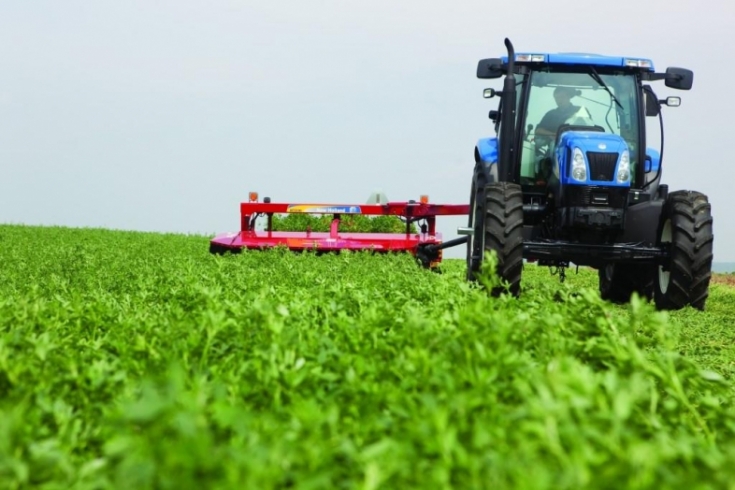
The report also notes the need for well-studied investment platforms in terms of agriculture machinery.
Reminiscences of the communist past when farmers were expropriated and forced to work in state-run cooperatives until the early 1990s remains a huge burden for the development of agricultural cooperatives.
“The mentality of cooperatives inherited from the totalitarian regime makes it difficult for farmers to willingly unite in such initiatives. Reminiscences of the communist past makes cooperatives as a notion, a tough project to be implemented,” says the study.
Studies have shown that cooperatives create jobs in poor areas where no high skills of the labour force is required and have a direct impact on poverty alleviation, by producing at a lower cost and as a result increase the poor consumers’ purchasing power.
In many countries, cooperatives are in the forefront in the production and marketing of foodstuffs, electricity and consumer goods as well as financial, insurance and social services, another study on the role of cooperatives in poverty alleviation has shown.
Cooperatives control 100 percent of market share in potato production in the Netherlands, 40 percent of agricultural marketing in South Korea, 33 percent of the Finnish banking sector and 13 percent of electricity supply in the United States.
The study recommends state institutions including the central bank and the financial supervisory authority should work together on boosting funding and insurance in agriculture, currently almost non-existent.
Settling the long-standing clear property ownership issue, establishing regional centers to support farmers with inputs and mechanization and a scientific research lab as well as a regional brand marketing agency for the key Myzeqe area in Lushnja are some the policies central and local government authorities can undertake, notes the report.
The area of Lushnje is the breadbasket of Albanian agriculture due its fertile lands and hard-working farmers with much of their products exported to regional but also EU markets.
The study also recommends revising the high tax burden in agriculture by offering differentiated rates compared to other sectors. Farmers currently pay 15 percent in withholding tax for the sale and rent of their land, a 20 percent VAT rate on fertilizers and have no subsidies on fuel whose prices, which in Albania are among Europe’s highest despite the country’s having one of the lowest GDP per capita and purchasing power.
The high level of informality in Albania’s agriculture sector, estimated at 70 percent, is the key barrier why Albanian farmers face difficulty in access to loans and international funding projects, mainly from EU funds, experts say.
The nationwide campaign against informality is estimated to have formalized some 19,500 farmers in 2015 when a reform in late 2015 obliged farmers to obtain tax ID numbers and pay social security contributions in order to sell their products. The number of registered farmers however represents only 5 percent of more than 442,000 people employed in the private agriculture sector.
However, with the remittances-fueled construction boom almost over, more and more Albanian enterprises are turning to agriculture as a real opportunity of growth engaging mostly in egg, fruit and vegetable production, a considerable part of which are destined for exports.
The mandarin cooperative
 The Konispol area, in southernmost Albania just off the UNESCO World Heritage site of Butrint, is a perfect example of successful farmers’ cooperatives in citrus cultivation.
Since the first commercial cooperative was established in 1995 in Xarra, the number of farmers who have joined forces to work together has increased from 7 to 350. The cooperative employs about 400 people, 250 of whom from outside the local area.
Dhimo Kote, a former head of the Xarre commune and a citrus entrepreneur, says the cooperative citrus farms, initially notorious because of the legacy of the communist regime, have helped increase production and is key for the cultivators to stay united as a strong community.
“It is time to rally together in order to better benefit from our own experiences and to speak with the same voice in order to grow our sales and keep investing in more orchards. For the moment let’s enjoy the fruit of our hard labor,” Kote has said.
“We are the main supplier not only in the domestic market, but also for exports. People are very interested because of providing a solution to market supply and employing themselves,” he adds.
The Albanian government spends only 0.5 percent of the GDP on agriculture while credit to the agricultural sector represents only 2 percent of total credit to businesses, according to central bank data.