TIRANA, Aug. 8 – The late 2015 nationwide campaign that the ruling Socialist Party undertook contributed to the deterioration of the business climate in Albania, a regional study examining tax evasion in Albania, Macedonia and Kosovo has found.
Launched in September 2015, the rather aggressive campaign mainly focused on small businesses formalized thousands of previously unregistered enterprises whose owners were forced to install cash registers and pay local taxes and social security and health insurance contributions.
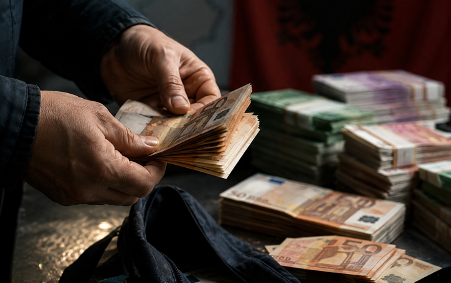
The campaign accompanied by a huge increase in tax evasion fines failed to address large-scale evaders, known as the ‘big fish’ and secure the expected tax hike from the fight of tax evasion, estimated at about 30 percent of Albania’s GDP.
The campaign also has failed to produce the expected hike in government revenue also because of an earlier campaign to collect hundreds of millions of euros in accumulated unpaid electricity bills significantly affecting consumption levels among poor households and more than 100,000 people leaving the country in the past couple of years to seek asylum in EU member states, mainly Germany.
“Due to its intensity and stronger focus on smaller businesses, the campaign did not have the expected results and contributed to the deterioration of the business climate in the country,” says the study examining hidden economies in the three neighboring Western Balkan countries.
The Tirana-based Institute for Democracy and Mediation, which examined the Albanian economy, says the approach of the Albanian tax authorities has currently changed “being more collaborative and mainly focused on smarter targeting through risk-based analyses.”
The nationwide campaign was accompanied by some tough penalties and what the business community called repressive inspections, leading to legal battles with the government.
In early 2016, the country’s Constitutional Court turned down a heavy fines law that increased fines on tax evasion by 50-fold to 10 million lek (about €75,000) as unconstitutional on “disproportionate” penalties to income and offences committed.
The court also later cancelled as incompatible some late 2015 legal changes that set reference wages on self-employed professionals increasing social security contributions by three times.
The regional study described the three small Western Balkan economies as hidden tax havens with the revenue to GDP ratios ranging between 27 to 29 percent of the GDP and failure to issue fiscal invoices on cash purchased goods and services ranging from 6 to 74 percent.
The 2016 survey shows Albania’s economy is much more informal compared to neighbouring Macedonia, a country that applies the lowest tax burden in the Western Balkan region.
About half of respondents in Albania, some 43 percent, say they did not receive an invoice for goods purchased in the past couple of years.
The situation is most problematic with the purchase of clothes and shoes, cosmetic and hygiene as well as alcohol and tobacco products with half of the respondents saying that are rarely or never provided fiscal receipts.
When it comes to services, informality rates are alarming in all three countries ranging from 54 percent in Macedonia to 65 percent in Albania and 74 percent in Kosovo.
In Albania, fiscal receipts are most frequently given for catering and restaurant services (84 percent), transportation services (66 percent) and least frequently for household maintenance (6 percent), home repair (8 percent), renting assets and premises (11 percent) and senior and child care services (15 percent.
The same study conducted by regional NGOs has earlier unveiled high unemployment rates, especially among youngsters, is the key reason behind alarming levels of the shadow economy in Albania, Kosovo and Macedonia.
Whether it is a factory worker who also works as an unlicensed plumber, an electrician being paid in cash, an IT professional receiving an envelope wage, hidden salaries are the most acute concern in the three Western Balkan countries aspiring to join the EU, affecting about half of workers.
“Hidden salaries remain the most acute concern with the employment income being partially or completely undeclared for 36 percent of workers in Albania, 37 percent in Kosovo and 40 percent in Macedonia,” the study has unveiled.
The three neighboring countries have a total resident population of about 7 million, with ethnic Albanians in Kosovo accounting for 92 percent of its 1.9 million population and a quarter of Macedonia’s 2.1 million residents.
The conclusions come from a survey conducted in May-June 2016 with 1,100 respondents in each of the three neighbouring countries.
Albania’s tax burden is significantly higher compared to neighbouring Macedonia and Kosovo who apply flat tax regimes of 10 percent.
Since 2014, the corporate income tax and the withholding tax on dividends, rents and capital gains have increased by 5 percent to 15 percent, making the tax burden in Albania one of the region’s highest and the key concern for the business community in the country.
Although making paying taxes easier by introducing a new online system for filing and paying taxes, businesses in Albania still need to make 34 payments a year and spend 261 hours a year on paying taxes, one of the region’s highest, according to the latest Doing Business report.
Albania climbed 32 steps to rank 58th among 190 global economies in the latest Doing Business report to score its best ever ranking, but yet lagged behind some of its key regional competitors offering lower taxes and easier procedures.