By Dardan Mustafaj
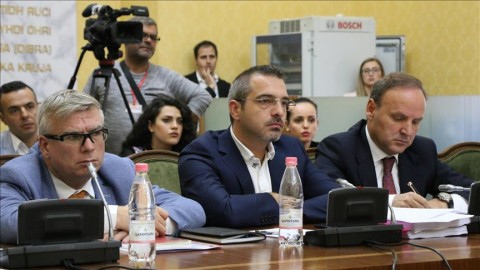
Like all compatriots at home and abroad, I also closely followed last weekend’s events. The work of the parliamentary commission, where not only its members, but also other parties involved, are experienced jurists who have practiced high functions, particularly grabbed my attention.
I expected to see discussions and decisions that would create important precedents for institutional development, for the ‘creation of a state’, as we are told and served for breakfast, lunch, dinner, everywhere and at any time.
Imagine my disappointment when from the first minute of the discussions, the Parliamentary Commission gave itself the role of a Court, which is beyond the role and constitutional function of this commission. It is not part of the duty of the Parliamentary Commission for Immunity and Mandates to judge alibis and evidence, their existence, their sufficiency, their deciding power or the conviction created by them! The reason is not just a principle, but also practical. The constitutional principle of coherence in abiding the law would limit the decision making freedom of Courts, which would not be able to maintain a position different from that of the Parliamentary Commission. In practice, Courts, but also the accused, would find themselves in a situation extremely threatening to their protection because if the Commission would evaluate the evidence sufficient to allow arrest, then it would be very difficult, if not impossible, to oppose this evidence in front of the Court.
What is the role of the Parliamentary Commission for Immunity and Mandates in this specific case then? The answer is simple: the Commission evaluates whatever is not in the evaluation focus of the Courts. Based on European Parliament practices, it appears when Parliamentary Commissions inquire a proposal for the removal of immunity, they should evaluate the following: first, whether the facts for which the deputy is accused are related to his parliamentary activity, and second, if he has fumus persecutionis, so, if the actions of the Prosecutor Office don’t act legally or seek the truth, but aim at stalling the political activity of the deputy.
In Mr. Tahiri’s case it is evident that, first, he is not accused for actions committed as part of his deputy function, and second the Prosecutor’s Office made that proposal, in a quest for the truth, to avoid a chance to hide evidence and furthermore the deputy has not partaken any parliamentary activity or proposed a legal initiative, which might be at risk from this accusation.
Moreover, the Commission crossed all limits when it also conducted the analysis of the opportunity for arrest, which is an exclusive competence of the Court! It is ironic to remember that, during the time this deputy was Minister of Interior, people were arrested for assumingly stealing electricity, for assumingly building a fence with no permission, even because cannabis was planted on their lands, despite the lack of proof they’d planted it.
On the other hand we have deputies who, though being mentioned in the talks of international criminals, they should not be arrested, deputies that even though are filmed beating another deputy in Parliament, should not be denounced because hitting can be an expression of opinion! If you don’t believe me, read decision nr.3/4, dated 10.06.2015, of the High Court, especially paragraph 30, and I cite, “[acts] defined by the Prosecution as penal acts of hitting due to duty according to act 237 of the Penal Code, belong or not to the forms and ways of expressing positions, opinions and vote during the Parliamentary activity, guaranteed by point 1 of act 73 of the Constitution and granting the lack of civil and penal responsibility of the deputies.” Dominique Strauss-Kahn was the Head of the IMF and the future president of France and was arrested solely on the testimony of a hotel cleaner. In this specific case, the Parliamentary Commission was holding reports and surveillance by Italian authorities, as well as testimonies by ex-police officers, and yet the Prosecutor’s Office proposal has not been approved!
The Parliamentary Commission for Immunity and Mandates put on its following ugly show this weekend. As always, when decisions are taken on unprincipled basis, the day comes they turn against you. The day will come when this dangerous and grotesque precedent of ‘creating a state’ will be used against the very same people that enacted it.
The moral of this story is this: let’s establish and build a state, even though we remove some bricks from its foundation from time to time, when it collapses, we can blame the designer.