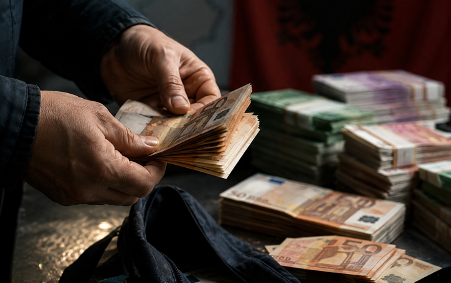
TIRANA, Dec. 26 – Albania’s national currency has gained ground against Europe’s single currency in the past few days, in a common year-end trend that sees the euro slightly depreciate against the Albanian lek following a rise in Euro inflows by dozens of thousands of Albanian immigrants who come home for the year-end holidays.
After slightly gaining ground against the Albanian lek following the end of the summer-reliant tourism sector last August, the euro has depreciated by 1 lek in the past three weeks, trading at 132.68 lek this week, only slightly higher compared to the 8-year low of 132 lek it hit last June.
Thousands of Albanian immigrants living and working in Italy and Greece, the hosts of about 1 million Albanian migrants, have arrived home for the year-end holidays, in considerably lower number compared to the common summer vacations, but enough to trigger a slight appreciation of the Albanian lek against the Euro, a currency accounting for about half of the country’s savings and credit and dominating the real estate and car transactions.
Migrants coming home also bring considerable amounts in remittances avoiding high costs estimated at a 9.4 percent rate if transferred through official channels.
A considerably weaker Euro this year has negatively affected Albania’s poorly diversified exports, two-thirds of which are destined to Eurozone countries.
On the positive side, the depreciation of the Euro against the national currency is good news for borrowers in Euro who have their income in lek, the government’s external debt payments as well as imports whose cost has slightly dropped.
Albania’s central bank attributes the strengthening of the national currency against the Euro to higher GDP growth fuelled by an increase in FDI and tourism revenue, but some experts say the euro inflows from rising cannabis cultivation and trafficking in the past couple of years has also had an impact.
However, when compared to the outbreak of the global financial crisis almost decade ago, the Albanian lek has lost ground against Europe’s single currency which traded at an average of 123.3 in November 2008.
The U.S. dollar, whose weight on the Albanian economy is considerably lower, has also lost considerable ground against the Albanian national currency in the past seven months, reflecting the EUR/USD pair performance.
The currency of major commodities, the U.S. dollar fell to 111.94 lek this week, down 13 percent compared to the average rate of 128.3 lek in December 2016, according to the central bank’s fixed exchange rate.
U.S. dollar-denominated loans in Albania account for around 10 percent of the total loans to businesses and a negligible 1.2 percent in loans to households.