TIRANA, Sept. 22 – A strong 5,6 Richter magnitude earthquake hit Albania on Saturday evening, with a smaller 5,4 Richter earthquake following and numerous aftershocks throughout the night, damaging over 500 homes and 30 buildings and hurting around 105 people in Tirana and Durres, which were the most affected cities.
According to the first preliminary official data, announced by Defense Minister Olta Xhaçka at around 8 pm, there were initially 68 reports of injured persons, but in all cases they were minor and mainly caused due to fear and panic experienced by citizens at the time of the earthquake.
According to Xhacka, damage of homes and flats “was mainly a matter of cracked walls or other damage of this kind, although in the coming days the seriousness of these damage will be verified by expert field teams.”
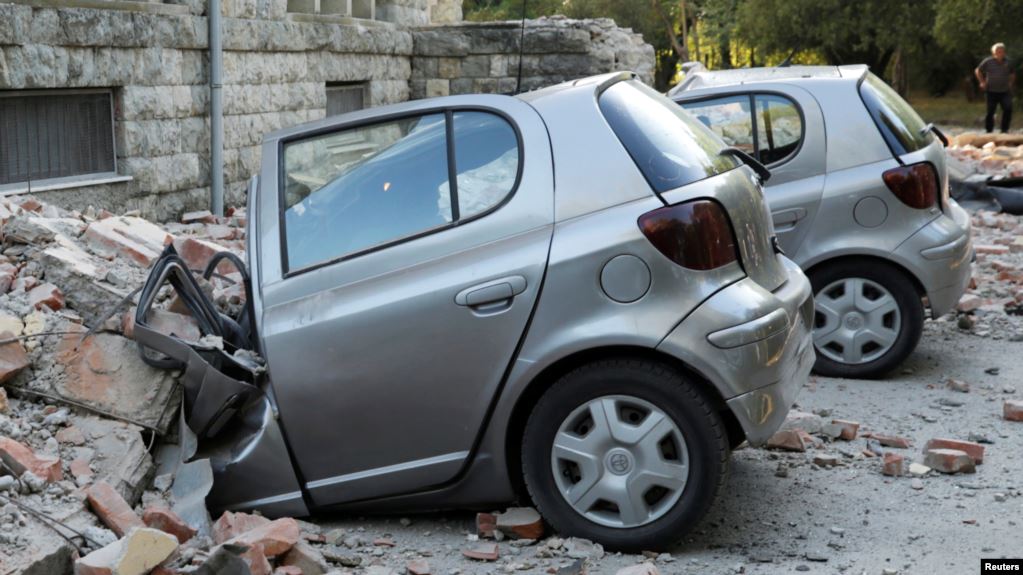
There were, however, cases like the one at the Faculty of Geology in Tirana, where stones and facade bricks fell apart, completely destroying two cars that were parked near the building.
The first earthquake marked “the largest recorded in the last 30 years”, according to seismologists, and was followed by dozens more at a lower intensity.
Mostly in Tirana and Durres, citizens experienced fear and panic for hours, leaving their houses to stay in the streets and squares.
In fact, a large portion of citizens were wounded while hurriedly fleeing to get out of their homes. In one case, one person suffered a leg fracture after throwing himself from the second floor of the apartment, while another was hit by a car while attempting to cross the road at speed.
Albania was hit at midnight by another strong earthquake, though at slightly lower intensity than Saturday afternoon. According to the data, the epicenter was 2 kilometers southeast of Durres, with a magnitude of 4.9 on the Richter scale, and the tremors were strongly felt in Tirana again, at the time the extraordinary government meeting concerning the earthquake was taking place.
Albanian Prime Minister Edi Rama said during the meeting that government structures reacted swiftly to the emergency situation and that he is willing to use the necessary available funds to meet the costs caused by the natural disaster.
However, historical records show that earthquakes have completely devastated Durres several times, with seismic aftershocks ranking first for catastrophes that natural disasters could cause the country.
Albania ranks 43rd in the world for earthquake risk, with devastating earthquakes occurring every century, while experts point out that the country has neither the funds nor the infrastructure to handle such phenomena.
Objects risking destruction
Damages caused on physical objects include those buildings that are constructed of materials that do not withstand earthquakes above 6 Richter scale and older buildings, mainly those built prior to the 1960s.
According to the study, buildings built with adobe, brick, stone and concrete and structural systems whose walls are made of prefabricated materials are most vulnerable.
Buildings constructed before 1960 have no earthquake resistance, those built between 1960-1990 have low seismic protection, while buildings after 1990 have insufficient protection, as many of them have abused the number of floors in relation to the foundations’ durability.
The study shows that the highest demands for the national civil emergency system would come from earthquakes that occur in Durres, Elbasan, Berat or Vlora, as low-impact seismic sources are capable of causing structural damage and collapses ranging from 1,9 to 5.2 percent of the national housing fund.
In the event of high impact earthquakes, which can occur once every 500 years, the liberated energy potential is capable of causing a nationwide construction disaster.
And although the displacement process has reduced the impact of strong earthquakes in the north and south of the country, it has significantly increased exposure in Tirana, Durres and other cities affected by the earthquake source areas in the coastal area.
Albania ranks 43rd globally on earthquake risk
Worldwide, Albania ranks 43rd in earthquake risk.
On the global map of the risk of this natural occurrence, Albania is located in the red zone.
From the evidence available to date, it follows that from the second century BC to the present day, Albania has been hit by 55 strong earthquakes of up to 8 Richter magnitude.
European seismology stations have recorded accurate earthquakes measuring 6 magnitude in Albania since the beginning of the 20th century, while the lower magnitudes up to 2 Richter began to be measured in the late 1960s.
Albania is among a wide area of contact between the African tectonic plates, with the regions surrounding it including a fairly extensive tectonic zone – Greece, Montenegro, Macedonia, Southern Bulgaria and Western Turkey. Every year, at least one earthquake less than 6.5 magnitude Richter occurs in this region.
Earthquakes in Albania
Seismic hazard estimates show that magnitude 5.0 earthquakes have a repetition period of 3.6 years, while earthquakes 5.5, 6, 6.5 and 7 have a repetition period of 10, 29, 94 and 505 years. According to estimates, with a 75 percent probability, Albania is affected every year by an earthquake of no greater than 4.7 magnitude and once every 50 years by an earthquake of no greater than 6.1 magnitude and once every 100 years by one earthquake not exceeding 6.4 magnitude.
Among the areas most affected by earthquakes is the Lezha-Ulcinj coastline, where the Albanian towns of Shkodra and Lezha are endangered and the town of Petrovac, Montenegro.
The second seismic zone is that of the Adriatic lowlands, including the cities of Tirana, Durres and Berat. Near Tirana, in 1988, a 6-magnitude earthquake was recorded, in Durres in 1926 a 6.6-magnitude earthquake was recorded and in Berat in 1959 a 6.6-magnitude earthquake.
The third seismic zone is that of the Ionian coast, including the cities of Vlora, Himara, Tepelena and Saranda. The latter two were hit in 1920 by a 6.6-magnitude earthquake, Himara was hit by a 6.6-magnitude earthquake in 1930 and Vlora in 1962 by a 6.6-magnitude earthquake.
Reaction capacities
The seismological network currently consists of 13 stations plus 34 other “large oscillation” stations. This network is already operating as a fully integrated digital system through the use of satellite communication.
These monitoring networks are the only seismological infrastructure in the country that addresses the monitoring and study of seismic activity in Albania. Seismic service personnel have been recently trained by NATO, although requiring further training because existing seismologists (six) participate in search, rescue, evacuation, treatment and transportation of injured persons.
In a study Colonel Foto Duro has done for the Center for European and Security Affairs, he says emergency response capabilities are provided by various institutions, including the military’s main contribution.
Currently, there are 16 trucks, 17 helicopters and about 65 small motor boats available for evacuation. Tents for 17,000 people are only available from the military, plus tents provided by other institutions.
Food is available at two units of bread production for 2400 kg of bread per day and 12 kitchens for up to 3000 servings per day. There are 7 buses available for drinkable water, providing a total of 67 tons of 11 pumps. Two units are for water purification and two shower units that can handle 200 people daily, which can be raised outside the affected area 72 hours after the emergency is declared.
Albania’s emergency means need to cover a greater number of people compared to the region states’ capacities; Another problem related to these capacities is the relatively low level of technical readiness of vehicles, aggregates and equipment, which in general assessment does not exceed 60-70%.
Limited financial sources
The current Albanian legislation has no clear definition of the percentage of funds provided for natural disaster management.
However, it has recently been stipulated that line ministries and other central institutions should have a separate Civil Protection budget of 0.3 to 1 percent of their budget. The law also stipulates not only the need for local government to rely on central government funds in the case of a disaster, but also the obligation of the local government to use its own revenues for this purpose. At the municipality level, 3 percent of its budget is planned to compensate citizens for damages from natural disasters, an amount well below the statutory requirement that compensation to the population affected by natural disasters should go up to 40 percent.
Although the intensity of natural disasters has increased tremendously in recent years, especially after floods, there is still no national insurance scheme to mitigate the consequences of disasters.
The World Bank has consistently assisted the Financial Supervisory Authority, but has yet to deliver a solution.