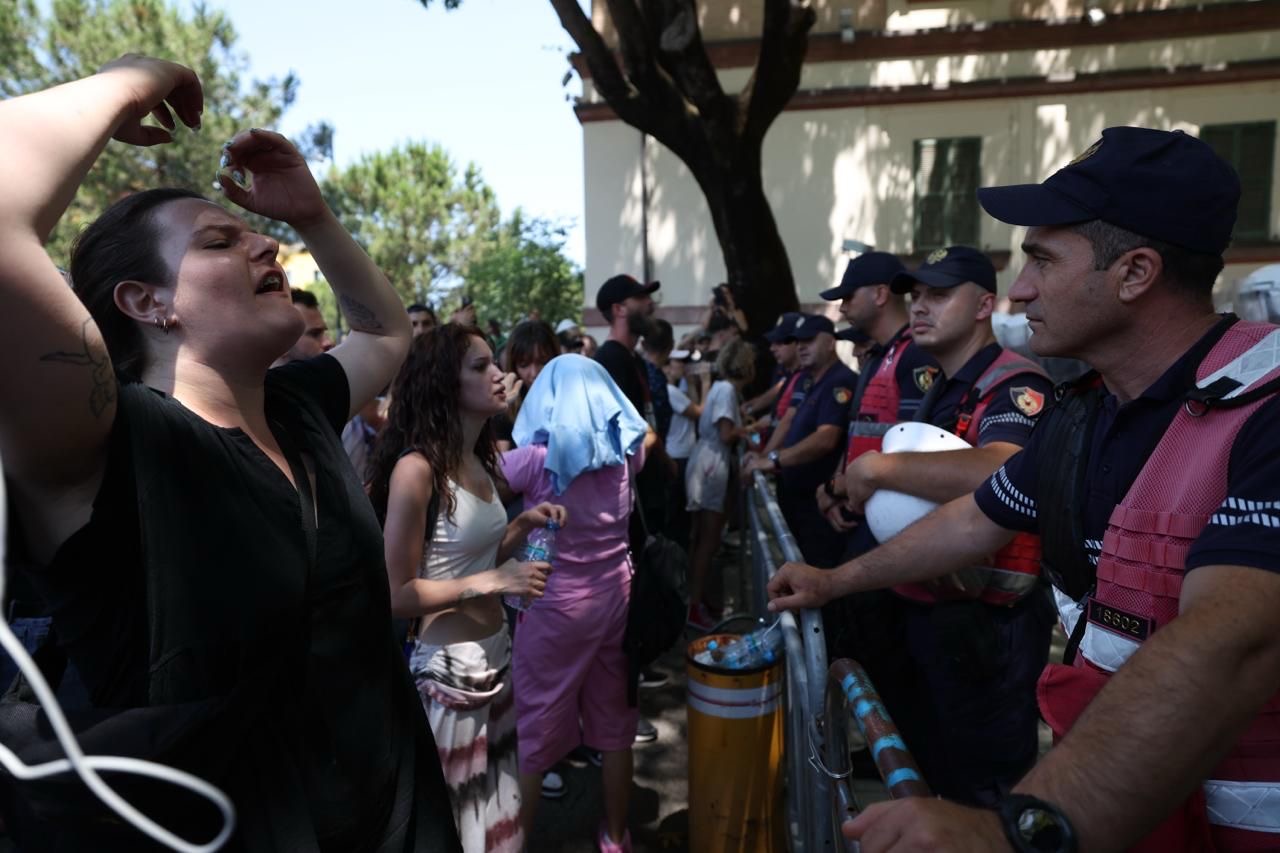
Tirana Times, July 03, 2026 – Albania’s month-long anti-government protest movement entered a more confrontational phase on Thursday, as demonstrators gathered outside Parliament, blocked access points and clashed with police while lawmakers were holding a plenary session inside.
The protest, now extending into its second month, has moved beyond its initial opposition to the controversial Zvernec and Sazan development projects and has become a broader civic revolt demanding the resignation of Prime Minister Edi Rama and his government. Protesters outside Parliament chanted against the government, called for the resignation of the prime minister and accused the political majority of protecting corruption and abusing state power.
Police intervened forcefully to disperse protesters from the Parliament perimeter, using riot units, pepper spray and other means to push the crowd back. Several protesters and activists were escorted by police, including Gent Progni, while demonstrators later moved toward police stations to demand the release of those detained. According to Activist Sidorela Vatnikaj, protesters accused the police of using disproportionate violence and acting under political orders.
Vatnikaj, speaking after the clashes, said that the violence first seen in Zvernec had now been transferred to Tirana. She described the police response as excessive and unjustified, arguing that citizens had gathered peacefully outside Parliament. Her message reflected a broader argument of the protest movement: that the state’s reaction to civic resistance has become a symbol of the very arrogance and abuse of power that protesters are denouncing.
Gent Progni, one of the activists reportedly detained, became one of the faces of the day’s confrontation. Protesters demanded his release and the release of others, chanting outside police stations and calling on officers to stand with citizens rather than with the government.
The protest movement also received support from independent MP Marjana Koçeku, who has distanced herself from the Socialist parliamentary group. In remarks reported by Panorama, Koçeku described the protest as the voice of the people and urged the prime minister to resign. Her position added political weight to a movement that the government has tried to portray as either manipulated or hijacked by violent groups.
Analyst Fatos Lubonja framed the police response as further evidence of a captured state. He argued that protesters had used symbolic forms of protest, including eggs, while the police reacted with force. Lubonja said the protest is no longer only about Zvernec or the Kushner-linked resort project, but about years of corruption, state capture and the weakening of democratic institutions.
The government, however, has rejected the protesters’ central demand. In an interview with Deutsche Prime Minister Rama said Albania is not facing a crisis of trust and described the protests as part of democratic life. “There is no crisis of trust in Albania,” Rama said. “On the contrary, Albania is a beautiful example of freedom and democracy in action, where the boulevard belongs to people from all walks of life, who have their views and want their voice to be heard.”
But Rama was categorical that he has no intention of resigning. Asked directly about the protests and whether he would step down, he said: “Resignation has not been, is not and will not be an option.” He argued that he and the Socialist Party had received a mandate from “868,000 Albanians” to complete the mission of closing negotiations for Albania’s membership in the European Union. “This is a historic mission that cannot be left halfway for any reason,” Rama said.
Rama also dismissed the idea that protests can overturn an electoral mandate. Responding to criticism over public services and governance, he said that citizens cannot simply wake up and demand the government’s departure because they want better healthcare or better administration. “It does not work that way,” he said. “You have to wait until the next elections.”
At the same time, Rama defended the controversial coastal development agenda that helped trigger the protests. He rejected claims that public space would be privatized, calling such accusations “a lie,” and insisted that legal changes related to environmental protection do not violate European standards. “Prejudices are not arguments, and insinuations are not facts,” he said.
The government’s political line was echoed by senior Socialist officials, who have sought to separate what they call “real protesters” from those they accuse of violence or political manipulation. Officials have also suggested that foreign actors, including hostile states, may be trying to exploit the unrest. Protesters and critics reject that narrative, saying the movement is a domestic civic revolt against corruption, clientelism, police violence and the concentration of power.
Thursday’s events outside Parliament marked a clear escalation. For more than a month, protests have continued in Tirana and among diaspora communities, with demonstrators demanding the cancellation of the Zvernec and Sazan projects, the resignation of the prime minister and his government, a technical government and early elections. By blocking Parliament, the movement directly challenged the country’s central political institution and signaled that the confrontation is entering a more volatile phase.
The battle is now not only over a development project, but over the legitimacy of power in Albania. For the government, the protests are an expression of democratic freedom but not a reason to abandon a governing mandate. For protesters, the government’s refusal to step down and the police intervention outside Parliament confirm their central claim: that Albania is governed by a political system unwilling to listen, unwilling to be held accountable and increasingly ready to use force against its own citizens.