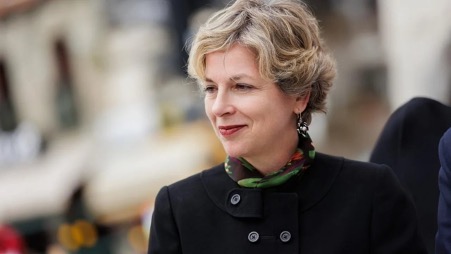
Tirana Times, September 09, 2026 — Albania’s Special Prosecution Office Against Corruption and Organized Crime has uncovered new evidence in its widening investigation of former Deputy Prime Minister Belinda Balluku, increasing pressure on one of the most powerful figures of the governing Socialist Party.
SPAK said Wednesday that a special court had ordered the seizure of a villa at the Green Coast complex in Palasë, on Albania’s southern coast. Prosecutors allege that the property was effectively owned by Balluku but concealed in the name of former Albanian international footballer Igli Tare.
It is the second villa that prosecutors say Balluku secretly owned and concealed through Tare. SPAK had previously seized another villa at the White Rock complex in Dhërmi, also formally registered in Tare’s name, alleging that the property was obtained as a corrupt benefit connected to a public tender.
The second villa adds a new dimension to the investigation because prosecutors are now alleging a repeated mechanism for hiding assets through the same third person.
In the Palasë case, SPAK says businessman Arbër Abazi, owner of Alko Impex General Construction, financed construction work on the villa worth between 288,616 euros and 410,526 euros. His company was part of the consortium that won Lot 7 of Tirana’s Outer Ring Road project.
Prosecutors allege that Balluku, while serving as infrastructure and energy minister, requested and received the investment in exchange for favoring Abazi’s company in the procurement procedure. They also allege that she used Tare to conceal ownership and failed to declare the property as required by law. Balluku is now suspected in connection with the villa of passive corruption, concealment of assets and money laundering.
The development comes after months of confrontation between SPAK and the governing majority over the Balluku investigation.
At an earlier stage, prosecutors sought Balluku’s suspension from public office, a measure approved by the Special Court. Prime Minister Edi Rama and the government challenged that decision before the Constitutional Court, arguing that a court could not effectively remove a minister from office and interfere with constitutional powers belonging to the executive. The Constitutional Court ultimately left the suspension in force after its eight judges split four to four.
The Socialist majority then moved to change the Criminal Procedure Code to prevent courts from imposing suspension from office on the President, the prime minister, Cabinet ministers and several other senior constitutional officials. The initiative emerged directly from the dispute over Balluku’s suspension and would significantly expand the category of senior officials protected from such a security measure.
The confrontation escalated further when SPAK later asked Parliament for authorization to impose a stronger security measure on Balluku, including arrest in prison or house arrest. The Socialist controlled Parliament rejected the request in March, with the governing majority arguing that existing measures were sufficient and that prosecutors could continue their investigation without arresting her.
The latest evidence is now raising expectations that SPAK could return to Parliament with a new request to lift Balluku’s immunity, potentially opening the way for her arrest.
Opposition parliamentary leader Gazment Bardhi called on prosecutors to do exactly that, asking how many more undeclared villas would have to be discovered before SPAK sought the removal of Balluku’s immunity. Bardhi said the new allegations had further aggravated her legal position and should be followed by a stronger security measure.
A second parliamentary request would come under substantially different circumstances. SPAK is no longer dealing only with allegations of manipulated procurement procedures. It now alleges a direct connection between a company that won a major government contract and investments made in a property prosecutors say belonged secretly to the minister responsible for the sector.
Balluku remains politically important despite the investigation. A former deputy prime minister and infrastructure and energy minister, she continues to be one of the central figures of the Socialist Party after Rama and was for years responsible for some of Albania’s largest infrastructure and energy projects.
The investigation covers alleged violations in eight procurement procedures, including the Llogara Tunnel and several sections of Tirana’s Outer Ring Road. SPAK says evidence indicates that Balluku personally followed procurement procedures even when formal authority had been delegated to subordinate officials.
The case is therefore increasingly becoming a test not only for Albania’s anti corruption justice institutions but also for the governing majority. SPAK was created to investigate high level corruption independently of political influence, while Parliament has already once refused to authorize Balluku’s arrest.
If prosecutors return with a new request after the discovery of what they describe as a second concealed villa, the Socialist majority will again have to decide whether to block stronger measures against one of its most prominent figures or allow the investigation to move into a new and potentially decisive phase.