Durres decision puts sanctions enforcement under scrutiny after vessel had previously called at Albanian port.
Tirana Times, September 01, 2026 – Albania’s decision to deny entry to a tanker identified by Ukrainian military intelligence as part of Russia’s so-called shadow fleet marks more than an isolated maritime enforcement action. It is also a test of how effectively the country is translating its political alignment with Western sanctions against Moscow into practice.
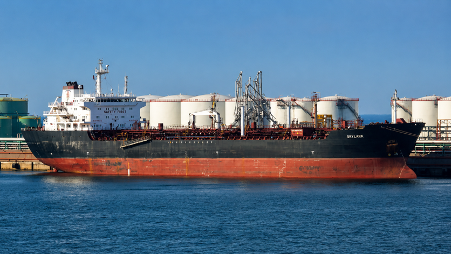
Albanian port authorities prevented the Sierra Leone-flagged tanker Hanuman from entering the Port of Durres after the vessel was identified by Ukraine’s military intelligence agency, known as GUR, and partner services as being connected to the network of ships used to transport Russian oil and petroleum products.
Taulant Allkja, captain of the Port of Durres, told BIRN that the ship, carrying IMO number 9295048, was notified of the decision while about 12 miles from the Albanian coast and was not permitted to enter the port’s anchorage.
“The ship received the notification from the Port Authority at a distance of 12 miles from Durres and is now continuing its voyage in the Adriatic Sea,” Allkja told BIRN.
The episode is significant because Albania, a NATO member and European Union candidate country, has consistently aligned itself politically with EU sanctions imposed on Russia following its full-scale invasion of Ukraine in February 2022.
But declaring alignment with sanctions and enforcing them across ports, financial institutions, companies and commercial networks are different challenges.
The Hanuman case illustrates that distinction.
According to data published by GUR and updated June 10, the tanker has been involved in transporting Russian petroleum products to third countries during the period in which the G7 and the European Union have imposed restrictions on Russian seaborne oil exports.
Ukrainian intelligence says that in September 2025 the vessel transported more than 30,000 metric tons of Russian petroleum products from Novorossiysk to Turkey. It has also called at the Sheskharis terminal in Novorossiysk, a major Russian oil export facility connected with Chernomortransneft, a subsidiary of the Russian state pipeline operator Transneft.
The wider problem for Western governments is the increasingly complicated maritime system Russia has developed to keep its oil exports moving despite sanctions.
The so-called shadow fleet generally consists of tankers operating through companies, owners, managers and flag registrations that can be difficult to trace. Ships may change flags or ownership structures and operate outside many of the traditional Western insurance and shipping networks.
That complexity makes enforcement particularly difficult for smaller countries such as Albania, which depend heavily on information supplied by international partners and intelligence agencies to identify potentially problematic ships before they enter territorial waters or ports.
The Durres decision therefore represents an important shift from political commitment to operational enforcement.
It is also notable because Hanuman had previously visited Durres, according to maritime traffic data cited by BIRN. The tanker called at the Albanian port in November 2025.
That previous visit raises the central question surrounding the latest episode: whether Albania’s sanctions enforcement system has now become more capable of identifying ships linked to Russia’s efforts to circumvent Western restrictions, or whether vessels connected with those networks had previously been able to use Albanian ports without sufficient scrutiny.
A BIRN investigation published in May raised similar concerns. It identified vessels suspected of involvement in transporting Russian oil or grain originating from Russian-occupied Ukrainian territories that had visited Albanian ports since 2022.
The investigation raised questions about the practical enforcement of the sanctions Albania had formally adopted against Moscow.
The decision to turn Hanuman away therefore carries political significance beyond the tanker itself.
For Tirana, enforcing sanctions is part of a broader foreign policy identity built around close alignment with the United States, NATO and the European Union. Albania has been among the countries seeking to demonstrate a clear strategic position since Russia’s invasion of Ukraine.
That alignment is particularly important as Albania continues negotiations for EU membership. Foreign policy alignment with Brussels is one measure of a candidate country’s willingness and ability to implement European decisions, but implementation increasingly matters as much as political declarations.
Russia’s shadow fleet has become a major focus of Western sanctions policy precisely because Moscow’s ability to continue exporting oil weakens one of the central objectives of those sanctions: reducing the revenues available to finance the war in Ukraine.
The G7 and European Union introduced a price cap system in late 2022 alongside restrictions on shipping services, insurance and financing for Russian oil transported above specified price levels. Russia responded in part by expanding its reliance on ships and commercial structures outside the traditional Western-controlled maritime system.
For Albania, the Hanuman episode demonstrates how that global confrontation can arrive quite literally at its ports.
There is also an important distinction. Identification by Ukrainian intelligence as part of the shadow fleet should not automatically be treated as proof that a vessel is individually listed under every EU or international sanctions regime, nor does the Durres incident by itself establish what cargo the ship was carrying when it approached Albania.
But port authorities do not have to view such intelligence as irrelevant. The broader pattern of a vessel’s activities, previous Russian port calls and information shared by partner intelligence services can create sufficient compliance and security concerns for authorities to refuse access.
That appears to be what happened in Durres.
The importance of the case will therefore depend less on the fate of one tanker than on whether the decision signals a systematic approach.
If Albania begins consistently screening vessels, ownership structures, previous port calls and possible connections to sanctions circumvention, the refusal of Hanuman could represent a meaningful tightening of enforcement.
If it remains an isolated action, the questions raised by earlier visits of suspicious vessels to Albanian ports will remain.
For a NATO ally and aspiring EU member, that distinction matters. Sanctions are ultimately effective not when governments endorse them in statements, but when ships, companies and financial networks attempting to circumvent them discover that ports such as Durres are no longer available to them.
Criminal Money Casts Shadow Over Albania’s Tourism Boom
Killing of Portuguese tourist raises broader questions about criminal capital, weak oversight and the future of Albania’s fast-growing coastal tourism industry
TIRANA, Albania — The killing of a 20-year-old Portuguese tourist at a luxury beach club in southern Albania has turned attention beyond a single violent crime to a more uncomfortable question confronting the country’s rapidly expanding tourism industry: Who is financing Albania’s coastal boom, and how closely are those investments being scrutinized?
Luis Miguel Varela Mendes was fatally stabbed in the early hours of Aug. 18 following a confrontation at Tortuga Bay, also known as Principotes, a luxury tourist complex in Ksamil, one of Albania’s busiest summer destinations.
The killing shocked a resort town that has become a symbol of Albania’s emergence as a major Mediterranean tourism destination. But details that emerged afterward have raised broader concerns about the ownership and management of tourism businesses, the employment of public security officials by private operators and the possible penetration of illicit money into one of the country’s fastest-growing economic sectors.
According to business registry records cited by BIRN, the Ksamil complex is owned by 76-year-old Kade Bulica, the mother of Bekim Bulica, 36, who was declared wanted after the killing on suspicion of failing to report a crime.
Police officials told BIRN that Bekim Bulica had previously faced criminal proceedings involving violence and had other problems with the law.
Questions intensified after authorities established that security at the tourist complex included an officer from the Gjirokastra Border Police, an employee of the Fier prison police and a Gjirokastra municipal police officer, along with a fourth person working as a bodyguard.
Police said the four were present when the confrontation that ended in Mendes’ death occurred but neither intervened nor notified authorities. They were detained on accusations that included failure to report a crime and failure to take measures to prevent unlawful activity.
For security and tourism experts, those circumstances make the Ksamil case more than an isolated test of policing. They expose weaknesses in Albania’s ability to oversee the people, businesses and money behind an unprecedented construction and tourism expansion along the Adriatic and Ionian coasts.
From Velipoja in the north to Ksamil in the south, Albania’s coastline has been transformed by hotels, apartment complexes, restaurants, beach clubs and large resorts. The boom has helped place the country firmly on Europe’s tourism map, but experts warn that rapid development has also created opportunities for money of questionable origin to enter the formal economy.
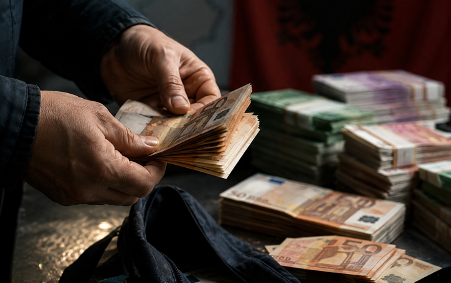
Former prosecutor Eugen Beçi says tourism and construction are particularly attractive sectors for laundering proceeds from criminal activity because of their heavy use of cash, large seasonal turnover and the relative ease with which revenues can be inflated or fictitious transactions recorded.
Building hotels and resorts, Beçi said, can allow illicit cash to move into the legal economic cycle and ultimately be converted into high-value real estate.
The problem is not merely theoretical.
According to figures cited from Albania’s Special Prosecution Against Corruption and Organized Crime, or SPAK, authorities imposed preventive seizures during the first seven months of 2026 on assets valued at 440 million euros that were suspected of having been financed through illegal activity, particularly international drug trafficking.
Hotels, many of them located along Albania’s coast, account for a significant part of assets seized from organized crime figures and people linked to them.
That pattern points to a potential structural vulnerability in Albania’s tourism model. An industry experiencing rapid growth and requiring enormous amounts of investment can offer legitimate entrepreneurs significant opportunities. But the same characteristics can make it attractive to criminal organizations seeking to convert cash into apparently legitimate assets.
The risks extend beyond money laundering.
Beçi warns that tourist properties controlled by people linked to organized crime can become logistical bases where weapons are stored, fugitives are sheltered or conflicts between rival groups are transferred into public spaces frequented by tourists.
Redion Qirjazi, executive director of the Mary Ward Loreto Foundation, which works against human trafficking, said reports and SPAK investigations suggest some large tourism businesses have operated not simply as commercial enterprises but as territories under the influence of structured criminal groups.
The presence of serving police or prison officers working as private security creates another layer of concern.
Qirjazi argues that such employment can compromise the professional independence of public officials and create an obvious conflict when an officer is expected to enforce the law against the same private business that provides additional income.
The Ksamil case therefore raises questions not only about criminal groups but about the state institutions responsible for supervising them.
Experts interviewed by BIRN argue that Albania already has many of the legal and institutional mechanisms needed to investigate the origins of investment capital. The central question is whether those mechanisms are being applied consistently and early enough.
They have called for greater cooperation among the Tourism Ministry, State Police, SPAK, tax authorities and the agency responsible for preventing money laundering. They also advocate more detailed checks on beneficial ownership and the financial background of investors before licenses are issued for major hotels, resorts or beach operations.
Beçi argues that financial investigations should not begin only after shootings, arrests or other serious criminal incidents. They should run proactively alongside major investment projects when an investor’s financial profile appears inconsistent with declared legitimate income.
That approach would represent a significant shift from reacting to criminal cases toward preventing illicit capital from becoming embedded in the economy.
Tourism industry representatives also see economic consequences.
Eva Rama, head of the Albanian Tour Operators Association, cautions against portraying the entire tourism industry as unsafe because of individual crimes. But she says businesses controlled by people linked to criminal activity can damage the credibility of the sector and distort competition.
Legitimate operators investing declared and lawfully earned capital cannot compete on equal terms with businesses able to draw on proceeds from crime.
That creates a problem extending well beyond policing. It affects prices, investment, competition and ultimately confidence in Albania as a tourism market.
Tourism management consultant Rezart Shehu similarly describes the Mendes killing as an isolated event rather than evidence that Albania as a whole is an unsafe destination. Serious crimes, he notes, also occur in established tourism destinations elsewhere in Europe.
But he places responsibility on state institutions to identify suspicious sources of wealth and prevent tourism businesses from becoming channels through which illicit capital can be invested and laundered.
That distinction is important for Albania.
The country’s tourism expansion has been one of its most visible economic transformations in recent years. New hotels, resorts and restaurants have changed entire stretches of coastline and brought international visitors to destinations that were largely unknown outside the region only a short time ago.
The danger is not that one killing will reverse that growth.
The larger risk is that repeated cases involving criminal figures, unexplained capital or compromised state officials could gradually undermine the reputation on which a tourism economy depends.
Tourism is unusually sensitive to perceptions of safety and trust. It is also dependent on investors believing that competitors operate under the same rules.
The death of a young Portuguese tourist in Ksamil has therefore become a test extending far beyond the investigation into his killing.
It is a test of whether Albania can ensure that the extraordinary physical transformation of its coastline is matched by equally strong institutions capable of determining who owns the new tourism economy, where the money financing it comes from and whether the law applies equally to those operating behind its most exclusive gates.