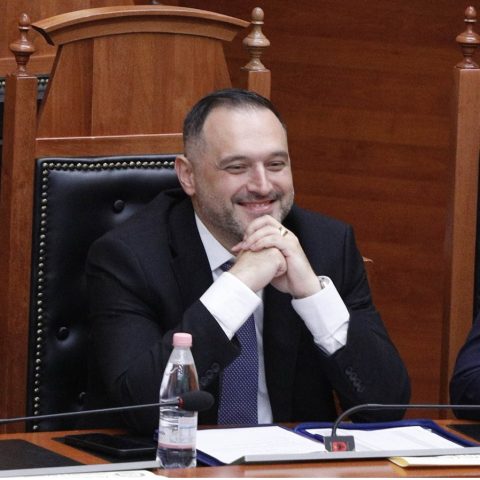
“Greece has a high level of foreign investment in Albania but Albania’s exports to Greece are low at only 3 percent, which is a factor showing that we are somehow immune economically,” says central bank governor Gent Sejko
TIRANA, April 22 – With the Greek eurozone exit edging closer as markets expect Athens to default on its debts, Albania’s central bank says it is prepared on every possible scenario.
“The Bank of Albania has been analyzing for a long time all possible scenarios in order to be prepared in case Greece exists eurozone,” central bank governor Gent Sejko has said.
Speaking in an interview with VoA in the local Albanian service, Sejko said the Albanian economy has already handled the major impacts of Greece’s six-year recession with a sharp decline in remittances from around half a million migrants in the neighboring country and a sharp cut in trade exchanges, especially exports.
“Greece has a high level of foreign investment in Albania but Albania’s exports to Greece are low at only 3 percent, which is a factor showing that we are somehow immune economically,” said Sejko.
The central bank governor assures the three Greek bank subsidiaries operating in Albania are liquid and well capitalized and have a capital adequacy ratio of 17 percent, well above the central bank’s regulatory minimum of 12 percent.
“We have been monitoring so that Greek banks are not exposed to their home country and parent banks. These banks are licensed and operate in Albania as independent banks and any deterioration in the Greek economy would not have any real and powerful impact apart from confidence factors,” added Sejko.
Speaking of the country’s economic prospects, the governor said he was optimistic of Albania’s recovery despite the ongoing spillover impacts from the crisis in Italy and Greece, Albania’s top trading partners, and problems at home with public debt at around 70 percent of the GDP and non-performing loans at around a quarter affecting business and consumer confidence.
The Albanian government and international financial institutions such as the IMF and the World Bank which are assisting in reforms, expect the Albanian economy to accelerate to 3 percent in 2015, up from 2 percent in 2014.
Possible Greek exit impacts
As eurozone officials prepare for further talks on Greece, investors are skeptical that Athens can agree reforms that will unlock further bailout funds and no deal is expected before next May. Greece’s recently elected leftwing-led government has so far failed to present a package of reforms to the IMF and its eurozone partners that those creditors deem serious enough to unlock the remaining bailout funds.
A possible exit of Greece from the Eurozone would also affect Albania, where the neghbouring country is one of the top trade partners, investors and source of remittances.
Analysts in Albania warned last December just before leftist Syriza party formed the new government, Greece’s return to its old drachma currency would have positive impacts in the short run because of the transfer of savings by Albanian migrants there but negatively affect remittances in the long run because of a weaker drachma.
Ardian Civici, an economy expert, says Greece’s eurozone exit would favor Albanian imports from Greece but damage Albanian exports to the neighboring country.
Back in 2012 when Greece was still in recession, the Albanian Centre for Competitiveness and International Trade (ACIT) had also warned of panic withdrawal of deposits if Greece returns to its old currency. Greek banks account for one-fifth of Albania’s banking system
As elsewhere in the region, Albanian banks witnessed substantial panic deposit withdrawals in the face of spillovers from instability of global financial markets, which were compounded by concerns about the health of the Greek banking system in the fall of 2008. Ample liquidity buffers were utilized to meet deposit withdrawals. To boost confidence, deposit insurance limits were raised fivefold to 2.5 million lek (€17,500), and deposits started to recover from the second half of 2009.
“If Greece abandons the Euro and reintroduces a depreciated drachma, Albanian exports to Greece would become more expensive and thus a significant drop in exports could be expected, deteriorating even further the trade balance. Secondly, Albania would receive lower remittances by at least half the value,” said ACIT.
“If Greece exits the Eurozone, the Albanian public might react by withdrawing their deposits, almost triggering a banking panic. This might disrupt the banking system and therefore have immediate repercussion on the economy,” it added.
Greece’s escape of its crippling six-year recession with two consecutive positive growth rates in the second and third quarter of 2014 is good news for the economy in Albania where the neighboring country is the second top trade partner and the largest foreign investor.
However, experts estimate that it will take years for Greece to recoup the economic ground during its worst-ever recession that has made its economy around a quarter smaller compared to the onset of recession in summer 2008.
Neighboring Greece, whose position as Albania’s second top trade partner sharply weakened during the past six years, registered a surprise increase in foreign direct investment in 2013 with its FDI stock exceeding 1 billion euros, ranking the top foreign investor in Albania, according to annual Bank of Albania data.