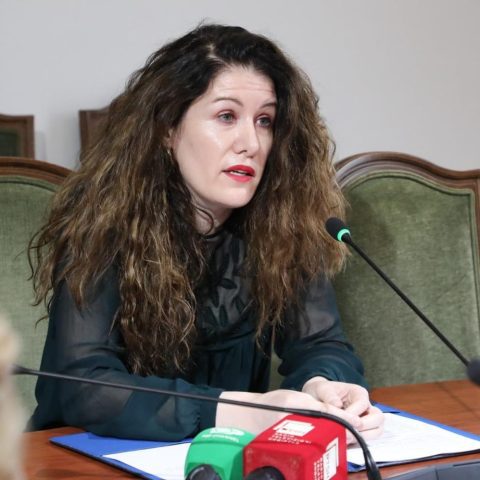
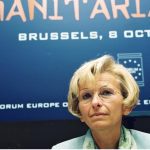
Judith Hoffmann, Political Scientist from Berlin, speaks for Tirana Times:
By Edlira Majko
Tirana Times: The Albanian Institute for International Studies and its partners organized in the end of October the international conference “Twenty Years After: Rethinking Democracy and State in Albania” where you were one of the keynote speakers. What is your opinion of the topics covered in the conference?
All topics were highly relevant for analysing twenty years of transition in Albania, and the conference brought together a wide range of national and international experts on those topics. In particular, I personally enjoyed the session on “Memories of Tirana 1990/1991” as the various presenters gave a personal account of the situation during these days and the high uncertainty whether the change would be successful and lasting. It also brought back some of my own memories of those intense days when the system of the former Eastern Germany had collapsed where people in the East were so enthusiastic about the change, while at the same time for most of them their whole life conception was turned upside down. We tend to forget those days quickly and thus, we sometimes forget where Albania is coming from.
As well, the Session on “Foreign Policy – International Relations from a totally isolated country to an active player” was very interesting as it gave the opportunity to listen to the views of experts from Albania’s neighbouring countries on the transformation in Albania. It showed the high relevancy of closer cooperation in the region, nonetheless because all countries of the region together will offer a much more attractive place for foreign direct0 investments.
I think that it would be important to continue analysing the topics of the conference, especially the one which are more relevant for the future of the country, like Albania’s European Integration Perspective, Albanian Democracy and Social and Economic Transformation. By doing so, it will be crucial to provide more space for detailed, even controversial discussions to stir our reflections on those issues and also raise public awareness. In sum, I hope that the conference is only a starting point and not a “one-time” event.
How would you assess these two decades of Albania’s transformation? How has Albania changed in these 20 years?
Albania changed a lot. Assessing Albania’s transformation, we have to take into account the starting point of the transition process which was very low. From this perspective, the changes are tremendous. You can even say Albania became a “different country”. But on the other hand, I understand that many people, Albanian citizens as well as the international community are expecting much more. They want changes to occur more quickly and with more vigor. And they are right, because as a country aspiring EU membership, all Albanian political actors have to do and actually can do much more to serve the citizens of their country.
Many political analysts assess the transformation taking a “Albania made progress, but” – type of approach, for example, the economic development is encouraging, but many reforms are being only slowly implemented, starting from building up a professional civil service to the independence of the judiciary etc. This is a legitimate approach if you look at the fulfillment of a standard set of criteria, like the political criteria of the European Union. But as social scientists, I think we have to take a broader perspective to the issues of transformation, namely as an open-ended and complex process, which involves positive as well as negative developments and thus, we have to try to understand its complexity and underlying factors.
What is your opinion of Albania’s current situation of democracy? Can we say that the Albanian democracy is a zero sum game?
I would like to take the example of the Albanian parliamentary elections and the electoral reform process to answer your question. Intriguing in the case of Albania is that even though we can observe considerable reform measures being taken towards the establishment of a formal democratic political system, Albania has been and still struggles with holding elections according to international standards – despite great support by the international community and continuous high demands for complying with international standards by the EU, the OSCE and others. On the contrary, even though the conduct of proper elections is one of the fundamental criteria of a consolidated democracy, the electoral reforms belongs to one of the most contended and contested areas of the political system in Albania. I am afraid to say that in this regard, Albanian democracy is a zero sum game as it still works according to a “winner takes all” logic, which inhibits crucial steps for change.
Can we say for sure that the Albanian transition, meaning the replacement of the totalitarian state regime with a democratic state and the transformation of a centralized economy to a market economy, has already ended?
Since the early 1990s when Albania’s transition process started, the country saw many changes in its political and economic system. While the first years were rather rocky and marked by setbacks and a major crisis after the collapse of the pyramid schemes in 1997, many steps have been taken in bringing Albania closer to a democracy and a market economy. I believe that we have to look at the state-society relation in Albania in order to understand the direction of change. As long as the attitudes of people towards the state and its political leaders remain embedded in a setting where they reward “old-fashioned” political behaviour at the elections, and at the same time, the actions of political leaders are not fully driven by providing true benefits for the whole of society, Albania will not “exploit its potentials” as much as it would be able to.