By Judge Rauf Soulio
Chair of the Australian Multicultural Council
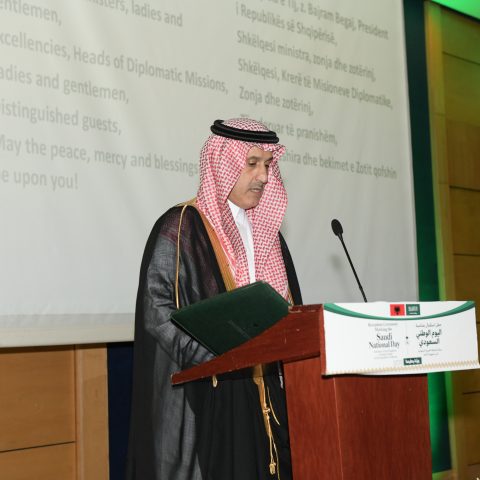
Speech held in Tirana on Sept. 30 at a reception to celebrate Australia-Albania relations.
I am honoured to be here, both as the resident Honorary Consul-General to Albania in Australia, and the Chair of the Australian Multicultural Council.
This occasion provides the opportunity to discuss with you the approach to multiculturalism in Australia and the work of the Australian Multicultural Council; the valuable contribution the Albanian community makes to Australian society; and the warm relationship enjoyed between Albania and Australia.
Multicultural Issues
Albanian Australians are a valuable part of the rich tapestry of multicultural Australia.
I wish to emphasise the benefits of diversity, and highlight how the Australian Multicultural Council seeks to support and strengthen multicultural Australia.
Australia’s Diversity
Diversity is at the heart of the modern Australian story.
Since the end of the Second World War, Australia has been transformed from a largely homogeneous Anglo-Celtic nation to one whose people come from over 300 different cultural backgrounds and speak over 300 languages, including the languages of the Aboriginal and Torres Strait Islanders, the first people of Australia.
Immigration since 1945 has seen more than seven million people settle in Australia, including over 800,000 refugees. Immigrants have come from diverse parts of the world in successive waves from Europe, Asia, Africa and the Americas
My own father arrived in Australia in 1950, after escaping persecution by walking into Greece, over Mount Gramoz in mid winter.
He was one of one hundred and fifty thousand people who made their way to Australia in 1950.
At that time he regarded Australia as a temporary home ͠but wwhen he could not return to Albania he, as with many others, made Australia his home ͠and there raised his familly.
What my father found in Australia, what all who come to Australia find, is a nation willing to welcome them, and to offer them opportunity.
The most recent Census figures show that of Australia’s resident population of 23 million people, over 10 million Australians were born overseas or have parents who were born overseas.
Almost four million people speak a language other than English at home.
Australia has a rich diversity of cultural and religious traditions.
Benefits of Diversity
This diversity brings energy and enterprise. It provides vast social and economic benefits for all Australians.
Migration grows the working population of Australia. It boosts productivity, and raises the living standards of all Australians.
Our nation’s diversity also increases our global connections, it fosters innovation, and it opens up new trade and investment opportunities.
Australian Multiculturalism
Yet although Australia has always been diverse, we have only begun to formally embrace our diversity in the past 40 years or so. In August 1973, a vision for multiculturalism was introduced by the then Minister for Immigration.
In 1975, the Australian Parliament passed the Racial Discrimination Act, which made it unlawful to discriminate against a person on the basis of their race, colour, descent or national or ethnic origin.
Our first official national multicultural policies, designed to assist new migrants to settle in Australia, were introduced in 1978, and these settlement programs continue today.
Central to Australia’s multicultural approach is the balance between rights and responsibilities.
The key social liberty of maintaining and expressing cultural traditions and language is balanced with the requirement of loyalty to Australia and its people, the obligations to uphold Australian laws and democratic principles, and the obligation to respect everyone’s rights and liberties.
The current multicultural policy, launched in 2011, makes it clear that, within Australian law, people are free to practice their cultural traditions free from discrimination.
In some countries of the world, being multicultural simply means allowing people of other ethnic or cultural backgrounds to be themselves and to be left alone. In Australia, multiculturalism involves a sustained effort in assisting those who arrive in Australia to feel that they belong, and in turn connect with Australia, and form part of a cohesive society.
The Australian Multicultural Council
Multicultural Australia also needs to be supported publicly in order to be strengthened.
The establishment of the Australian Multicultural Council was a key initiative of Australia’s 2011 multicultural policy. The Council is independent and non-partisan.
ՠ it advises government on multicultural affairs; and
ՠ it works to promote social cohesion.
The Council has been centrally involved in ensuring that all Australian government departments and agencies have a multicultural plan to make their services accessible to Australians of culturally and linguistically diverse backgrounds.
We have commenced the process of forming links between Aboriginal Australia and Multicultural Australia.
We are a key member of the National Anti-Racism Strategy.
And we have conducted visits across Australia to examine social cohesion issues at the local level.
All these activities publicly support and strengthen a multicultural Australia. Australia’s reputation as a successful multicultural nation is an important reason Australia is the preferred destination of so many migrants. As the former Foreign Minister of Australia observed: One of the main tenets of Australia’s UN Security Council campaign was highlighting that Australia is a strong democracy built on diverse cultures, and that we are one of the most multicultural countries in the world.
The Contribution of the Albanian Community to Australian Society
Albanians have a history of settlement in Australia extending over almost a century.
Today there are strong Albanian communities in Melbourne, in Shepparton, in Sydney, Brisbane, and Adelaide where I now live.
I am delighted that the city in which I grew up, Shepparton, has formed a sister-city relationship with Korce, the city near where my father was raised.
Albanians in Australia Today
Today, Albanian Australians number over 20,000. Albanians in Australia come from a diverse range of backgrounds, from Albania, from Kosova, from the former Yugoslav Republic of Macedonia, from Greece and from Italy. The Albanian Australian community is religiously diverse and, as in Albania, cooperate together and celebrate one another’s religious occasions.
The Albanian Australian community coexists together peacefully with other cultural and ethnic groups.
The ability of each community in Australia to air their views freely and peacefully is reflective of an acceptance of each other’s differences and a demonstration of the way people of different views can live side by side in Australia, all contributing to the success of the nation.
Prominent Albanian Australians
Albanian Australians have made significant contributions to Australian society – in the professions of medicine, and law, in literature, in the performing arts, and in sport. An area in which Albanian Australians have made a very important contribution is in the field of business. There are a significant number of successful, indeed wealthy, Albanian Australians, and I will return to that topic in a moment.
Part of the reason Albanian Australian communities contribute effectively is because they are supported both to retain their cultural identity and to participate in Australian society.
A number of organisations fulfil this role, including the Albanian Australian Community Associations around the country ͠an important part of retaining language, culture,, and connections with each other and with the shared Albanian heritage.
Relationship Between Albania and Australia
In our increasingly globalised world, diversity and multiculturalism have become the norm. We are all experiencing global flows of people, cultures, and ideas.
Albania has also embraced this global climate. Over the past twenty years, Albania has become a positive actor and a valued global presence. This is in large part due to Albania’s acknowledgement of the diversity of the Balkan region, and commitment to international peace and security.
Albania’s efforts have been recognised, with Albania’s entry into NATO, and the European Commission acknowledging that accession into the EU is definitely within reach.
As everyone will be aware, in February 2008, the Australian Government recognised the Republic of Kosovo as an independent state. Just as Australia has a reputation for providing sanctuary to those in need, Albania, with its strong tradition of hospitality, and the protection of guests, provided a temporary home to thousands upon thousands of Kosovars fleeing atrocities in the late 90s. Similarly, during World War II Albanians provided hospitality and protection to Jews fleeing persecution, with the result that not a single Jewish guest under protection, was lost.
Australia supports Albania’s European integration and continuing development as a peaceful and prosperous country in a stable South East European region.
In conclusion, I look forward to a continuing strengthening of the relationship between Australia and Albania. Events like today allow for joint celebration and the sharing of knowledge and ideas. This contributes greatly to reinforcing the relationship between our countries.
I value the contributions Albanians make to Australian society and a multicultural Australia. Albanians have made a home for themselves in Australia, have embraced Australia’s diversity and have made distinctive and significant contributions to the benefit of all Australians.
I would again like to acknowledge Ambassador Bloomfield and thank her for the warm way she has engaged with Albanians both here and in Australia.
I close by returning to the topic of successful Albanian Australians. I suggest the establishment, in Australia, and in Albania, of a joint Chamber of Commerce to discuss investment opportunities, trade opportunities and cultural and educational exchanges. I hope that in turn will lead to more formal diplomatic ties between our two countries.
I am honoured to have been able to speak with you today about these issues, which lay close to my heart. Long live Australia. Long live Albania.