TIRANA, Dec. 5 – Albanian farmers received peanuts after losing land and livelihoods to the major Trans Adriatic Pipeline and sharply lower compensation than their peers in neighboring Greece, a report has shown unveiling the other side of the coin for the country’s major energy project and key driver of growth in the past couple of years.
A new fact-finding mission by Bankwatch, a Czech Republic-based environmental and human rights group in central and eastern Europe, has shown that farmers affected by TAP’s Albania route were dissatisfied with the level of compensation they received and the way they were treated by the company and its Albania representatives, but had no other option.
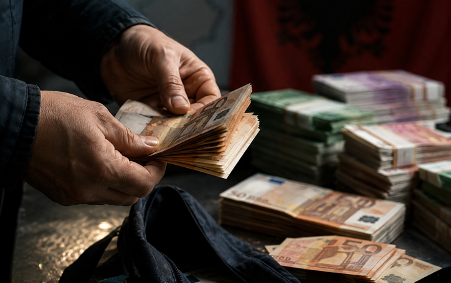
Arjan, an olive farmer in Berat, southwestern Albania, used to own 130 olive trees that were 70-80 years old. In his irrigated and well-maintained orchard, one tree gives up to 150 kg of olives per year. At a price of 150 lek (€1.12) per kg, he earned about 22,500 lek (€169) per tree every year. The compensation he received was only 25,000 lek (€187.5) per tree, hardly more than one year of his income per tree. But it will take 15-20 years until newly planted trees will give olives. And even then, they will only provide about 10-15 percent of the yield he used to have.
In effect, Arjan received the worth of one year’s olive production while losing more than 15 times that, Bankwatch experts say.
Arjan’s business not only supported a family of about 16 people, but also several seasonal workers he employed. Now he is left with next to nothing for years to come. “I don’t know what we will be doing,” he is quoted as saying by the report. “We had a good income from those trees,” he adds.
The report shows two different unjustified formulas were developed for Albania and Greece to calculate compensation for crops and land with the TAP consortium providing no reasonable grounds for its decision to treat farmers differently depending on the country.
“Although the market conditions and prices differ in Greece and Albania, the nature of impacts are identical – the pipeline crosses agriculture parcels with annual and perennial crops, causes damages to infrastructure and reduces the value of private properties. The general principles for compensation proposed by TAP are therefore the same in both countries,” says the report.
In late 2016, Albania finalized contract renegotiations with the Trans Adriatic Pipeline consortium with a new deal that will increase the country’s financial benefits by another €80 million following complaints of smaller financial benefits compared to neighbouring Greece, from where TAP crosses Albania before it reaches southern Italy through its offshore section across the Adriatic.
None of the dozens of compensation offers and agreements as well as notarial documents provided by TAP that relate to the compensation include a detailed valuation of land lease, crops and assets. Meanwhile in several cases, where a person’s land was affected, they received new certificates where the boundaries and even the size of their land had changed, says the EU-funded Bankwatch report.
Considered a project of common interest by the EU and its Energy Union, the TAP project bringing Caspian gas to Europe also curbs Europe’s reliance on Russian gas.
As the project is being considered for a staggering loan of up to €2.5 billion by the European Investment Bank, the European Union’s Bank, and London-based EBRD, Bankwatch warns European financial institutions must not support a project that violates human rights and fundamental right to property as in Albania’s case unless the compensation methodology is revised to provide fair replacement based on market prices and that the project does not lead to the loss of livelihood for all affected people.
The Trans Adriatic Pipeline consortium has rehabilitated several local roads, bridges and schools and paid attention to archeological finds during its Albania-section works in the past three years as part of its corporate social responsibility.
At the end of 2016, TAP says it completed the first phase of road infrastructure rehabilitation in Albania, comprising the upgrade of approximately 58 km of access roads, the construction of two new bridges and refurbishment of 40 bridges. Works are underway for the second phase of building access roads and by end-November 2017, more than 78 percent of works had been completed.
With investment of more than Euro 1 billion, about 10 percent of Albania’s GDP, TAP has been a key driver of Albania’s growth in the past couple of years and is expected to considerably negatively affect Albania’s FDI inflows after its completes its investment stage by late 2018.
Experts have described TAP as an opportunity that would benefit Albania both economically and politically, making the country an important hub of the international gas pipeline for the Western Balkans.
The pipeline in Albania will be approximately 211 km long, starting at the Korça region, southeastern Albania on the border with Greece.
About 13,000 pipes of mostly 18 metres are being used for the Albanian section of TAP, which also includes a 37 km offshore section in the Albanian part of the Adriatic linking it to southern Italy.
With construction works already in their peak stage, TAP’s first gas deliveries to Europe are targeted by early 2020.