TIRANA, March 29 – At a time when credit is showing sluggish signs of recovery after a one-year contraction, it is not domestic firms who have increased demand for new loans.
The 16 overwhelmingly foreign-owned banks operating in Albania seem to have found a solution to their ample deposit-funded liquidity by providing it in loans to non-residents, mainly in regional countries.
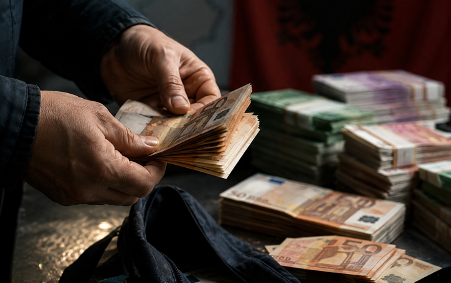
Central bank data shows loans to non-residents have followed a sharp rising trend in the past three years, reaching a total stock of 98.2 billion lek (€718 mln) in January 2017, more than double compared to early 2014. The amount is equal to about 18 percent of total credit in early 2017, raising concerns about the investment of Albanians’ savings abroad at a time when lending standards at home remain tight.
When compared to the sluggish performance of domestic credit, lending to non-residents has thrived in the past three years, according to central bank data. Lending to the economy rose by a mere 663 million lek (€4.85 mln) from January 2014 to January 2017, but was up by was up by a huge 54 billion lek (€396 mln) over the same period in the past three years, 80 times as much as the domestic lending increase.
Experts hint credit is mainly being provided in regional countries, especially in neighbouring Kosovo where euro-denominated loan rates seem more favourable. The country’s biggest commercial bank, Turkish-owned BKT bank has several branches in Kosovo, while Austrian and German lenders Raiffeisen and Pro Credit are also present there.
Lending abroad in foreign currency does not seem to worry much the central bank which has announced a de-euroization strategy that would accelerate the reduction of the current high levels of foreign currency in the country’s banking system, considered a key barrier for the transmission of its easier monetary policy and giving a boost to sluggish credit and consumption.
Lending in foreign currency, especially euro, accounts for two-thirds of total credit in the country, where half of deposits are also denominated in Europe’s single currency, making the country highly euroized.
Non-performing loans at about 20 percent continue keeping lending standards tight in Albania while demand for new loans seems to have stalled again due to political and economic uncertainties as the country heads for general elections next June while the opposition remains firm in its stance for a boycott unless a caretaker government is installed to guarantee free and fair elections.
The central bank has been holding the key interest rate at a historic low of 1.25 percent since May 2016 in a bid to stimulate sluggish consumption and investment through lower loan rates and discouraging investments in deposits. However, since late 2011 when the key rate was at 5.25 percent, the central bank’s easier monetary policy has been mostly reflected on deposit rates and T-bill yields on government’s internal borrowing, rather than lower loan interest rates.
Credit officially returned to positive growth rates in the third quarter of 2016, overcoming a one-year period of contraction also affected by the write-off of non-performing loans from banks’ balance sheets artificially keeping credit at statistical negative growth rates.
Lending to the economy has been striving to maintain positive growth rates since 2012 after growing by 30 to 50 percent annually in the pre-crisis years, an average of 10 percent from 2009 to 2011 and sluggish growth rates of 1 to 3 percent in the past few years.
The poor domestic credit and high level of non-performing loans in the past few years has not affected the performance of commercial banks in the country which have benefited from lower saving interest rates, invested abroad, and continue dominating about two-thirds of domestic government debt.
Central bank data shows the 16 overwhelmingly foreign owned banks operating in Albania reported net profits of 9.27 billion lek (€68.5 million) in 2016, down 40 percent from a historic high of 15.7 billion lek (€116 mln) in 2015.
The Albanian economy is estimated to have grown between 3.2 to 3.4 percent for 2016 and is expected to pick up to 3.8 percent in 2017, in figures which experts say does not produce welfare for the current stage of the country’s development.
Experts say the Albanian economy, one of Europe’s poorest, needs to grow by at least 6 percent annually, a rate it enjoyed for about a decade until the outbreak of the global financial crisis in 2008, in order to produce welfare for households.