By Sashenka Lleshaj
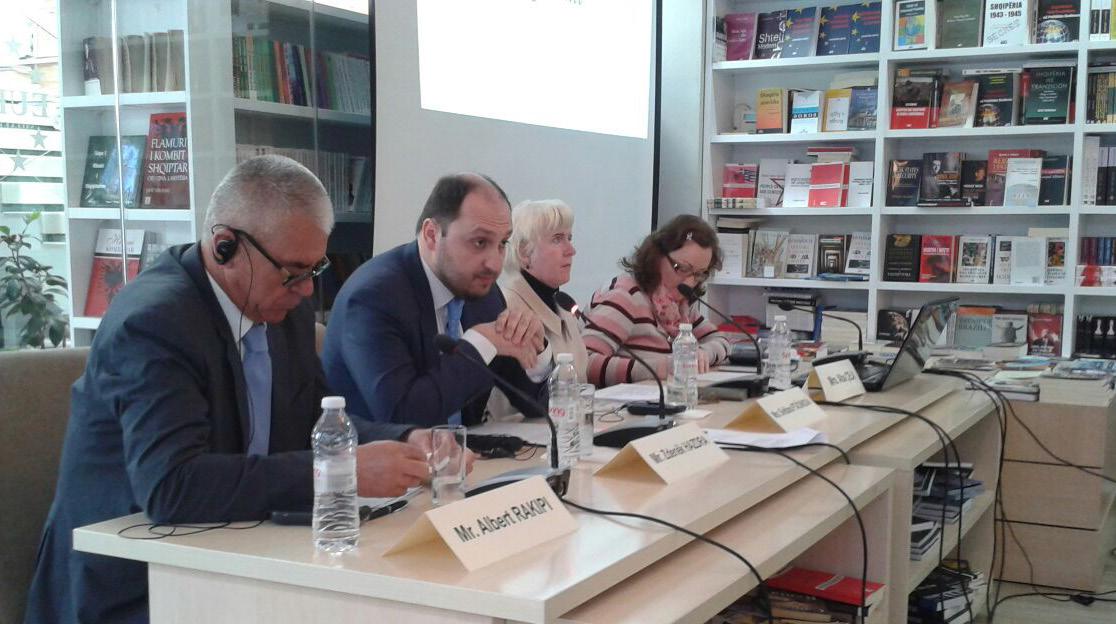
The Albanian Institute for International Studies launched Wednesday its newest series of talks “Dealing with the Past”, which will continue to run throughout 2015.
At the centre of the series of reflections is the need to open a pro-active debate among researchers, policymakers and citizens in the context of the 25th anniversary of the fall of communism in Albania.
While it took Albania a quarter of a century to find the courage to deal with its painful past, this series tries to promote a much needed inclusive public debate to accompany the recent initiatives to open the communist files in Albania.
Through these lectures, AIIS will bring to Tirana the experience of other countries of the post-communist space as well as insights from relevant experts on the field.
The first lecture of the series brought to Albania the valuable experience of Czech Republic in dealing with both the period of Nazi occupation and the Communist dictatorship.
Under the title “The role of the Institute for the Study of Totalitarian Regimes and of the Security Services Archive in the process of knowing and understanding the period of the Nazi occupation and of the communist dictatorship in the former Czechoslovakia (1938-1989)”, Zdeněk Hazdra, director of the Institute for the Study of Totalitarian Regimes (ISTR) and Ms. Světlana Ptáčníková, director of the Security Services Archive (SSA) shared the long process of opening the files of the Czechoslovak intelligence services, the StB, and the challenges encountered in making them fully available and accessible to the public.
Czech Republic has developed a full institutional structure under the ISTR in dealing with past records of agents and allegations of collaborations while the institute itself has broad independence (the election and recall of the members of its supreme Council is done by the Senate of the Parliament of the Czech Republic).
The legislative measures in this regard started in early 1990s and continued throughout 2000s in gradually extending public access to archival materials. While describing in detail the legislative and structural measures their country went through and the work that is still going on, both speakers emphasized the fact that the process has been accompanied by a calm atmosphere with no major scandals involving state officials (the case of the allegations against the current Czech Minister of Finance, Andrej Babiš, were not elaborated by the speakers).
Although the former Eastern Bloc was not homogeneous in terms of the countries’ experiences with communism and the transition period (some were invaded by the Soviet Army and others were not, some developed a more severe Stalinist dictatorship and other tested more liberal forms of socialism, some renewed their communist elites in the early post-communist period and other recycled their communist elites to a great extent), nevertheless the cross-country experience of dealing with the past is valuable to late-comers in the process, such as Albania. Especially the Czech experience – a country as closed as Albania after the events of 1968 and with a similarly strong and patronizing intelligence service (the StB in Czechoslovakia and Sigurimi i Shtetit in Albania) – can be valuable to Albania while the country is starting such an important process of opening the communist files.
Following the questions from the audience both speakers emphasized that Albania had to try its best to avoid the political instrumentalization of the process. This may become the most delicate part of a process that is already painful on its own. The way the process is handled, the way responsibilities are shared and the way people are categorized may be even more important than the result itself. Furthermore, another suggestion was for the public to be informed throughout the process. Czech experience showed that an important part of the process was the communication of results, especially with teachers and schools, in order to discuss the best ways to educate the next generation about past events and the potential need of revising history books.
The way we handle the past tells a lot about our present and defines the way the future is approached. The late developments in Albania in regard to the opening of the files of communism tell a lot about the country’s transition period while the way the process will be handled will define the way the communist period in Albania will be regarded in the country’s collective memory.