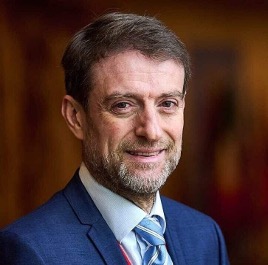
Suma Chakrabarti, the president of the European Bank for Reconstruction and Development says Albania, Macedonia and Kosovo countries must think regionally and promote regional cooperation through joint infrastructural projects
TIRANA, April 23 – London-based EBRD says Albania, Macedonia and Kosovo must intensify cooperation to handle crisis impacts better. Speaking in an interview with VOA in the local Albanian service, Suma Chakrabarti, the president of the European Bank for Reconstruction and Development said all three neighbouring countries must think regionally and promote regional cooperation through joint infrastructural projects such as highways and railway, and the Durres Port whose extension and modernization by EBRD is turning it into a regional hub.
Albanian central bank governor Ardian Fullani has also stressed that increasing regional cooperation will make the Balkan economies stronger in their growth prospects and more protected to crisis threats. Criticizing the drafting of development strategies with a clear national character as problematic for the region’s long-term sustainable growth, Fullani has stressed in regional conferences that “lack of regional viewpoint does not favour the individual success of small economies in the global economy.”
Asked about the Eurozone crisis impacts on the three Western Balkans countries countries, Suma Chakrabarti said he was confident all countries including Macedonia which registered a slight shrink of 0.3 percent in 2012 would recover in 2013 with their growth rate accelerating.
“I think this year they must consolidate their fiscal status and continue with the reforms they are implementing while global recovery takes place. These countries are small economies but I think they could benefit from the recovery of the global economy if they take measures through their economic policies now. I am confident this will happen because these countries have a business spirit and political commitment to do what it takes,” said Shakrabarti.
Speaking about Albania, whose economic growth slowed down to 1.6 percent in 2012, down from an average of 3 percent during the global crisis years of 2009 to 2011, the EBRD President said Albania must do more to promote the country’s image by attracting more foreign direct investment and reducing the country’s dependency on remittances from crisis-hit EU top trade partners Italy and Greece where an estimated more than one million Albanian migrants live and work.
“I think the key issue in Albania is that it is highly dependent on remittances from Italy or Greece. That is why the Albanian economy must recover. Albania must promote itself better among foreign investors even better than in the past. In Albania, the business spirit is quite good. I must stress that Macedonia has done a great job in marketing and has attracted a great number of investors, and that is why my message for regional countries is ‘Look at how Macedonia has worked and adjust its model to your country,'” said Suma Shakrabarti.
Praising Albania’s hydroelectricity resources, the EBRD President reconfirmed the bank’s commitment to engage in regional projects.
During his first visit to Albania last February, EBRD President Suma Chakrabarti reconfirmed support to Albania, where the bank has emerged as one of the largest investors in the private sector.
In a joint press conference with Prime Minister Sali Berisha, Chakrabarti called on the Albanian government to undertake further reform that would improve the business climate and keep the economy growing. “We think that further reforms are needed in the tax administration, land ownership and the legal framework, which of course are difficult issues for a country. The further improvement of the business climate would help us bring more investors to this country,” said Chakrabarti.
In its latest economic outlook issued last January, the European Bank for Reconstruction and Development expected the Albanian economy to grow by 1.8 percent in 2012 and 2 percent in 2013 up from 0.6 percent and 1.3 percent respectively last October.
“Albania’s economy slowed down significantly in the first half of 2012, but some growth returned in the third quarter, largely as a result of recovery in manufacturing and extractive industries. However, Albania’s strong trade, investment and remittance ties to Greece and Italy, both of which face continued economic gloom, are likely to continue to constrain growth in the coming year, and the high level of public debt, at close to the statutory limit of 60 per cent of GDP, will limit the room for fiscal manoeuvre,” says the report.
The EBRD is one of the largest investors in the private sector in Albania. Since the beginning of its operations in Albania, the EBRD has invested over Euro 700 million in various sectors of the country’s economy, mobilising additional investments of more than Euro 2 billion from other sources of financing.