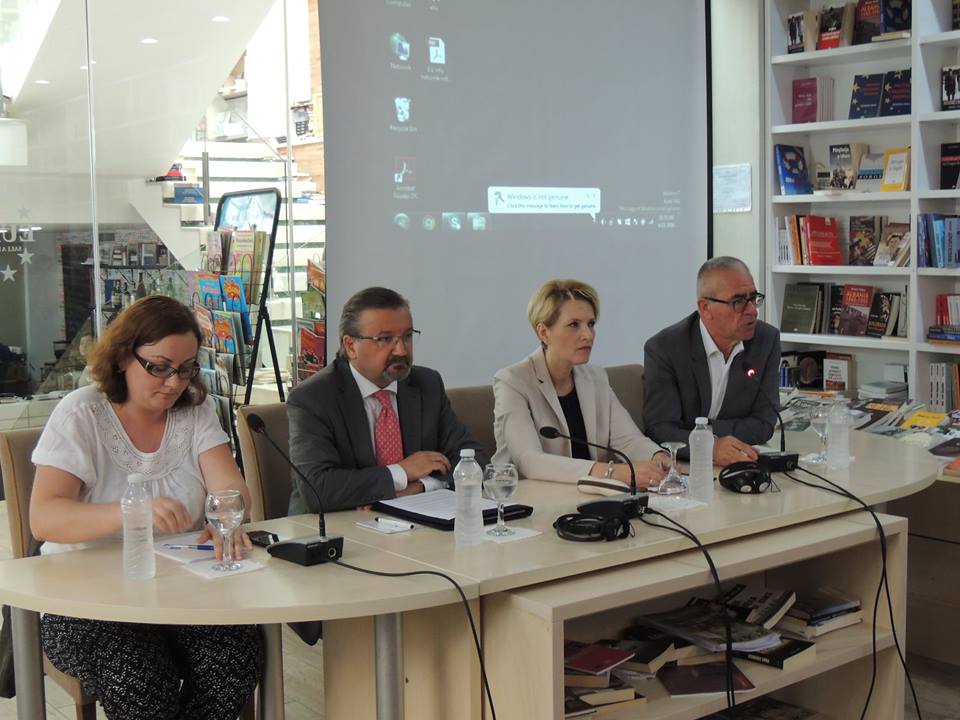
TIRANA, June 21 – Euro-Atlantic integration can prevent new conflicts in the Western Balkans, one of Europe’s most endangered regions, Defense Minister Mimi Kodheli said on Tuesday at a seminar held in Tirana ahead of the NATO Warsaw Summit next July.
“Albania is situated in one of Europe’s most endangered regions where Euro-Atlantic integration has been delayed and the economic situation lags behind. Albania is the only NATO member while Montenegro is finalizing its membership. Bosnia and Herzegovina, Kosovo and Macedonia have not been able to join the Alliance yet although being potential candidates for several years,” Kodheli said at a seminar organized by the Polish embassy in Tirana and the Albanian Institute for International Studies (AIIS).
Albania has been a NATO member since 2009 and is hoping to open EU accession talks after being granted candidate status in mid-2014, but has to adopt a long-awaited justice reform and tackle corruption before being given the green light by the European Commission.
The Western Balkans, also known as Europe’s powder keg, has seen many armed conflicts, but has mostly been in peace since a NATO-led military intervention against Serbian occupying forces in Kosovo in the late 1990s.
“The road to EU is more complex for Western Balkans countries and also for Albania. Political insecurity and economic difficulty are waning the integration dream and at a time of such conflicts we all agree that the emergence of new conflicts could be easily prevented by integration processes,” said Kodheli.
Polish Ambassador to Tirana Marek Jeziorski described the upcoming Warsaw summit as crucial to tackle new threats of Russian aggression and acts of terrorism .
“The Summit in Warsaw should achieve three key objectives. It must be universal to respond to the challenges in the area of security of the entire Alliance. It must be current so that decisions which will be taken are based on the latest data and analyses, allowing to take into account the most likely scenarios of the turn of events. It must be decisional so that the provisions adopted in its course precisely define the way to strengthen the capacity of defence and deterrence,” said the ambassador.
“The fulfilment of these three conditions will make a potential aggressor aware of the high unprofitability of attack on any member of the Alliance,” he added.
The Ambassador also praised Albanian-Polish cooperation as NATO allies.
“In recent months we witnessed a growing military cooperation with Poland. Our navies will serve in the Aegean Sea operation. Participation of Albanian troops in the NATO military exercises in Poland, Brilliant Jump-2016 and Anaconda-2016 are the most visible and appreciated examples of our allied friendship and brotherhood-in-arms,” said Jeziorski.
Albert Rakipi, the director of the Albanian Institute for International Studies, said the Warsaw Summit will be one of the Alliance’s most important events due to a fundamental change in the current security environment with potential aggression in NATO’s eastern borders, terrorism, the migrant and economic crisis.
“A possible Brexit could also create unfavorable circumstances for the Alliance considering the close EU-NATO relations,” said Rakipi.
“This hierarchy of threats and this context of political developments in Europe but also in the U.S. make the Warsaw summit one of the most important where the Alliance has to decide on a number of important issues including debates over NATO’s new role in a totally different security environment,” said Rakipi.
NATO ‘s Parliamentary Assembly, gathering for the first time ever in Tirana late last May, called on alliance members to boost up collective defences to face an increasingly aggressive Russia.
Albania has offered to establish a NATO Center of Excellence to study the phenomenon of foreign fighters.
An AIIS study has unveiled most of Albanian fighters in Syria come from poor undeveloped areas where they live in isolation and are lured to join ISIS because of socio-economic conditions.
The Albanian Institute for International Studies has been researching on radicalism after more than 100 Albanian citizens were reported to have joined ISIS, focusing on what drives them to join extremist violence.