By: Anastasia Nazarko
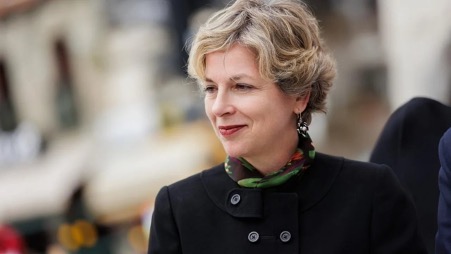
TIRANA, Dec 1 – The Montessori model of education is one that has developed into a significant alternative to what most consider “traditional” education. The vision of Italian physician and teacher, Maria Montessori, this approach emphasizes independence of students, and respect for each child’s natural psychological development. Though these elements have gained popularity and seen Montessori education spread throughout the world, Albania’s exposure to the model has been modest. As a result, Russian-American educator and international representative of the Montessori Foundation, Zhanna Salitsky has come to the small Balkan country to better understand the needs of the community and the efforts required to expand the Montessori program.
“The Montessori approach is very unique and different from the predominant education system in Albania that provides for a conventional leader-follower relationship,” observes Zhanna.
“For example, the Montessori system typically consists of large classes with children of different ages who follow the same program for a period of two to three years each. We also do not place as much value on homework, the way other schools do. All of these elements, and others, have proven to be causes of skepticism here in Albania. This needs to be addressed before further expansion can begin.”
“We don’t want Montessori schools to be restricted to the wealthy or the foreign community. Montessori is an educational philosophy and approach that can be found in all sorts of settings, from the most humble to large, well-equipped campuses. In general, Montessori schools consciously strive to create and maintain a diverse student body, welcoming families of every ethnic background and religion”
In fact, Zhanna emphasizes the fact that the unconventional Montessori approach is one that Albanian students could benefit from. For example, by placing children of different ages in one class, the approach is combating the common notion that a teacher is the sole source of instruction. Zhanna notes that students should also be able to learn from each other. Younger students can learn from older ones, while the older students benefit from acting as a role model to the others. Furthermore, by providing a large combination of students, each one is likely to find other peers who learn at the same pace. As a result, the classroom becomes a more dynamic environment in which students are allowed to help each other and truly understand the materials, rather than simply learning under the pressure of a teacher-imposed pace.
“Dr. Montessori believed that teachers should focus on the child as a person, not on the daily lesson plan. Montessori teachers lead children to ask questions, think for themselves, explore, investigate, and discover. Their ultimate objective is to help their students to learn independently and retain the curiosity, creativity, and intelligence with which they were born,” explains Zhanna.
“While conventional teachers have told us that they ‘teach students the basic facts and skills that they will need to succeed in the world,’ studies show that in many classrooms, a substantial portion of the day is spent on discipline and classroom management. This is why, Montessori teachers usually present lessons to small groups of children at one time and limit lessons to brief and very clear presentations. The goal is to give the children just enough to capture their attention and spark their interest, intriguing them enough that they will come back on their own to work with the learning materials,” she adds.
Though critics may contend that such a program lacks structure, Zhanna also explained that there are measures used to evaluate and monitor each child’s progress. Oral quizzes as well as written tests are common; although standardized tests are usually only given to older students. In addition, the children take tests prepared by their peers, participate in self-evaluations, develop student portfolios for evaluation, and receive narrative progress reports from their teachers. Ultimately, however, the Montessori approach tries to present assessments to its students as a challenge, rather than pressure for good grades.
“In Montessori schools, students learn to collaborate with each other rather than mindlessly compete. Students discover their own innate abilities and develop a strong sense of independence, self-confidence, and self-discipline. In an atmosphere in which children learn at their own pace and compete only against themselves, they learn not to be afraid of making mistakes. They quickly find that few things in life come easily, and they can try again without fear of embarrassment. Dr. Montessori argued that for an education to touch children’s hearts and minds profoundly, students must be learning because they are curious and interested, not simply to earn the highest grade in the class,” the Montessori representative explains.
However, Zhanna is also quick to note that the approach remains aware of cultural norms regarding what children are expected to know by a given age. As a result, Montessori teachers are careful to provide structure within the freedom which students experience.
“The prepared environment of the Montessori class is a learning laboratory in which children are allowed to explore, discover, and select their own work. The independence that the children gain is also intrinsically involved with helping them become comfortable and confident in their ability to master the environment, ask questions, puzzle out the answer, and learn without needing to be “spoon-fed” by an adult. Even children who are highly gifted will find Montessori to be both intellectually challenging and flexible enough to respond to them as unique individuals,” adds Zhanna.
In the end, the Montessori representative recognizes that the liberal nature of the program may appear strange at first, especially given the educational precedents set by Albania’s communist regime. However, she also believes that expanding the concept of education could prove beneficial not only to students, but to the society as a whole.