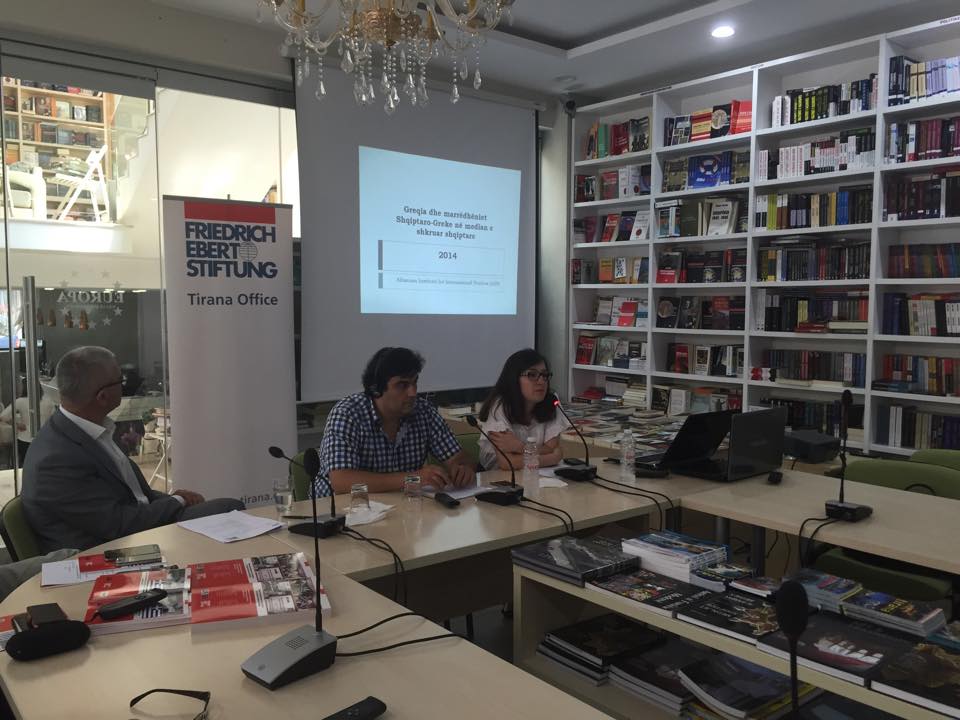
The Albanian Institute for International Studies (AIIS) and Friedrich Ebert Stiftung (FES) organized the conference “Greece and the Albanian-Greek relations in the Albanian printed media 2014”. AIIS and the Hellenic Foundation for European and Foreign Policy (ELIAMEP) in Greece, supported by FES, are conducting a joint study on the modalities of media reporting about the neighbouring country and people in both Albania and Greece. During this first conference, AIIS’s researcher Sashenka Lleshaj presented the finding of the study on the Albanian media and the researcher from ELIAMEP, Panagiotis Paschalidis, outlined the primary findings from the Greek media as the project in Greece will be finished in autumn 2015. A second conference will follow in Athens once ELIAMEP concludes its study.
During the conference opening remarks, Dr. Albert Rakipi, the Executive Director of AIIS and Frank Hantke, the Executive Director of FES in Tirana underlined the importance of the media in shaping public perceptions in both countries. Andi Balla from Tirana Centre for Journalistic Excellence (TCJE) elaborated the character of media reporting in Albania and some broader trends that are visible when reporting about neighbouring countries.
The second panel focused on the studies and their main findings. The monitoring of the Albanian media outlets was conducted over a period of seven months, from January 2014 to July 2014. This study analyzed a sample of 225 articles from three daily Albanian newspapers published in Albanian – Shqip, Panorama and Mapo – and one weekly Albanian newspaper published in English – Tirana Times. The study shows that the Albanian media is very sensitive towards news related to the Albanian-Greek relations given the fact that from the analyzed sample, 213 articles have been published by the three daily newspapers in 7 months, which means at least 10 articles per month/each on average. Obviously, the intensity was not consistent as it depended on the specific issues that were ‘hot’ at the moment and which attracted public opinion’s attention the most. Thus, January, April and June had a relatively high level of articles on issues related to the Albanian-Greek relations, with April being the frontrunner with 61 articles in total.
The report peaks in January, April and June were related to three issues in particular: (1) the Greek Presidency of the Council of EU and the bilateral high level visits between Albania and Greece; (2) the Kareli case: the killing of an Albanian prisoner in a Greek prison; and (3) a mix of issues, although it is mainly related to the coverage of the administrative reform in Albania and the side implications this could have for the Greek minority in Albania. Other issues covered in a more balanced way throughout this seven months period were: the issue of the toponyms of birthplaces in the Albanian passports of Albanians born in Greece, the Cham issue and issues related to the Albanian Orthodox Church.
Furthermore, from the analyzed sample it looks like the Albanian media widely covers political and socio-political issues which also demonstrate a hunt for sensational stories that would produce headlines and thus provoke reaction in the Albanian public opinion.
By using a basic content analysis with a specific emphasis on connotation the study divided articles in four main categories: positive connotation, neutral connotation, quasi-negative connotation and negative connotation articles. The study found that during the seven months period results were mixed although the negative connotation articles were the biggest group with 35% of the sample. The neutral connotation articles represented 28% of the sample while the quasi-negative articles and the positive articles followed with 24% and 13% respectively.
Despite the above ‘negative’ picture, the study showed that reporting in the Albanian media was situational, depending on the specific case under consideration, and it varied considerably from case to case. Thus, this period saw the Albanian media moving from ‘happy’ stories to ‘bitter’ ones in a very short period as it was the case with the vastly positively covered Greek Presidency of the Council of EU and the bilateral visits in January and February (with 47% of articles having a positive connotation) to the vastly negatively covered Kareli case (with 68% of articles having a negative connotation) in March and April. In between these stories and all over the period other stories were covered mainly through a neutral connotation as it was the case with the issue of toponyms of birthplaces in the Albanian passports of Albanians born in Greece (45% of articles had a neutral connotation).
Thus, given the above picture and especially the vehement way the Kareli case was covered in the Albanian media, the study also considered the general distortion of the data because of such an outlier and unusual case which is not representative of the Albanian-Greek relations in the long-term. Accordingly, if the data was analyzed without the Kareli case, the picture would be considerably neutral, with the neutral connotation articles representing the biggest share with 35% of the sample.
Although reporting in the Albanian media was situational depending on the case under consideration, there were some main themes throughout the sample which could be noticed despite the case, especially when articles had a negative connotation. These were:
- Relations with Greece should be handled carefully as the country cannot be fully trusted. This theme was present throughout the study in all three case studies that were analyzed especially in the negative connotation categories of each case. In the case of the Greek Presidency of the Council of EU, the bilateral visits and the EU candidate status of Albania, the message was: Greece is a rational actor, aiming at its own interest and will certainly ask something in return for its current support to Albania and the closer ties with Albania. These articles were mainly counterbalancing the more enthusiastic ones on the subject. In the case of Kareli and the toponyms, the message was: the same old Greece that cannot be trusted when it comes to the most sensitive issues with Albania and Albanians.
- Greece mistreats Albanian migrants in many dimensions. This category of articles was present in both Kareli and the toponyms case and portrayed Greece as a systematic violator of Albanian migrants, that tortures them, bans them from seeing their families, bans them from entering Greece, makes their lives difficult even when they are born and have lived in Greece since then, violates their basic human rights, etc. This category of articles often was accompanied by a national collective victimization of Albania and Albanians towards Greece. These articles were also aiming at provoking an emotional effect to readers.
- There is a potential in the Albanian-Greek relations for a long-term partnership. This theme was present in the positive connotation articles when reporting bilateral visits and the finalization of the agreement that resolved the issue of toponyms. These articles were extensively referring to the novelty of developments with terms such as: ‘new start’, ‘new chapter’, ‘new partnership’.
- Albania and Greece can resolve issues but they are far from a ‘romantic affair’. This theme was mainly present in the neutral connotation articles and aimed at balancing enthusiasm for new positive developments in the Albanian-Greek relations with the issues that are still to be discussed and solved between the countries. This theme was especially present in the case of bilateral visits and Greece’s support for Albania’s EU candidate status as well as in the May coverage of the resolution of the issue of toponymes.