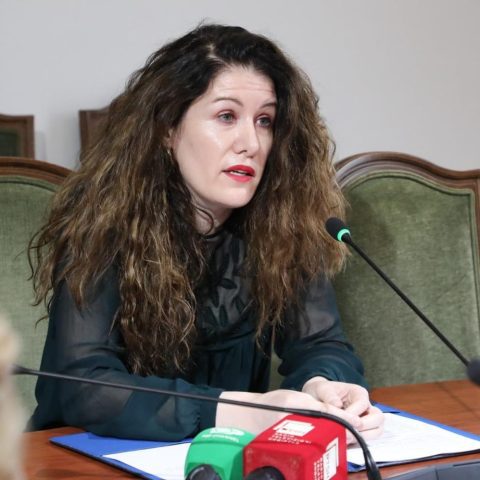
Tirana, 3 April 2008. The Governor of the Bank of Albania, Mr. Ardian Fullani, spoke April 3 in The Forum to members of Albania’s financial community. The meeting was called to debate the functioning of the financial markets, its supervision, and financial stability.
A successful year
In general, financial year 2007 was very successful. The net revenue of the bank increased by 42 percent compared to 2006. The total assets of the bank increased by 19 percent, coming to 118.6 milliards compared to 2006. The credit surplus in 2007 increased by 47.7 percent, reaching 94.5 milliards compared to 2006.
Albanian banks are offering new products to individual and business customers. Eleven banks are using secure electronic transactions and three of them are offering on-line bank services. During 2007, Albanian banks opened 103 new branches and offices, 43 just in the Albanian capital, Tirana.
Also in 2007, the organization of the credit register began recording all loans contracted by persons and businesses, enabling the banks to assess the risks they incur when granting loans, and to avoid bad loans.
World financial crisis has little effect on the Albanian financial market, says Fullani
Fullani noted that the Bank of Albania is worried about the “relatively complex situation in global developmentsŮ.because of several factors related to the characteristics of the development of the financial activity in the country, it is not expected that the difficult situation in the international markets is going to have a real and substantial effect on the internal financial market”. However, the situation remains indeterminable and unstable and, therefore, its effect on the Albanian financial market possibly will change. The banks should be very cautious and observe and analyze global trends, warned Fullani.
It was also noted that a prolonged and more severe crisis in international financial markets may have a limited effect on Albanian financial markets. First, unstable exchange rates are going to increase the risk of loans in foreign currency, especially of consumer loans. Second, a slow down in the regional and global economy may have negative effects in several sectors of the Albanian economy and, consequently, affect those banks that finance these sectors. Third, the Albanian economy may be affected by a combination of a credit crunch in global financial markets and increase in the price of energy and raw materials.
No, no, no, to loans in foreign currency
Mr. Fullani warned in unequivocal terms against issuing loans in foreign currency, especially with consumer loans. “To finance individual consuming in foreign currency is the same as selling food products without an expiration date”, Fullani said. The Bank of Albania is deeply worried that commercial banks are trying to grab a larger share of the loan market by neglecting the quality of both consumer and business loans. It is intolerable, he said, that the difference between the bank interest rate for time deposits with one-year maturation and loan interest rates for loans with the same maturation time is 7.3 percentage points. The same difference between the time deposits in foreign currency and loans in foreign currency is only 4 percentage points. This artificial difference and huge marketing campaigns are creating a public perception that borrowing in foreign currency is cheaper and even less risky. “The Bank of Albania thinks that individuals and companies are not taking into consideration the risk of disruptions in the currency exchange rates that can multiply the cost of loaning in foreign currency and increase the number of bad loans. It is even worse if the bankers themselves do not appreciate this risk and continue to advocate loaning in foreign currency”, said the Governor of the Bank of Albania.
Risk management raises concern
Fullani further warned that the banks are not showing the necessary prudence in their lending practices. “Let me remind you, you manage the savings of the Albanians and consequently, your risk exposure does not endanger only your capital, but the capital of the individuals also”, Fullani said.
The Governor of the Bank of Albania called for new internal procedures based upon the new regulation, “One basic criteria for the management of banks, and branches of foreign banks, and their administrators”.
Transparent to the public, no small print
Fullani said Albanian banks are not sufficiently transparent. First, he said, every bank customer is entitled to know the financial situation of the bank in which he has deposited his own savings. Second, transparency gives customers the opportunity to find the best bank to save or to borrow money. Third, the banks should explain in detail to customers what they offer and their contractual terms are.
Optimal liquidity structure
The Bank of Albania, said Fullani, is going to increase its efforts to create an optimal liquidity structure in order to encourage the activity in the inter-bank market. Bank of Albania is unsatisfied with the current structural liquidity surplus that is accompanied by passive behavior from commercial banks.
The Bank of Albania is planning to relax the rules governing reserve requirements. However, it is up to the commercial banks to train their people and to transform these possibilities into revenue for their shareholders.
Further, the Bank of Albania is preparing a draft law on the repurchase agreements between commercial banks. In the Euro zone, the repo market is the largest inter-bank market, constituting almost 35 percent of the total trade. Bank of Albania expects that those Albanian banks owned mostly by large European banks, are going to show the same interest in the repo market as their major shareholders.
Bank of Albania and its monetary policy
The main priorities of the Bank of Albania are the stability of the banking system and the efficiency of the financial market. The Governor of the Bank of Albania explained the three fundamental elements of the monetary policy of the Bank of Albania.
First, the Bank of Albania is going to signal its monetary policies only through the decisions of the Supervisory Board of the Bank of Albania regarding the interest rate. Second, its main instrument to implement the monetary policy is, and is going to be, repurchase agreements with one week fixed maturity. Third, the use of repo agreements with longer maturity or the use of other auction forms, do not signal a change in its monetary policy, but they are simply operational techniques for the efficient intervention in the financial market.