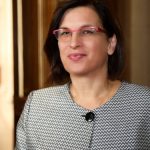
As the Austrian Development Cooperation marks its 20-year anniversary in Albania, the head of ADC’s Tirana office, Astrid Wein, discusses the work of the organization and the Albania-Austria relationship in an interview with Tirana Times.
Tirana Times: Austrian Development Cooperation is marking its 20-year anniversary in Albania. In that time the organization you lead here in Albania has been involved in a series of activities ranging from helping providing access to safe drinking water to building professional skills to improve the Albanian economy. You have also worked with gender equality and social inclusion projects as well as environmental and green energy issues.
Q: But let’s start from the beginning, why did ADC first come to Albania two decades ago?
A: In the early nineties Austria supported Albania primarily with humanitarian assistance to respond to the immediate needs of the Albanian citizens, however improvements for small infrastructure interventions such as repair of school roofs, etc. were financed soon upon request of the desperate municipalities. Building on the traditional historical ties Austrian Development Cooperation decided to focus its assistance on Northern Albania. Apart from the humanitarian assistance, Austria, of course, was motivated to support Albania’s transition to a democratic state. We were also very much interested in seeing a fast integration of Albania in the region and in Europe. When I say Austria, it is not only meant the Official Development Assistance, Austrian people were engaged in many forms to support this isolated country suffering from cruel dictatorship.
Q: What kind of change have you seen in this country over the past two decades?
A: We have seen a lot of changes related to the improvement of the infrastructure such as the water sector where Austria has put a focus of its assistance; we see a very dynamic society striving with full enthusiasm to catch up with the world and become integrated in the global market, for example by introducing IT technology. However, we also see some huge challenges Albania is dealing with when it comes to waste and pollution. If Albania really wants to become an attractive tourism destination in order to boost the economy, it needs to tackle the environmental issues seriously and quickly.
Q: How did you select the areas in which you’ve worked so far?
A: One criterion to identify the focus areas of intervention is of course know-how, i.e. where can we add value and provide our expertise appropriately considering the respective country context. The water sector is a traditional area where Austria has much to offer considering the high quality of drinking water available to Austrian citizens, another area is Vocational Education and Training. Austria has the second lowest youth unemployment rate in Europe and we strongly believe this is related to the school system where 80% of pupils attend professional schools so they can become equipped with the best possible skills for the demands of the labour market.
Another criterion to define the intervention area is close coordination with other donors. This coordination is guided by the Albanian government, which negotiates the assistance programme with the respective donors.
And all our interventions have to be guided by the mandate given to the Austrian Development Cooperation by the Austrian Parliament to contribute to poverty reduction as well as to social justice by applying a human rights-based approach.
Consequently, we are engaged in areas to boost the economy and at the same time to address social inclusion and injustice. Examples for this in Albanian are that ADC is very much engage in regional development – an area where we would like to introduce new concepts of regional development applied in many EU countries and the region and our engagement to support the social sector reforms with a particular focus on improving social services. We financed and provided technical assistance for the establishment of Child Protection Units which started as pilots and are institutionalised in 64 Local government units by now. We are convinced and hope that by this reform children’s rights are going to better fulfilled and protected, especially for children in need and at risk.
Q: Can you give one or two examples of the kind of impact have you seen from these projects?
A: Our support and contribution to improve the water supply in Shkodra is remarkable and I think without the significant investment of Austrian Development Cooperation Shkodra’s water supply would not be at that stage as it is today.
We have seen considerable improvements in regard to human trafficking and believe that our technical assistance has supported the Albanian government in tackling the issue. We are very glad to see the institutionalisation of the previously mentioned child protection units at local level as one of key milestones in the social sector reform.
Q: What’s next for ADC in Albania?
A: Over the course of the next two years, we will continue to assist the water sector with a special focus on strengthening the capacities of water utilities to increase their performance; finalise our programme in the Vocational Education and Training (VET) sector and we hope that with our regional development programme in Northern Albania new concepts such as a Regional Development Agency, effective planning for sustainable regional development, etc. will be take off.
And, of course, our engagement for social inclusion will continue to support people who are affected by the transition process and provide opportunities to re-integrate them into the society such as Roma, Egyptians, disabled, elderly, children at risks, etc.
By the endof 2014, the ADC Office in Albania will be closed. However, the strong partnership between Austria and Albania will continue building on the more than 20 years of close cooperation.
Q: Austria has an ever increasing presence in the region. In Albania, this is strongly felt through major private Austrian investments in the banking and insurance sectors. How do you see the current and future relationship between the two countries?
A: As mentioned at the beginning of this interview, Austrians are very much interested in Albania in general; therefore there is a significant engagement of the Austrian business sector in Albania. Austrian Development cooperation is supporting business partnerships between our two countries.
However, we have observed that there is often a need to increase the skills set and qualifications of Albanian employees as potential Austrian business partners would expect increased managerial as well as technical capacities from their Albanian partners. Another area which hinders Austrian investments is corruption which does not at all contribute to an enabling environment for sustainable economic development.
Q: Is there anything else you’d like to add?
A: Austrian Development Cooperation would like to thank all the partners for their constructive and fruitful engagement and cooperation. Without the sincere engagement on the part of our partners, Austrian Development Cooperation would not have been successful and in addition, we would not have continued to support Albania, were it not for the ownership and willingness for change.