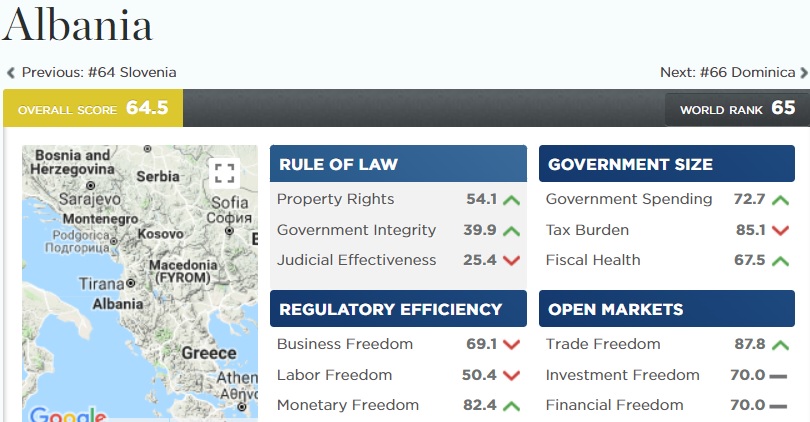
 TIRANA, March 1 – Albania failed to make any significant progress in its economic freedom performance over the past year as it maintained its 65th place among 180 global economies, according to the 2018 index of economic freedom published the by Heritage Foundation, one of the top think tanks in the U.S.
The report ranked Albania as a moderately free economy, performing better than regional EU aspirant competitors Serbia, Bosnia and Herzegovina and Montenegro in four broad policy areas that affect economic freedom such as rule of law, government size, regulatory efficiency and open market.
Neighboring ethnic-Albanian dominated Kosovo which this year marked its 10th anniversary of independence ranked 56th, losing 10 places compared to last year’s ranking on a steep decline in property rights and labor freedom indicators.
Macedonia, which has the region’s lowest tax burden, is the only EU aspirant regional economy that ranks mostly free as the world’s 33rd best performer with its internal political crisis hampering economic performance.
The Heritage Foundation says unclear property titles, endemic corruption and an inefficient judiciary are key barriers for Albania’s rule of law efforts and its bid to open accession talks.
“Regulations and laws governing business activity are changed regularly without any input from the business community,” says the report about Albania’s regulatory efficiency.
Albania achieved its best ever result in the Index of Economic Freedom in 2010 when the country ranked 53rd.
Rule of law
Protection of property rights is still being reestablished after the long Communist era. Clear titles to property are difficult to obtain. Endemic corruption, most apparent in the judiciary, seriously limits government accountability. The constitutionally independent judiciary is subject to political pressure, intimidation, and limited resources. Albania wants to join the European Union but cannot fully qualify without implementing judicial reforms required by the EU.
Government size
The top individual income tax rate is 23 percent, and the top corporate tax rate is 15 percent. Other taxes include value-added and inheritance taxes. The overall tax burden equals 27.2 percent of total domestic income. Over the past three years, government spending has amounted to 30.1 percent of total output (GDP), and budget deficits have averaged 3.7 percent of GDP. Public debt is equivalent to 71.5 percent of GDP.
Regulatory efficiency
In 2016, new construction was facilitated by the reintroduction of building permits. Regulations and laws governing business activity are changed regularly without any input from the business community. The rate of informal employment is high. The government liberalized the power sector in 2017 by permitting businesses to buy electricity at market rates instead of forcing them to buy from the state-owned distribution authority.
Open markets
Trade is significant for Albania’s economy; the combined value of exports and imports equals 74 percent of GDP. The average applied tariff rate is 1.1 percent. Nontariff barriers impede some trade. Government openness to foreign investment is above average. The financial system remains relatively well developed and stable.
‘No need for rule of law, but free market’
That is the awareness campaign Tirana-based Pashko Institute has launched this year to address what it calls lack of economic freedom in the country and rising state intervention in the country’s economy with higher taxes and unfair competition.
“‘We don’t need rule of law, but a market’ is a campaign which beyond its provocative slogan does not intend to fight rule of law, but promote fair competition. When the government functions as an economic operator, it must undergo the same market rules as all market operators,” says Selami Xhepa, the president of the liberal “Pashko” European Institute.
The Tirana-based think tank is named after Gramoz Pashko, a late Albanian economist and politician who led the country’s shock therapy in the early 1990s when the communist regime and its planned economy collapsed.
According to Xhepa, the government is in open conflict with the market and a weak state has led to unfair competition and operators with monopoly positions.
Currently, several companies in the electricity production and distribution as well as the railway sector are state monopolies and many private companies are operating under monopoly conditions following concession or public private partnership deals. However, the public sector accounts for only 20 percent of the GDP.
The Pashko Institute’s campaign is a reaction to Socialist Prime Minister Edi Rama’s consecutive rule of law campaigns since he came to power in Sept. 2013 and follows a similar awareness campaign against high taxes in 2015 after Albania lifted the 10 percent flat tax regime to adopt progressive taxation and make its tax burden one of the region’s highest.
“The state and the market cannot exclude each-other. No one exists independently. A market can never exist without a functional and efficient state and a weak state implies a failed state. That is why I want to make it clear in order not to be misunderstood as if we are allergic to everything linked with the state,” says Xhepa.
“When we say we don’t want rule of law, we don’t imply lack of government as a regulator, but the government to apply the same market rules when functioning as a market operator,” he adds.
Henri à‡ili, the head of a private university in Tirana, says bureaucratic, statist and structural barriers are holding back the development of market economy and free competition.
“There has been a slowdown in the economic engine, depression, stagnation and a miserable performance of the state administration in their second and third tiers. Those are characteristics of a cultural and political anthropology such as statism,” says à‡ili.