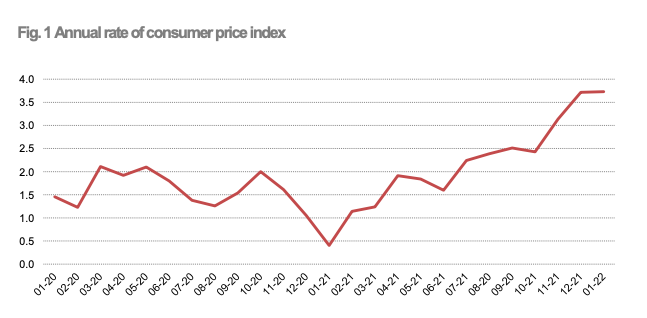
TIRANA, Feb. 10, 2022 – Prices for consumer goods increased to a new high last month, with official data released this week showing the Consumer Price Index rose by 3.7 percent, compared to January 2021.
Albania’s official Statistical Institute, Instat, data showed the increase was highest in a decade – looking back to July 2011.
The inflation is largely due to the increase in the price of food and fuel for all consumers and electricity for businesses.
Central bank thinks inflation will slow down later this year
Inflation is now higher than Bank of Albania’s target of about 3 percent. The central bank had warned of the coming inflation in a recent report, in which it also said prices are likely to increase until the summer of 2022.
“The rise in demand, employment and wages has pushed inflation up in the course of 2021. Nevertheless, the upswing in inflation, in the fourth quarter, primarily reflects the effect of the considerable rise in prices for food, oil and electricity in global markets,” BoA Governor Gent Sejko said in a speech on Dec. 22, 2021.
He added: “This shock is expected to keep inflation above our target in the next months. Further, we expect demand-supply to re-adjust in global markets, logistic problems be resolved and energy prices to stabilize. This performance will ease inflationary pressures and reduce the effect of foreign prices on inflation in Albania.”
Albanian inflation is part of larger global trend
As mentioned by the central bank governor, Albania is not alone in facing inflation, an almost global phenomenon as post-pandemic supply chains are struggling.
Europe has been hit particularly hard due to sharp increases in energy prices this winter. Euro area annual inflation was 5 percent in December 2021, up from 4.9% in November, according to Eurostat estimates.
But the approach of the European Central Bank has been similar to what has been seen in Albania.
ECB’s chief economist Philip Lane wrote this week: “Since bottlenecks will eventually be resolved, price pressures should abate and inflation return to its trend without a need for a significant adjustment in monetary policy.”
Transport and food saw highest increases in Albania
Compared year-over-year to January 2021, the largest increase in prices was seen in transportation, 9.0 percent, followed by food at 6.7 percent, entertainment by 3.5 percent, communication with 3.3 percent and hospitality with 3 percent.
One of the few services that had a decrease, -0.1 percent, was spending on healthcare, signaling the ebbing of the pandemic.
Food prices make up a large part of family budgets in Albania, and within that particular group, staples like vegetables increased by a whopping 17 percent, cooking oil by 9.1 percent, fruits by 8.5 percent and bread by 6 percent. Meat and dairy increased by 3.1 percent and 3.0 respectively.
Larger expenses like rent and utilities were stable, neither increasing nor decreasing, according to the data.